
The Last Ride: The Final Chapter for Central Park’s Horse-Drawn Carriages
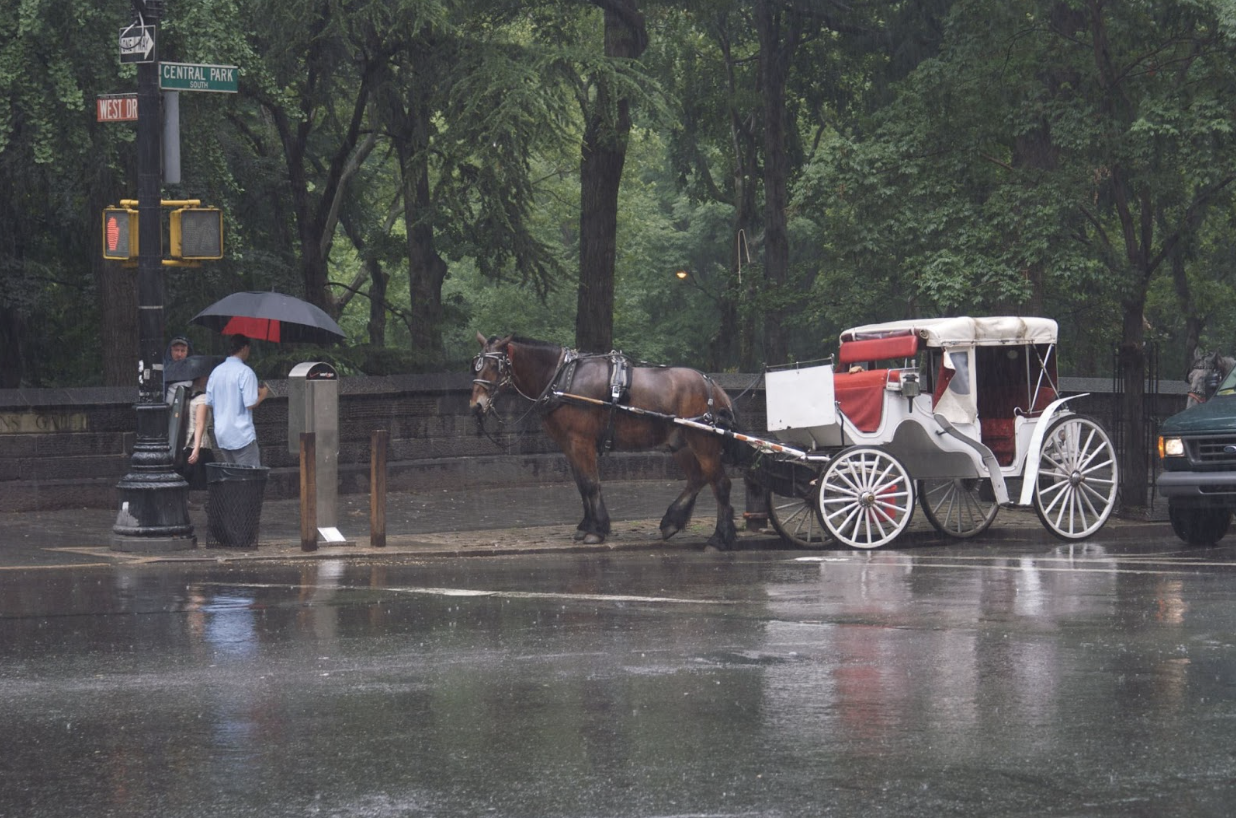
One of Central Park’s many horse-drawn carriages waits in the rain on the outskirts of the park for its next customer(s). Photo courtesy of C-P-S on Flickr.
Amidst New York’s most cherished green space, controversy firmly roots itself through Central Park’s infamous horse-drawn carriages. A tourism staple, the centuries-old practice has been under attack for its inhumane treatment of the horses. Animal rights organizations, regular New Yorkers, and netizens have advocated for years to expose the abuse the horses in the carriage industry are subjected to, including being worked in extreme temperatures and pulling unnaturally heavy loads. The horses’ living conditions, oftentimes stables that are not nearly big enough to properly accommodate the animals, only aggravate concerns. The Central Park horses are primarily housed in the Clinton Park stables, located on 52nd Street, which operates along with three other horse stables in the city—a number that has gradually gone down with the horse population in New York and the city’s overall need for them. Despite NYC being once reliant and built for horses, its need for horsepower has completely diminished, and the continuation of horse carriages not only promotes animal abuse but does so in vain.
There is a fine line between tradition and rightfully outdated practices, and advocates for the continuation of Central Park’s horse carriages have too long operated along it, failing to account for history in their defense of the operation. When horses arrived in New York 200 years ago with early European settlers, they were essential to powering the city’s transportation, labor, and public services. By the 1800s, horse-drawn omnibuses ran along Broadway, and even Central Park was designed with horse travel in mind. But widespread abuse consequentially accompanied this dependence, prompting the founding of the ASPCA in 1866, which began organized animal welfare in the city. Across the decades, reports of overwork, dehydration, and horses dying in the streets show how persistent mistreatment has been. While such abuse is not new, the context is: New York no longer needs horsepower for daily life. A once essential labor force has been reduced to a spectacle for leisure and profit.
Today, horse carriages remain a familiar presence all around Central Park and parts of Midtown. Dozens of licensed carriages operate daily, offering rides in decorated vessels that evoke eras from NYC’s past. Drivers— many of whom are part of multi-generation carriage families— argue that the trade preserves an important piece of NYC history.
In recent times, social media has emerged as a modern defining role in the movement, with platforms such as Instagram or X having thousands of anti-horse carriage posts upon a single search of the practice or the #StopHorseCarriages. The internet has revitalized the debate over the horse-drawn carriages, bringing what was once a relatively niche controversy into the spotlight of broader discourses about ethics, tourism, and modernization.
The situation has gained attention from a far larger audience than just Manhattan residents: people nationally are calling for justice. Just this past summer, videos popped up all over the internet of a distressed horse collapsing and passing away on the street. This is just one example of many incidents that captured the public’s attention, alongside videos of horses running from their drivers and endangering pedestrians. Hashtags such as #BanHorseCarriages have mobilized thousands of users, bridging the gap between on-the-ground protests and digital advocacy. Instagram accounts such as @nyclass are dedicated to stopping horse carriages by posting content of these disastrous outcomes, amplifying levels of awareness and pressuring city officials to revisit long-standing policies, inciting true reform. The copious videos show how the once crucial function has morphed into a misconstrued monetary exploitation of animals, forcing horses into an environment in which they simply do not belong.
Over the last decade or so, the publicization of the carriage industry has sparked the beginning of the end for the practice. A gradual phase-out of horse carriages has been implemented, backed by former Mayor Eric Adams. Adams has publicly called on the NYC Congress to pass Ryder’s Law, a piece of legislation that helps refine and ultimately eradicate horse carriages. The legislation proposes prohibiting the new issuance of carriage-driving licenses and ending the sale of horses for carriage purposes, alongside humane regulations for the treatment of the horses.
Another crucial aspect in this debate involves the loss of employment for those who depend on the horse-carriage industry, from drivers to stable workers. Working long hours through all seasons, the carriage drivers’ primary salaries is the money gained from the carriage rides. Ryder’s Law successfully addresses these concerns by requiring the Department of Consumer and Worker Protection to create a workforce development program for the displaced carriage workers.
Along with Ryder’s, Adams also signed Executive Order 56, an official document preparing for the end of horse-drawn carriages in NYC, as well as sending a letter of necessity to the city council. Though these documents are a step in the right direction, they are only the beginning of the process of phasing the carriages out- a process that certainly is not linear. As recently as November of 2025, the City Council’s Committee on Health struck down a proposal from being considered by the rest of the council, in defense of the Transport Workers Union of America, the union that the carriage workers are a part of. The rejection of the proposal is a setback in the movement to abolish the carriages and a harsh reminder that although 71% of New Yorkers agree the practice should be discarded, it systematically persists.
The developing fight for the ban of horse-drawn carriages speaks volumes about how New York reconciles its history with its present: a city that prides itself on evolution had long battled hypocrisy with its clinging to outdated traditions under the guise of heritage.
The initiatives to get rid of horse-drawn carriages in the city represent a break from a past that has too often prioritized profit and nostalgia over compassion. In an era where public sentiment is shaped just as much by viral videos and city council votes, the movement against horse-drawn carriages reflects a growing alignment between civic values and social awareness—calling New Yorkers to address their ethical responsibilities. New York City has set an example that progress can honor history without continuing animal abuse—horses will forever be an essential component in the construction and progress of the city, but New Yorkers have long extended their roles.
Madeline Lee (BC ‘29) is a staff writer at CPR studying political science. She can be reached at mpl2160@barnard.edu.