Fast Justice and The Court Enabling Trump
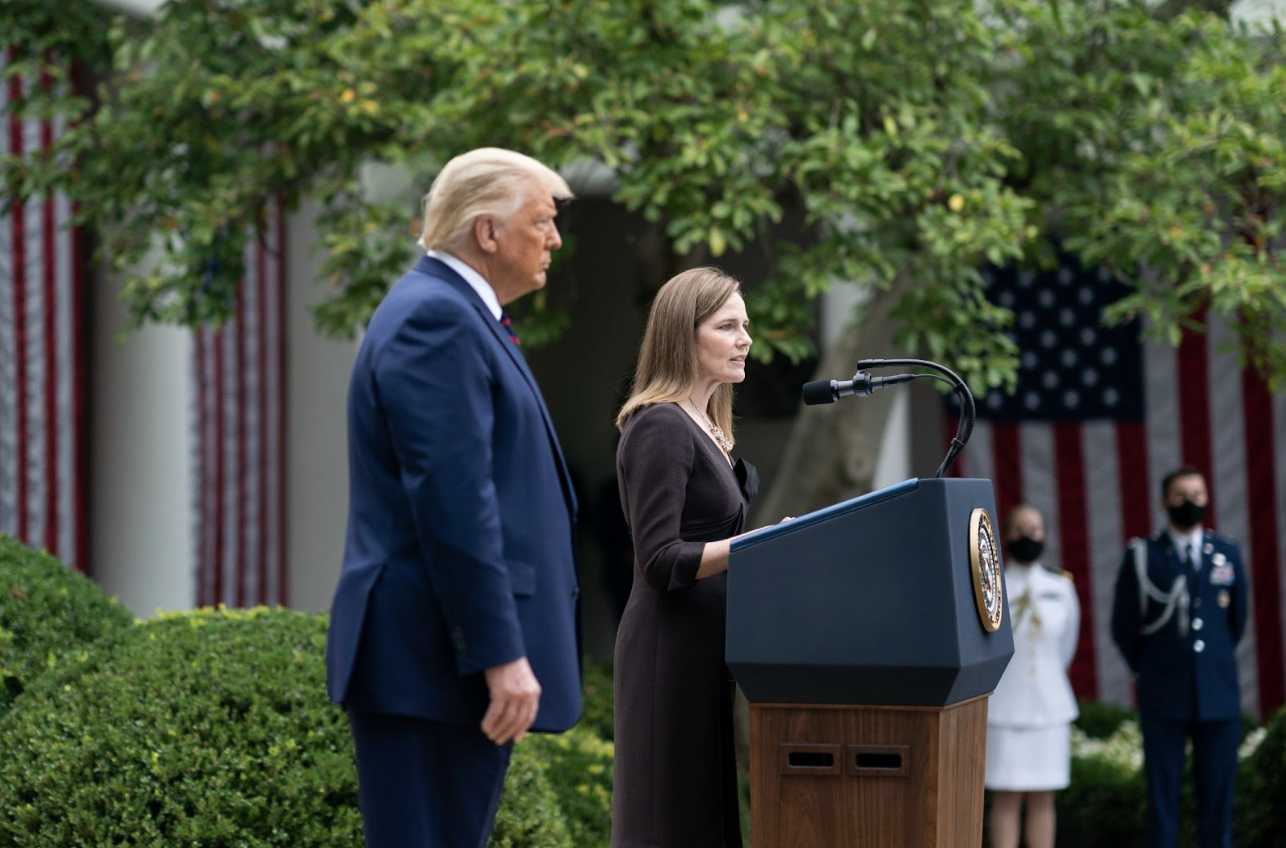
Judge Amy Coney Barrett delivers remarks after President Donald J. Trump announced her as his nominee for Associate Justice of the Supreme Court in September 2020. Photo courtesy of Andrea Hanks.
On September 8, 2025, the White House released a public statement touting the numerous favorable Supreme Court rulings that the Trump Administration had so far secured. Framed as “Supreme Court Victories,” the statement listed 21 different cases that came before the highest court in the nation, all decided in favor of the Trump Administration. Looking closer at the reported list of victories on the White House website, however, unearths problematic assumptions the Trump Administration makes about how cases have been decided at the Supreme Court since January. These can be categorized by both the content of the announcement itself and the type of cases referenced within it. The Trump Administration has listed repeat cases, like “Third Country Removals #1” and “#2,” that do not correspond to separate Supreme Court cases. The second entry on the White House website actually refers to an administrative stay granted by the court, decided on its “shadow docket,” often called the emergency docket, that entertains cases for Court review without full briefing or oral arguments. It is strange that Trump and his associates seem to classify this as a separate win in and of itself. But the more concerning pattern this announcement reveals is the gradual subordination of fully-briefed, standard rulings to shadow docket rulings by the Court. Normally, this might not raise alarm bells. But the extent to which Trump has taken advantage of the shadow docket and the Court's willingness to expand the number of cases that appear on it, only emphasize the White House’s political war path that is actively steamrolling civil rights.
To show you what I mean, it is important to take a momentary step back from this list of 21 supposed Supreme Court victories and consider the longer history of the Supreme Court. During the 1980s, the Supreme Court was deciding around 160 cases per year until Justice William Rehnquist became Chief Justice. The docket began gradually shrinking thereafter, with the Rehnquist court only hearing around 85 standardly ruled (i.e. with full briefing and oral arguments) cases in 2004, the final year of his tenure. There has been much debate about the number of cases that should be decided by the Supreme Court, and during current Chief Justice John Roberts’ confirmation hearing, he lamented the smaller docket and argued that the Court should be deciding at least 100 cases per year via standard ruling. Not once in the twenty-year history of Roberts’ tenure has the Supreme Court ever come close to that number. This fact makes the expansion of the Court’s shadow docket that much more alarming. While the Trump Administration claims these victories as solid wins, the Court is hearing and deciding them in ways outside standard convention; they draw a false equivalency between wins on the shadow docket and fully argued cases. Fully informed argument and decision in the highest court in the nation in front of nine incisive justices is gradually disappearing in favor of fast, rapid-fire jurisprudence. Only last year the Court was deciding only around 44 cases per year on its “shadow docket,” but this year the number has skyrocketed to 113 and counting.
A notable exception to this pattern of ruling first and reasoning later was in Trump v. CASA, Inc. decided last summer. That case dealt with the constitutionality of nationwide injunctions that universally block the enforcement of federal executive orders. Oral arguments were heard on May 15, 2025 and the case was decided in favor of the Trump administration. The key issue to note here, and perhaps the reason why this specific case did not come before the court on its shadow docket, was because it grappled with important jurisprudential issues of pressing concern to district courts around the nation. To understand the complexity of nationwide injunctions, the Court might have reasoned that oral arguments were necessary to expound both sides of the issue central to the case. More importantly than that, the reason why many of the earlier shadow docket cases came before the Court in the first place was because of nationwide injunctions issued by lower courts against executive orders coming from the White House. The gravity of the issue, compounded by its significance for future jurisprudence in lower courts, meant that oral arguments themselves were critical. Ruling on the fully-briefed, orated arguments of the case, in CASA specifically, could not be avoided.
The expansion of the shadow docket of the Supreme Court is largely in response to the type of governance coming out of the White House. Sweeping executive orders and an unprecedented crackdown on prior freedoms—most critically for immigrants and undocumented folks—have required legal mechanisms that protect civil rights to move faster than ever in response. Thus, there is an increasing shift in the Court toward ruling first and reasoning later. Emergency opinions without the deliberative back-and-forth required during oral arguments allows the Court to generate rulings on Trump’s appeals without reasoning out and challenging the issues in question. This means that Trump’s wins are accumulating not because of how right his administration is, but because his aggressive power grabbing is incompatible with the way the Court is used to handling its business.
Given all this reasoning, the Trump administration’s claim to victory is overstated not merely because of its factual inaccuracies, but because of the nature of those wins. His victories in front of the justices rest more on the changing procedure of the court than the actual principles of legal argumentation; counting rulings on emergency injunctions and temporary relief not durable wins. In fact, the negative ramifications of, for example, allowing executive overreach—as Justice Kentanji Brown Jackson’s dissent in CASA makes clear—loom large above the entire corpus of these supposed wins. And the psychological impact of these wins on our current President are even worse and spell potentially more aggressive power-grabbing in the future.
It is not a new fact that Trump is a leader in constant need of reinforcement. An analysis in the Atlantic from his first presidential campaign highlighted his childhood need to be number one and pursuit of popularity throughout his time in private boarding school in New York. Most recently, that past history came to the forefront of national reporting when news outlets like NBC described the White House as “bullish” and “ecstatic” about recent wins in the nation’s highest court. To feed this childhood desire through consistent rulings on the Court’s shadow docket is to play with fire. The psychology of an insatiable narcissist obsessed with winning is hard to predict, and even more challenging to deal with when it takes a turn for the worse. The shortcuts that the Court is taking to decide cases as rapidly as they surface is a clear and present danger to functional democracy. Because the moment when a leader who fears losing more than anything else discovers that the nation’s highest court can deliver victories without resistance, is the moment the fear of fascism and dictatorship is no longer hypothetical. If the justices continue to meet Trump’s craving for instant validation with instant rulings, they may soon find themselves creating bad precedent and enabling the volatile temperament of a President who, having found his need for victory insatiable, may soon go for the jugular of the judicial branch.
Ishaan Barrett (CC ‘26) is a senior studying urban studies and political science. His previous writing has been featured in URBAN Magazine at Columbia GSAPP, the Harvard Urban Review, PIDGIN Magazine at the Princeton School of Architecture, the Barnard-Columbia Urban Review, the Columbia Policy Journal, and the Columbia Daily Spectator. A current Rose Research Ambassador and Gilder Lehrman Institute grantee, Barrett has previously held fellowships at the IRCPL, Harriman Institute, and the Holder Initiative, where he currently serves on the board. He can be reached at i.barrett@columbia.edu