The EU’s New Iron Curtain
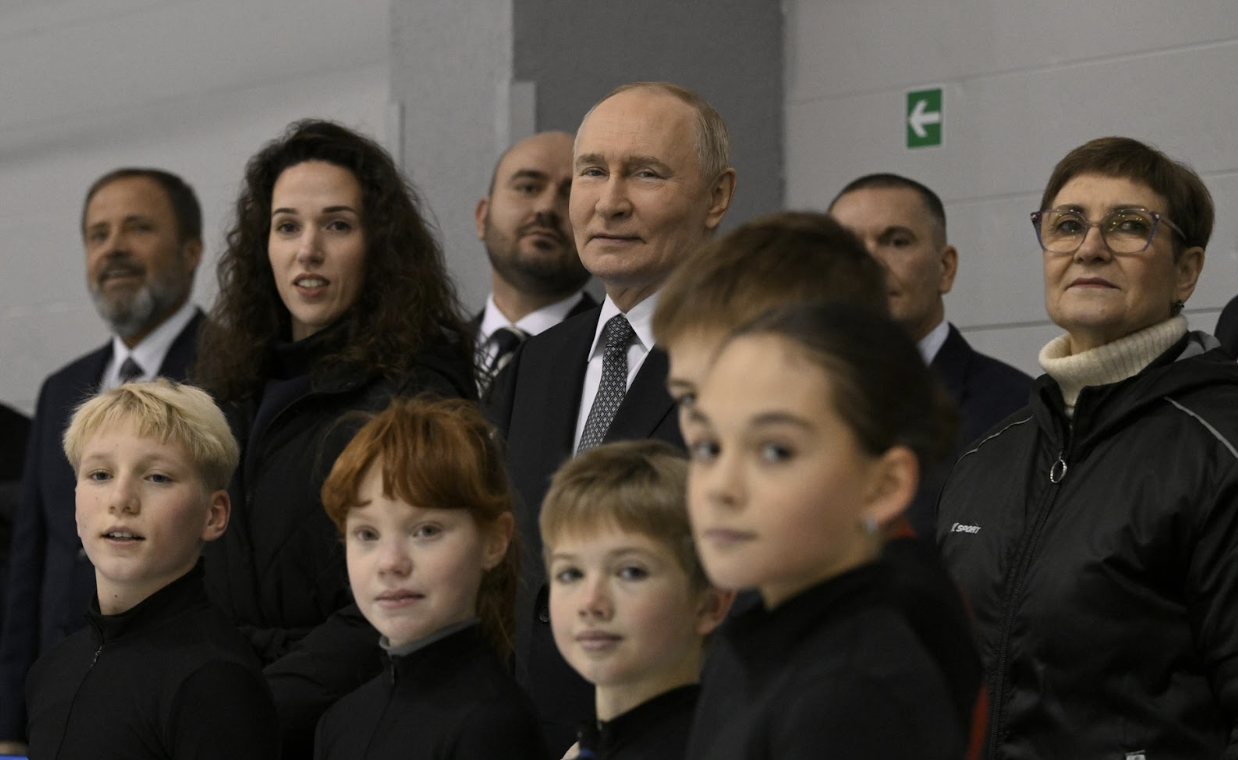
A photo of Vladimir Putin visiting a children’s sports complex. Photo courtesy of the President of the Russian Federation.
"Vladimir Putin is not all of Russia. Sanctions should hit the system, not ordinary citizens" -Yulia Navalnaya
Nearly four years ago, on February 24, 2022, Russian President Vladimir Putin announced the commencement of a "special military operation" in Ukraine, a brutal invasion that has cost hundreds of thousands of lives and displaced millions. The Russo-Ukrainian war has become the largest conflict on the European continent since World War II and has developed into a war of attrition. Immediately following the start of the Russian bombardment of Ukraine, European Commission President Ursula von der Leyen announced a sweeping package of sanctions aimed at the Russian finance, energy, technology, and transport sectors, seeking to "weaken Russia’s economic base and its capacity to modernise." In the following days, as Russian troops quickly marched towards the Ukrainian capital, Kyiv, additional sanctions were introduced. These packages, however, shifted from targeting broad economic sectors towards focusing on the comfort of Russian nationals.
From banning Russian aircrafts from flying in EU airspace to prohibiting the import of luxury goods, the supplemental rounds of sanctions directly targeted the privileges of the Russian elite. Furthermore, those in Putin’s inner circle, including members of the State Duma and his ministers, were individually sanctioned. This means their EU assets were frozen and they were banned from entering the EU. Additionally, thousands of Western businesses participated in "corporate self-sanctioning" by shutting their doors in Russia, fearing reputational, ethical, and legal repercussions if they continued operating in the invading country. These businesses included McDonald’s, Nike, Apple, Mastercard, and several other household names. When asked about the sanctions’ goals, the then-High Representative for Foreign Affairs and Security Policy, Josep Borrell, remarked, "The aim is not to harm the Russian people, but to pull the rock out from under the Kremlin’s war machine… to make the Russian economy feel the consequences."
Unfortunately, following Borrell’s departure from the role in late 2024, the EU has diverged from its ambition of protecting the Russian people. Since the appointment of former Estonian prime minister Kaja Kallas as Borrell’s replacement, the EU has shifted blame for the war to the Russian middle classes. By directly accusing ordinary Russian citizens, who have little agency in deciding their government’s actions, of helping the war effort, the EU is shutting down a possible key ally in its opposition to Putin. Furthermore, the wider sanction packages targeting political elites are easily undermined because of a lack of effective enforcement. Therefore, if the EU wishes to make an actual impact on ending the war, it needs to shift its focus from targeting the broad Russian public and actually enforce sanctions on those in power.
To understand this idea, it is critical to contextualize Russia’s immediate domestic reaction to the war. While the EU was quickly responding to the invasion, people inside the Federation began to panic. Hundreds of thousands of Russians frantically fled Putin’s regime, fearing a military draft and, even worse, possible government-enforced travel restrictions. This would be a move eerily similar to the Soviet period, when the Communist-controlled Iron Curtain prevented people from traveling outside the Eastern Bloc. Day-long traffic jams emerged at the borders, as citizens packed what they could and left for nearby countries such as Georgia, Armenia, and Kazakhstan. Surprisingly, though, this travel ban never occurred.
Unlike Soviet times, Putin is still allowing Russians to exit and enter the country freely. However, the EU is now restricting Russians from entering the Schengen Area, a zone of 27 European countries that have abolished internal borders, ensuring free and easy travel between them. In a misguided attempt to further punish the government for its invasion, EU countries have enacted severe travel restrictions on Russian nationals trying to enter their borders, culminating in the November 6 decision prohibiting the issuance of multiple-entry EU visas to Russian passport holders. This has made travel to the EU incredibly difficult, especially for ordinary Russians as they must apply and pay for a visa every time they wish to enter the EU, effectively cutting them off from Western and Central Europe. High Representative Kallas has justified the EU’s decision by claiming that "traveling to and moving freely within the EU is a privilege, not a right" and asserting that ordinary Russians should do more to stop the invasion. Unfortunately, EU leaders do not recognize that these restrictions are only turning Russians away from Europe and are reinforcing propaganda material for Putin’s domestic claims of Russophobia and Western aggression.
Putin’s emphasis on an aggressive and Russophobic West has been central to justifying the invasion of Ukraine, because he has framed the war as a necessary defense of Russian interests against Western imperialism and anti-Russian sentiment. Six months before the start of the conflict, Putin released an essay called “On the Historical Unity of Russians and Ukrainians.” He used this essay to examine the joint histories of Russia and Ukraine, concluding that they had only become divided because of Western intervention and the promotion of Russophobia by Kyivan politicians. Many Western scholars have condemned this essay for using misleading information and falsehoods to reach this point. In his February 24th announcement of the invasion, Putin further blamed Western nations for the conflict, citing the expansion of NATO as a primary source of aggression against the Russian Federation. By barring Russians from receiving mutli-entry Schengen visas, the EU has handed Putin a new “Russophobic” soundbite. Maria Zakharova, a spokeswoman for the Russian Ministry of Foreign Affairs, spoke out against the recent sanction, claiming that the EU was prioritizing undocumented migrants over law-abiding Russian citizens. Her words demonstrate how the Kremlin is using the visa regulation to its advantage, emphasizing that the EU would rather house thousands of illegal immigrants than legally let Russians into their borders. By charging all Russian nationals for the crimes of their government, as the EU has done with the recent sanction passage, Putin’s propaganda rhetoric is only strengthened.
When evaluating the effectiveness of restrictive measures, it is essential to understand the disproportionate effect that sanction packages have on ordinary Russian citizens compared to powerful Russian elites. The Anti-Corruption Foundation (ACF) investigates high-scale Russian corruption and, following the start of the war in Ukraine, works to expose how elites evade sanctions. The foundation was established by Alexei Navalny, Russia’s most prominent opposition leader, though currently is overseen by his widow, Yulia Navalnaya, following her husband’s death under suspicious circumstances in a Russian penitentiary. The ACF investigates the loopholes that Putin’s allies exploit to continue living lavishly, even under the guise of sanctions. Their recent video essay, “The Channel One Anchor from Honduras: Inside the Lavish Life of Putin’s Favourite Propagandist,” describes how Ekaterina Andreeva, a key propagandist who the EU individually sanctioned, has avoided restrictive measures and travels freely. In Russia, Andreeva is the figurehead of television, due to her thirty-year tenure as the primary news anchor for the country’s leading state-controlled television program, Channel One. She is indispensable to Putin’s propaganda machine, and spends her time on air spewing Kremlin talking points promoting European Russophobia, Nazification in Ukraine, and the legitimacy of Putin’s government. Yet, when she is not in the broadcasting studio, she spends her time traveling freely through EU countries, including Finland, Norway, and Montenegro, where she owns a villa worth 10 million euros. Furthermore, her children comfortably live in another EU member state, Latvia, while their lives are funded by rubles stolen from the Russian government. The Moscow native Andreeva holds three citizenships: Russian, Houndruan, and finally Montenegrin, which is her key to crossing the EU border.
The main factor that EU officials seem to misunderstand is that the recent visa regulation packages do not affect elites like Andreeva, as she can continue traveling as a legal Montenegrin citizen. Andreeva is not alone in this: hundreds of elites hold “golden passports” that allow them to bypass any travel regulations. They include Sergey Brilev, a fellow Channel 1 host and Putin propagandist who holds British citizenship, and Ekaterina Lavrova, who holds American citizenship. Lavrova is the daughter of Sergey Lavrov, the Russian Minister of Foreign Affairs, whose authority in the war is second only to Putin’s, and she is a graduate of Columbia College. It is important to recognize that it is rare for individuals directly in Putin’s inner circle, such as Andreeva, to hold these citizenships. However, those adjacent to them, such as friends or family members, often do, as their support of the war is more indirect and unnoticed. Through these connections, inner circle elites can profit handsomely. Dmitry Medvedev, the former Russian President and Prime Minister, is reportedly the primary beneficiary of a Tuscan vineyard owned by his longtime associate, Ilya Yeliseev. Shockingly, the vineyard receives major EU subsidies, with Medvedev having indirectly received 94,200 euros from the EU following the Russian invasion.
Ordinary Russians do not have the same access to citizenships or resources as the political elite. The brunt of the sanctions falls disproportionately on them, even though they are not the ones leading the war. Aside from visa regulations, another way this disproportionality is evident is through the business practices of Western companies in Russia. Corporations accessible to the lower and middle classes, like Starbucks, Levi’s, or Amazon, have almost all left. However, Italian fashion house Brunello Cucinelli continues to operate and show new collections in Moscow locations. The designer brand is known for its high-end and luxurious clothes, with jackets from its latest winter collection starting at $11,800. Obviously, this price point is tailored for the most affluent Russians, who have the most to gain from the continued war in Ukraine. Another example concerns the release of Apple’s iPhone 17. Although Apple pulled out of Russia shortly after the invasion, the latest iPhone showed up on shelves in Moscow immediately after it was released. Resellers sold the new phone at a price 57% higher than its price in the United States. Clearly, elites are still accessing the Western goods they prefer and only suffer relatively minor inconveniences like price rises, yet ordinary people are completely cut off from the Western world. This inconsistency represents the major problem with the EU’s sanctions: they punish the Russian people for their government’s crimes, while leaving loopholes for letting elites live as they please.
The EU’s emphasis on Russian citizens’ collective responsibility for the actions of the Kremlin completely undermines its credibility and institutional resourcefulness to the Russian people. The EU achieves nothing by alienating the common people in its’ misdirected attempt to end the war. Officials are actively playing into Putin’s hands by providing him with the evidence and opportunity to strengthen his claims of Russophobia and Western aggression. The EU is effectively drawing a new Iron Curtain between itself and Russia; this time, however, the curtain has gold-trimmed openings, big enough to fit just the privileged few. Rather than taking away the passports of Kremlin crooks and strengthening the sanction enforcement mechanisms against them, the EU targets the majority of Russians who have no say in their governance. If the EU wishes to stop the conflict, it must reassess its priorities. Will they prioritize performatively sanctioning Russia, and only hurting those not in power? Or, will they work to investigate and punish the elites whose hands are stained red from Ukrainian blood?
Stephen Zhukov (CC’28) is a Staff Writer from Knoxville, Tennessee. He is studying political science and Russian and is interested in Eastern European policy, diplomacy, and law. He can be reached at sz3313@columbia.edu.