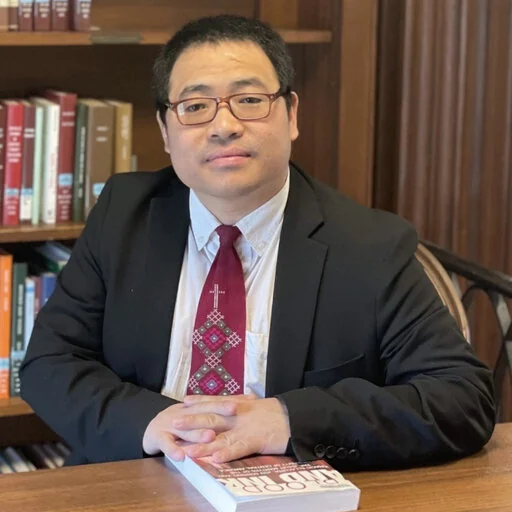
Photo courtesy of Professor David Thang Moe.
On February 1st, 2021, the Myanmar military regime, called the junta, seized power in a coup, overthrowing the democratically elected government led by the National League for Democracy (NLD). Since then, Myanmar has been in a deep political and humanitarian crisis. Now five years into the conflict, the nation has endured a civil war between Myanmar's military junta and anti-junta resistance and a growing divide between state authority and community-led resistance. In this interview, Professor Moe presents two contrasting visions of Myanmar. The first is ‘imagined communities’, which are state-enforced frameworks constructed by the ruling military regime and centered on nationalist control. The second is ‘ungovernable communities’, which are autonomous, local structures in the highland regions created by civilians resisting the state. In this interview, conducted on March 4, 2026, Professor David Thang Moe, an ethnic minority scholar and affiliate of Yale University, offers his perspective on the origins of the conflict, the rise of decentralized civilian resistance, and the competing politics that continue to shape Myanmar today.
Amanda Hui (AH): As of early 2026, Myanmar is five years into a post-coup Civil War, complicated by a massive earthquake in 2025, a struggling junta-led election process organized and controlled by Myanmar’s military government, and the rise of fraud compounds in the borderlands. Can you give us some background on the issue at hand, how the civil war started, what groups are involved, what the NLD and junta are, and what Myanmar looks like currently?
Professor David Thang Moe (DTM): Let me begin by saying that Myanmar is now a country with two different communities: imagined communities, which are shaped by the ruling military regime, like nationalist imaginations group, and what I will call uncountable communities, shaped by the resisting group. Imagine a community on the side of the coup and the state, and then ungovernable communities led by the civilians. This is what Myanmar looks like today. As you rightly said, it has been five, six years now.
What is happening now in Myanmar is not just about the conflict. It’s not just about the ethnic conflict between the majority and the minority. This is really a civil war beyond the ethnic conflict and this resistance movement. [It is] a civil war started by the ordinary people, those who are not necessarily professional politicians. That’s why I call this a decentralized resistance, which emerged among ordinary people across the nations, Hill villages, and Buddhist valleys. The military regime believes that detaining Aung San Suu Kyi, who is the state councilor and a Nobel Peace Prize winner, will stop these public protests, but it doesn’t. Many civilian groups continue to protest and resist against the coup, at the risk of their lives. There are many people involved in these current situations. It’s not just the resistance group on the ground but some civilian students, some scholars and political leaders, for example, the National Unity Government (NUG), which was formed after 2021.
AH: You mentioned the ungovernable communities; what do these local and autonomous government structures look like, and are they potential models for future national governments?
DTM: Let me give credit to Professor James Scott, who was my late mentor at Yale. He published a very influential book, The Art of Not Being Governed. The subtitle is, “An anarchist history of upland Southeast Asia,” so I drew the idea of becoming ungovernable from his book. What I’m trying to say is that the people, especially in upland Myanmar and Southeast Asia, really are beyond the central state. If you go to Myanmar, or even [anywhere in] Southeast Asia, most of the administrative offices and the states are in the lowland. Those who represent the ethnic and religious majority are living in the lowland, but most of the ethnic and religious minorities are living in the upland. This is how you can see Myanmar: lowland and upland. If you want to visit Myanmar, you have to [decide if] you want to visit the lowland or upland. If you visit the upland, you will see a lot of ethnic minorities, with people and languages completely different from one another, so that area is now becoming ungovernable.
It has been six years, and the military regime is very powerful. The people in the Hill areas are non-state people as well as anti-state people. That’s why they are far away from the center side; that is what I mean by ungovernable communities. There are several challenges for those ungovernable communities in terms of the local government, like local autonomy, local governance, and education systems. There are a lot of challenges, but they feel that they don’t become ungovernable. That’s why these many ethnic minorities in the Hill region feel that, now, we are living in a pre-colonial period. This is how they see themselves—as ungodly communities. People will say, including James Scott, that these ethnic minorities who are living in the Highland region are like runaways from the central state, which is true, but it doesn’t mean that these ethnic minorities in the high regions are avoiding the central state. It’s not just running away and they’re living there, but they still receive the census tract from where they are.
AH: The Junta has been trying to implement a “Disciplined Democracy” in Myanmar. Can you explain more about that?
DTM: Let me briefly elaborate on the concept of decentralized resistance. As compared to the Ukrainian resistance to Russia, because that emerged at around the same time as Myanmar’s resistance movement, [Ukraine’s] resistance has been more like centralized resistance because everyone is involved. What is happening in Myanmar is highly decentralized resistance because the resistance really emerged from the bottom-up. When that resistance emerged, it emerged among everyday people.
As I said earlier, Aung San Suu Kyi was a very influential person in Myanmar. Aung San Suu Kyi is the Burmese lady who is the daughter of Aung San, the hero of national independence. She’s the iconic leader in Myanmar. Many people love her very much. However, the military regime detained her, and there is no leader like her. That’s why this resistance really comes up with these ordinary people. That is what I mean by decentralized resistance.
Before I talk about democracy, I think I should touch a little bit on nationalisms, like Buddhist nationalism. Buddhist nationalism emerged in three different periods. It emerged in the anti-colonial [movement] during the colonial period, and as the anti-ethnic minority after independence, because those ethnic minorities are not Buddhist. That’s why these Buddhist nationalists emerge as a movement that discriminates against ethnic minorities based on their religion and identity. The third is that Buddhist nationalism now emerges as the anti-liberal democracy movement because the Buddhist nationalist regime believes that liberal democracy is not suitable for Myanmar. What is suitable for Myanmar, according to the military regime, is disciplined democracy because that democracy and the rules are set up by the military regime. There is no freedom of speech, there is no freedom of assembly, there is no freedom of protest. If you protest against them, they will treat you as a criminal. We have our own version of democracy that is based on discipline. You have to be disciplined as a good citizen. You have to obey the military regime because, in Myanmar, the military believes that they control the state and the nations, but, in democratic countries, the state controls armies and ministries. When they say disciplined democracy, that means that they have set up the rules, discipline, regulation, and everything within to obey the military. Whenever you stand against them, they will see you as a criminal and they will arrest you and put you in jail, or even kill you. That is what they mean by disciplined democracy, against a Western version of liberal democracy.
AH: How do the Hill people, or other such communities, respond to the military power that is infringing on their sovereignty?
DTM: The Hill people started their recession to the regime even in the colonial period. In 1947, the current ethnic minority in the eastern part of Myanmar resisted this. However, their resistance to the state power was not successful because the minority are still a smaller community, and they are weaker. It was not that successful in the past, but now, even when the ethnic minority resisted state power, the Burma Buddhist majority group, those who are living in the lower part, misunderstood the ethnic minority as a kind of rebels. Rebels has a positive meaning in English, but it has a negative connotation in Burmese. Rebel simply means the illegal resistant group, so this is how the Burmese Buddhists—the majority group—misunderstood ethnic minorities for their resistance to the state.
After this coup, what surprised me and other people is that the ethnic majority came to realize their own suffering under the same regime, saying that they apologize. Even ethnic minority people now understand this suffering. That’s why they have come together and resist the military regime as their common enemy. With inter-religious solidarity and ethnic reconciliations among this, the anti-coup resistance movement is becoming very strong.
AH: What surprised you most about the ways that the Hill communities and the Buddhist Valley communities are currently building solidarity to challenge Romanization?
DTM: Inter-religious solidarity between the Burma Buddhist majority in the lowland and the Christian ethnic minority in the Highland really surprised me because no one ever expected this to happen. The ethnic minority in the Hill region has been resisting state power for many decades, and the ethnic majority did not respond to that in a positive way. They just misunderstood them as illegal rebels. But what really surprised us is that the ethnic majorities also came to understand those ethnic minorities as a fellow core under the same military regime. That is something that surprised us in a good way. Then, they really built their religious and ethnic device, and they resist the military regime as their common enemy. They even use Buddhist religious terminology, like Dhamma, but those who resist the coup see the coup as like Atma, simply meaning moral evil. This is how they really came to see the military regime as their common enemy and evil. That is something good among the ethnic minority and majority; solidarity is very good.
AH: I think it’s important to discuss your forthcoming book, titled Beyond Buddhist Nationalism. What do you see as the future of the Burmese identity and, more specifically, is it being replaced by a more inclusive identity that prioritizes shared democratic values over ethnicity?
DTM: I understand that, in order to really build a nation where religious freedom is practiced, we have to challenge the idea of Buddhist nationalism. Although there is a polity of religious freedom in Myanmar, in the constitutions, the ethnic minority (those who choose to be Christians) still face discrimination under Buddhist nationalism. That’s the reason why we really need to challenge the idea of a Buddhist nation. We really need to move beyond Buddhist nationalism so that we have an equal identity, mutual respect and other things.
However, in that approach, I have to admit that I’m not Buddhist and I don’t want to challenge this from my non-Buddhist background. I respect the Buddhist people. What I’m trying to do is through the lens of inter-religious engagement. I engage with some Buddhists, those who resist Buddhist nationalism, and then some Christians groups, particularly in the Hill region. I’m really trying to approach Buddhist nationalism through the lens of inter-religious engagement, which [is] fair because I’m not a Buddhist, so I cannot simply list other religious groups as bad.
In Myanmar, there’s a slogan: “To be a Burmese is to be a Buddhist,” and this is how they imagine the nations in the post colonial period. If you’re not a Buddhist, you face discrimination, although there is a policy of religious freedom. That’s why we really challenge the idea of Buddhist nationalism as the problem, because it does not see multiculturalism. They only look at the nations through their own monocultural concept of nationalism, like the Buddhist idea. That’s why we really need to move beyond Buddhist nationalism and build multicultural nations with the respect of other religious groups. I will also say that we really need ethnic reconciliations. It’s very, very important because there isa lot of division and hatred among the religious and ethnic [groups], and we really need ethnic reconciliation. We need to heal one another and we need to apologize to one another so that we can build a united nation where everyone can practice their religion or faith.
AH: What about Myanmar’s elections? What do they look like today?
DTM: I will call it, first and foremost, selections. They’re not elections. The NLD (National League for Democracy) won by a landslide victory. That’s the reason why this resistance movement came up—because they didn’t answer. The military regime always claimed that this election was not fair and that it was a lie because they didn’t win at all. They just don’t want to lose power. That’s why they want to detain many leaders.
They recently held an election because they wanted to get international recognition, saying, “Look, we had an election, recognize us.” Particularly, they are trying to show this to China. China recognizes them, unfortunately, and Russia will recognize them, but many countries in ASEAN [The Association of Southeast Asian Nations] don’t recognize this military regime’s elections because they’re not free and fair, and it’s just one party. They just hold “sham elections.” If you ask me [about] the impact of these elections, I really don’t think they would impact the nations because the resistance is very strong.
AH: How has your personal proximity to these conflict zones shaped your academic perspective in ways that traditional research and data collection might not?
DTM: The reason I’m doing this is because I’m coming from a village, and I bring my firsthand experience of Buddhist nationalism as an ethnic minority person. Then, I bring my firsthand experience of discrimination. These are some things that I bring into my academic work. My academic work is not detached from real life. I’m always trying my best to integrate academic work as well as left hand experience because, at the end of the day, what I’m doing is justice, peace, and freedom for the community, especially those who are marginalized by the dictatorship and militia regime.
I will also say that my academia has been deeply shaped by James Scott because he emerged as a pioneering Southeast Asian scholar during the Vietnam War. He was shaped by this war, and then we worked together during the Burmese democracy movement. Because he was a senior scholar, I really see him as a role model in advocacy and activism. That’s why I’m engaging with all kinds of people within my academic discipline [and] beyond. That is how I train myself. I always say that I was born, raised, and educated in the Hill Village, Kim Kong. I’m always passionate about bridging the gap between the ungovernable village voices and the Ivy League voices, including my affiliate school, Yale. Sometimes we don’t listen to the village voices but, when it comes to the resistance movement, the village people are the strongest people. We need to engage with them and listen to them. We need to begin with where they are, bring their voices here, and integrate [their voices] into the academic work, and find a better truth. This is what I’m doing.
AH: Are you hopeful for the future of Myanmar’s politics? Can you compare the political circumstances in Myanmar to patterns in other countries?
DTM: During the NLD’s time, under the leadership of Aung San Suu Kyi, Myanmar looked at Indonesia as a pattern. Indonesia also made a democratic transition from dictatorship to democracy in the 1990s, so Aung San Suu Kyi asked some of her colleagues to visit Indonesia to learn about their democratic transitions. It was more successful because the military regime took power. Now something that they look at in Indonesia is neighbors and their parents of democratic transitions.
Another thing that people are looking at are ethnic reconciliations. They are looking at South Africa situations like truth telling. These things are also parents for the ethnic reconciliations. However, the challenge is that there could be cheap reconciliations without restoring social justice, so you have to restore justice [to] really achieve national reconciliations. In that case, you also need to practice relative justice, you need to punish the regime, and all these things, otherwise the industry will continue. This is something that they are looking at now: democratic transition as well as ethnic [transition], like the national reconciliation in the nation. Again, the first important thing is to defeat the military regime. That is the first challenge.
As Professor Moe makes clear, Myanmar’s crisis cannot be reduced to a single conflict or broader authoritarianism. While the military regime continues to assert control through force and “disciplined democracy,” grassroots resistance and interethnic cooperation offer a different vision for Myanmar. The future of Myanmar remains uncertain but, as this conversation suggests, its trajectory will ultimately depend on more than the fall of the junta. It will also depend on the ability of its people to reimagine the nation beyond the divisions that define it. What is most striking about Myanmar's struggle is that democratic resilience isn’t coming from institutions with power, but rather from ordinary citizens from marginalized communities. As global citizens, it is our responsibility to educate ourselves on the realities facing both lowland and upland communities, and to amplify local voices that are excluded from pressing international conversations.
Amanda Hui (CC ‘29) is a staff correspondent at the Columbia Political Review majoring in Architecture and Economics-Mathematics. You can contact her at amh2410@columbia.edu