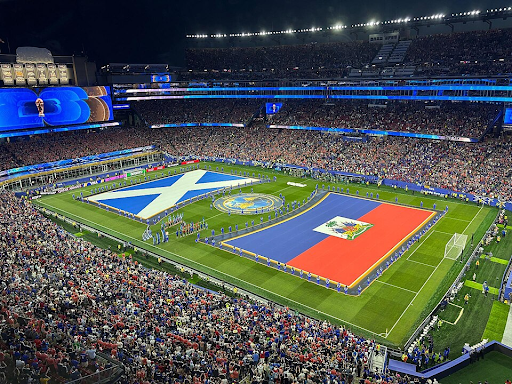
Fans await the start of the Scotland vs. Haiti match on June 13, 2026, marking Haiti’s first participation in the FIFA World Cup since 1974. Photo courtesy of Wikimedia Commons.

In November 2025, Haiti’s national soccer team made history when it defeated Nicaragua 2-0 and qualified for the World Cup for the first time in 52 years. The game’s result was thrilling precisely because of how improbable it was. The team couldn’t play a single qualifying match at home, as their national stadium, Stade Sylvio Cator, sits within gang-controlled territory in Port-au-Prince, the nation’s capital, and has not been used for years. Instead, the team played their “home” games at Stadion Ergilio Hato in Curaçao, approximately 500 miles away. When the team finally did land in Port-au-Prince upon their exit from the tournament, they were immediately whisked away from the airport in black cars due to concerns regarding gang violence in the area.
A national team unable to play qualifying matches on its own soil and welcomed home under armed security is as good a summary of Haiti’s current crisis as any statistical metric. With no sitting president and no functioning parliament, the government of Haiti is currently in shambles as it attempts to restore order and political legitimacy to the nation. Armed groups control an estimated 90 percent of Port-au-Prince and its surrounding areas. Further, at least 1.4 million people have been forced to flee their homes due to gang violence, which has been referred to by the UN’s Designated Expert, William O’Neill, as an “unprecedented level of internal displacement.” The human rights NGO, Amnesty International, reported that ongoing gang violence has exacerbated food scarcity and homelessness in a country already affected by natural disasters, resource shortages, and the long-lasting impacts of colonialism and slavery. Of the gang members, around half are children, who are often trafficked by the gangs or coerced into joining with promises of housing, food, and medical assistance.
While this may initially appear to be a straightforward story of state collapse, this framing leaves out much of the complexity of the situation caused by a government that has failed to establish legitimate authority and allowed armed groups to fill the power vacuum. In fact, Haiti’s gang war cannot be understood in isolation from overwhelming debt imposed two centuries ago at the end of the Haitian Revolution and externally imposed political arrangements that have repeatedly hollowed out the state’s capacity to govern itself.
Gang violence is not a new issue in Haiti, but increased political destabilization has contributed to its rise in the past few years. Haiti’s current crisis is often attributed to the assassination of President Jovenel Moïse on July 7, 2021. At the time of the assassination, Moïse had been ruling by decree for over a year after federal elections were found to be fraudulent. Selected as the incoming Acting Prime Minister two days before the assassination, Ariel Henry stepped into the vacancy with the backing of foreign governments, despite never being formally sworn in. His government attempted—but ultimately failed—to control the increasing power of armed groups and subsequent civil unrest. In early 2024, while seeking international support abroad for a security mission in Haiti, Henry was effectively exiled when gangs surrounded the country’s main airport at his return. He then resigned in April 2024. Since then, Haiti has cycled through numerous acting prime ministers, and the Transitional Presidential Council, tasked with governing until elections can be held, has failed to gain effective control over the state. Simultaneously, both the police force and the court system have been critically weakened by severe under-resourcing, mass resignations, and gang infiltration.
The resulting power vacuum has allowed for the rising gang coalitions to consolidate real power, with the most notable being Viv Ansanm (“Living Together”), led by former police officer Jimmy “Barbecue” Chérizier. With no legitimate political authority and increasingly unsuccessful state services, gang coalitions claim they rose to the occasion in the face of a failing government, establishing systems of territorial control, taxation, protection, and essential resources for their affiliates. In interviews and social media broadcasts, several gang leaders have even cast themselves as revolutionaries rising against a corrupt political and economic elite. While many of their criticisms of Haiti’s government may be justifiable, it is difficult to reconcile with the mass displacement, rampant sexual violence, and extortion of both civilians and officials that has been documented by human rights groups.
But Haiti’s current instability has not emerged from out of the blue. The Duvalier family dictatorships between 1957 and 1986 normalized armed non-state violence as a tool of political control, with the Tonton Macoute paramilitary and secret police force being infamous for their brutal terrorization of the country. Since 1986, Haiti has cycled through coups, disputed elections, and foreign-brokered political transitions that have repeatedly interrupted or undermined the development of stable democratic governance in Haiti. Thus, it is evident that the current gang war is not a sudden outbreak of violence but the latest, most extreme development of a much older pattern.
Amidst this pattern of political conflict, foreign intervention has played a large part in Haiti’s troubles. The United Nations Stabilization Mission in Haiti (MINUSTAH) was established in June 2004 following the ousting of foreign-backed President Jean-Bertrand Aristide during a rebellion. The mission lasted until October 2017, bringing a brief return to order but ultimately failing to create lasting improvement. In 2010, UN peacekeepers from Nepal were deployed following a 7.0 magnitude earthquake. Though the UN denied responsibility until 2016, the troops were identified as the source of a devastating cholera outbreak that emerged shortly after their arrival, resulting in the deaths of an estimated 9,000 people. Additionally, Sri Lankan members of the mission preyed upon young children in a series of sexual abuse claims that spanned three years. The lack of accountability from both the UN and the Sri Lankan government led to increased criticism regarding screening processes for officers, safeguarding measures, and the lack of compensation for the civilian population they were intended to assist.
These instances, among others, have contributed to the vast distrust of foreign intervention felt by many Haitians, as well as reflecting a general failure for external actors to create long-term safety and stability for the country’s general population. In part for this reason, in October 2023, the UN Security Council (UNSC) chose not to deploy a formal peacekeeping force but to establish the Kenya-led Multinational Security Support (MSS) mission. This mission consisted of a coalition of national police forces from Kenya, Jamaica, Belize, Guatemala, and El Salvador. MSS, though not explicitly launching counter-gang operations, aimed to support the Haitian National Police in their campaign to rein in the gangs. However, the decision to acquire funding through voluntary contributions rather than UN peacekeeping assessments unsurprisingly resulted in chronic underfunding, understaffing, and an inability to effectively quell gang-related violence. In October 2025, the UNSC authorized a new Gang Suppression Force (GSF) to replace MSS. The GSF, which was intended to be larger and more aggressive than its predecessor, is currently working in coordination with both the Haitian National Police and the Armed Forces of Haiti. While the force has renewed hope, long-term change and the successful neutralization of armed gangs is still to be determined.
It’s important to note that Haiti’s history of foreign interference dates back much further. Haiti won independence from France on January 1, 1804, following the only successful, large-scale slave revolt in history. However, in 1825, Haiti, once again, had to fight against an invading French army and was ultimately pressured to agree to pay 150 million francs to former slaveholders as compensation for their “lost property.” Overwhelmed with such a large debt, the young Haitian government borrowed from French banks to make the initial payments, resulting in interest on loans that skyrocketed over the years into what became dubbed the “double debt.” Haiti did not finish paying off this debt to France until 1947, over 140 years after declaring independence from the European nation. This made Haiti the first and only nation to pay reparations to its former colonizers and slave masters.
The economic burden that this placed on the small island country for more than a century and a half has been immense and is often blamed as the root of Haiti’s poverty. In fact, the New York Times estimated that Haiti paid France the equivalent of $560 million in today’s dollars, costing Haiti between $21 billion to $115 billion in lost economic power over time. For much of that period, a majority of the Haitian government’s national budget went not towards providing services or building infrastructure such as schools, hospitals, or roads, but towards the debt for their independence. Additionally, along with a 19-year-long American military occupation in the early 1900s, US banks and Wall Street played an increasingly greater role in controlling Haiti’s national finances, allowing external actors to profit while Haiti struggled to escape widespread poverty and economic instability. While France has forgiven other, more recent loans to Haiti, the former colonizing country has consistently declined to revisit the independence debt itself, despite repeated Haitian demands for restitution, including a formal $21 billion claim from President Aristide in 2004.
Through this centuries-long economic crisis, what remains clear is that Haitian sovereignty has repeatedly been treated as negotiable by outside powers when it conflicts with their interests. The pattern continues today through the “Core Group,” an influential group of international diplomats that has directed political affairs and institutional transitions in Haiti since 2004. The group was formally created by the UN Security Council as an advisory body and includes representatives from the US, Canada, France, the European Union, the UN, and the Organization of American States. Though the group’s influence in Haiti has diminished over recent years, it remains an example of undemocratic meddling in Haiti’s internal affairs, through the backing of disputed elections, the propping up of certain political candidates, and even the issuing of pointed warnings to Haiti’s Transitional Presidential Council as recently as January 2026 after it briefly tried to remove Prime Minister Alix Didier Fils-Aimé.
Other forms of foreign entanglement in Haiti’s affairs have further exacerbated the problem. For instance, US immigration policy has resulted in the deportation of thousands of Haitians while simultaneously issuing travel advisory warnings for US citizens on account of the “kill zone” of Port-au-Prince and the frequent “robbery, carjackings, sexual assault, and kidnappings.” Additionally, UN reports and law enforcement investigations have confirmed that the majority of illegal firearms used by Haitian gangs are trafficked through the largely unregulated US civilian gun market and smuggled primarily through Florida ports, despite the fact that Haiti has been under a UN arms embargo since October 2022 and has some of the strictest domestic gun laws in the world. This pattern of foreign intervention clearly fails to effectively address the nation’s underlying political and economic weaknesses, instead mainly serving external interests by controlling migration flows, securing trade routes, and influencing politics.
While foreign influence in Haiti is undoubtedly strong, this leads back to the question of what the Haitian population actually wants from their government and how their daily lives can be improved. Haiti has not held a national election since 2016, meaning that every mandate—both presidential, legislative, and most municipal—has expired. The Transitional Presidential Council installed in April 2024 was meant to restore security and organize elections within roughly two years, with a new president’s inauguration by February 2026. Instead, the council was dissolved in February 2026 after being consumed by internal power struggles, corruption allegations against several members, and repeated changes of prime minister, all while the security situation has continued to deteriorate and no elections have been held.
This is the crux of the international response’s central weakness. Even a well-funded, well-armed foreign security force cannot substitute for a credible domestic political process. While the Gang Suppression Force is a meaningful step, it is by no means a long-term solution to rebuilding Haiti’s institutions and infrastructure. The Haitian National Police remains drastically under-resourced, outgunned, and even infiltrated by the same gang networks it attempts to fight. Haiti’s courts function only sporadically in gang-controlled zones, and without an elected government capable of claiming genuine legitimacy, every foreign-brokered security mission risks being seen as an occupying force propping up an unaccountable transitional elite, rather than a true partner to a functioning Haitian state.
Ultimately, Haiti’s participation in the World Cup exemplified that, although it is a country whose formal institutions have all but collapsed, it still has a functioning civil society, a fierce sense of national identity, and enormous, underappreciated human capital, much of which is now scattered across a global diaspora. A state repeatedly denied the resources to build independent institutions, saddled with foreign-selected leaders with contested legitimacy, and forced to rely on underfunded foreign security missions is a state that will struggle to develop the durable domestic capacity needed to prevent crisis. To resolve this, genuine Haitian sovereignty would require sustained, unconditional support for domestically-led elections and police building, debt relief or restitution from France and the US that is not contingent on political concessions, and a security response designed to eventually phase itself out. However, whether major powers such as the US, France, Canada, or the EU are willing to support that kind of sovereignty remains uncertain.
Ariel Mura (BC ‘29) studies Political Science-Human Rights and Spanish & Latin American Cultures, with a focus in human rights law and international affairs. She can be reached at avm2158@barnard.edu.