Pakistan’s Courts Have a New Master
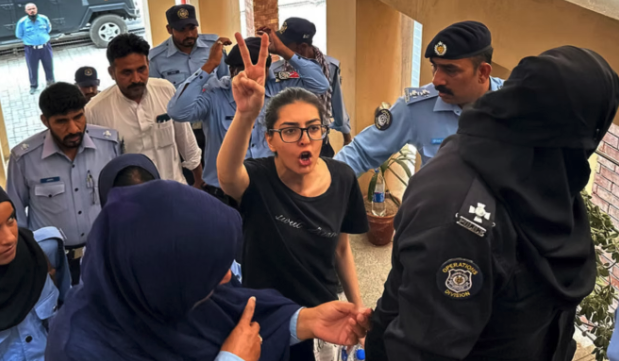
Police officials arriving with arrested human rights activist, Imaan Mazari-Hazir, before a court in Islamabad, Pakistan, on August 20, 2023. Photo courtesy of the Human Rights Research Center.
On January 24, 2026, human rights lawyer Imaan Zainab Mazari-Hazir and her husband, Hadi Ali Chatta, were both sentenced to seventeen-year prison terms on charges of “cyber terrorism” and “false information.” These charges stemmed from posts on their respective X accounts between 2021 and 2025 that expressed solidarity with Baloch and Pashtun activists, who highlighted human rights violations in Pakistan, and criticized the Pakistani military. The couple was charged under the Prevention of Electronic Crimes Act (PECA), a law that criminalizes online speech and cybercrime offenses. Unfortunately, the procedural abuses in their case and the speed and severity of their sentencing reflect deeper constitutional shifts already underway in Pakistan’s judiciary and a broader expansion of state power.
Their arrests reflect a broader pattern of constitutional violations and abuse of state power. Although Pakistan formally operates under a civilian democratic system, the military remains the country’s dominant political institution. Civilian leaders serve in office, but the military often has final say and exerts decisive influence over national security policy, foreign affairs, and key political decisions. Rather than serving as independent checks on one another, the executive and military establishment have become increasingly aligned, allowing for the expansion of state power and the weakening of judicial and democratic accountability. The country has some features of a democracy, such as elections and a parliament, but an unelected power, the military, continues to hold significant control. Pakistan therefore functions as a de facto hybrid regime of autocracy and democracy.
Increasingly common political repression and human rights concerns also indicate Pakistan’s move to an authoritarian state. Pakistan’s democratic backsliding is most evident in the adoption of the country’s Twenty-Seventh Constitutional Amendment, which President Asif Ali Zardari signed in November 2025. The amendment effectively centralizes state power, weakens judicial independence, and strengthens the military’s power. Although this amendment was formally enacted through civilian institutions, its goals reflect the growing alignment between the executive and military establishment, as elected officials continue to facilitate the military’s consolidation. Therefore, the enactment of this amendment is directly connected to the persecution of Mazari-Hazir and Chatta, whose cases were tried under the same weakened judicial protections and expanded state power the amendment enshrines.
Mazari-Hazir has represented numerous victims of human rights violations in her legal career. She has taken on cases of enforced disappearances, extrajudicial killings, arbitrary arrest, and custodial violations. Her advocacy directly challenges the oppressive practices of state authorities, especially the military police and intelligence agencies. Her husband, Hadi Ali Chattha, has likewise represented victims of false blasphemy cases, sexual violence, rape, and enforced disappearances in Pakistan. Chattha worked with the Justice Project Pakistan (JPP), a government-recognized legal nonprofit founded in 2009 that represents vulnerable Pakistani prisoners facing the death penalty, torture, or injustice within the legal system. In December 2016, JPP received the National Human Rights Award from the Pakistani government. Additionally, he also worked with the Asma Jahangir Legal Aid Cell (AGHS), founded in 1980 by the late human rights lawyer Asma Jahangir and Hina Jilani, which was the first women-led law firm in Pakistan focused on providing free legal representation. As part of a broader crackdown on lawyers representing victims of state abuses, Chattha and Mazari-Hazir have faced repeated retaliation by the Pakistani state, including attempts to falsely implicate them in anti-terror and blasphemy cases. Their case, however, drew unusually direct condemnation from both Amnesty International and UN human rights experts, underscoring the severity of the procedural violations involved.
During their trial, both Mazari-Hazir and Chattha were denied due process rights at every stage. Police presented neither an arrest warrant nor a First Information Report (FIR)—a formal report of a cognizable offense that initiates criminal proceedings under Pakistani law—at the time of the arrest, as required by law. After detention, authorities transferred them to an undisclosed location, violating basic national laws against arbitrary detention. During proceedings at the anti-terrorism court, authorities barred them from entering the courtroom, and hearings were conducted without their lawyers present, denying them access to legal counsel. Their court appearance was conducted via video link and lasted less than a minute; it was rushed and concluded abruptly. In addition to the list of violations, there was a pending transfer application before the High Court since the trial court lacked jurisdiction, calling into question the legality of the entire conviction. Together, these repeated procedural failures raise serious concerns about the fairness and independence of Pakistan’s judiciary.
The procedural abuses in Mazari-Hazir and Chattha’s case reflect deeper constitutional shifts in Pakistan’s judiciary and the expansion of state power. As the Twenty-Seventh Amendment significantly restructured judicial and military powers, it also granted the President and senior military officials lifelong immunity. It established a “Chief of Defense Forces” post for the Army Chief, centralizing control over the Army, Navy, and Air Force under a single individual and abolishing the Chairman of the Joint Chiefs of Staff Committee. The military’s growing influence, combined with the increasing cooperation of elected officials, has completely eliminated key institutional checks and balances on executive authority. Essentially, the constitutional and judicial changes implemented by the Amendment transform the military from a state institution into the primary locus of power. The Amendment also moved constitutional cases to a newly created Federal Constitutional Court (FCC). Since the FCC’s Chief Justice and inaugural judges are chosen by the Prime Minister and President, it has drawn criticism for undermining judicial independence and enabling executive overreach. This new court, more powerful than the Supreme Court of Pakistan, now handles constitutional cases and does not follow past Supreme Court precedents. In addition to the new FCC, the judiciary now has less independence because the government and parliament have strong influence over future judicial appointments. Thus, these judges may feel pressure to align with the government. Critics like the International Commission of Jurists believe that this organization concentrates power within an executive structure closely aligned with the military, undermining the judiciary’s role as an independent check on state authority.
These constitutional changes are clearly not coincidental. When viewed alongside the denial of due process in Mazari-Hazir and Chattha’s trial, it is clear that the centralization of power through the constitution has eroded the integrity of the legal system. As judicial independence is curtailed and military authority is strengthened, the space for dissent continues to narrow. These changes have far-reaching implications, with the FCC now empowered to decide key constitutional matters. Future cases, such as election disputes or challenges to executive authority, may be ruled by judges appointed through processes heavily influenced by the government. Consequently, as such decisions become less impartial, securing an objective judicial review of their impact on political opposition becomes increasingly difficult. Public confidence in the judiciary also risks significant erosion, as courts may be perceived less as independent arbiters of the law and more as extensions of executive authority. The arrests of Mazari-Hazir and Chattha are not anomalous; rather, they reflect an increasingly authoritarian legal order. The Mazari-Hazir and Chattha cases show that the broader erosion of judicial independence and expansion of state power in Pakistan is coming into sharp focus, particularly in light of the 27th Amendment.
As of early 2026, Mazari-Hazir and Chattha remain imprisoned in Adiala Jail under Pakistan’s cybercrime laws. UN experts and human rights organizations warn that their prosecution reflects a broader pattern of legal harassment against dissenting lawyers and activists. The escalating legal pressure aligns with the constitutional changes introduced by the Twenty-Seventh Amendment. By consolidating executive and military authority while weakening judicial independence, the Amendment has created conditions for more aggressive criminalization of dissent. The state is making a targeted effort to silence critics. The trial itself is clear evidence of this shift. Mazari-Hazir and Chattha were arrested without proper procedure and sentenced via video link. When legal institutions are reshaped to elevate state power over accountability, fundamental rights are eroded. For a nominally democratic state like Pakistan, the consequences are profound. Courts are no longer functioning independently, and the military’s influence is expanding unchecked. The rule of law is crumbling. The line between criminal justice and political repression blurs, leaving lawyers, activists, and ordinary citizens increasingly vulnerable to state retaliation.
Anaya Qayyum (BC ’28) studies Anthropology and Human Rights, with an academic focus on international law, politics, and foreign relations between the United States, South Asia, and West Asia. She can be reached at aq2251@barnard.edu.