Undermining Democracy for Decades? Here’s Your Award.
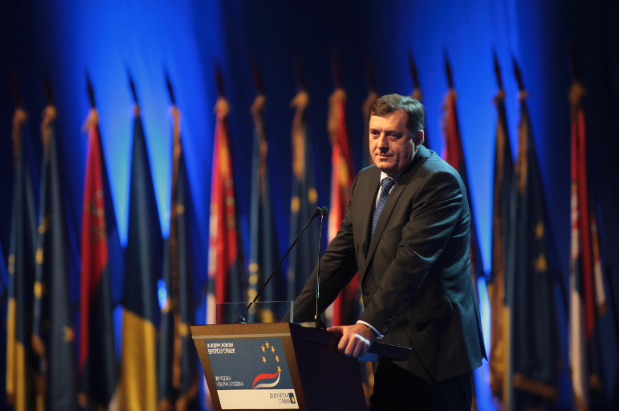
Milorad Dodik addresses the XIV Electoral Assembly of the Democratic Party of Serbia in Belgrade on December 18, 2010. Photo courtesy of DEMOKRATSKA STRANKA DS via Wikimedia Commons.

Somewhere in Elgin, Illinois stood a plaque with Milorad Dodik's name on it. It read: "Leadership and Standing Up for Democracy Award." Dodik is the former president of Republika Srpska, one of Bosnia's two constitutional entities. Last year, the Court of Bosnia and Herzegovina found him guilty of defying the orders of the country’s internationally mandated High Representative. He was sentenced to one year in prison and barred from holding office for six years. Still, he accepted the award on April 30 at Judson University's World Leaders Forum. For an award intended to honor democracy’s defenders, the bar, it turns out, is flexible enough to accommodate its gravediggers.
Bosnia and Herzegovina is a small country in southeastern Europe, with a population of roughly three and a half million, composed of Bosniaks, Serbs, and Croats. Between 1992 and 1995, it was the site of a war that produced ethnic cleansing on a scale Europe had not seen since the Second World War. It culminated in the Srebrenica genocide, in which more than 8,000 Bosniak men and boys were executed in a matter of days, a crime adjudicated as genocide by both the International Criminal Tribunal for the former Yugoslavia and the International Court of Justice. The war ended with the Dayton Peace Agreement, which stitched the country back together under a fragile consociational structure that requires international supervision to function.
Milorad Dodik did not fight in that war. In the years after it, he presented himself as the reasonable one, a moderate reformer. Washington loved him, and he entered politics in the late 1990s as something of a Western darling. Madeleine Albright famously called him "a breath of fresh air” in the Balkans. He was even on record in 2008 acknowledging that "genocide happened in Srebrenica" and that this was "an undeniable legal fact." The West bankrolled his ascent and called it a success story.
Then Dodik did the math. He figured out that ethnic nationalism is a more reliable electoral engine than moderation and rebuilt himself accordingly. By 2010, Srebrenica became “a myth.” He reversed a 2004 government apology for the killings, and pushed legislation to ban the teaching of the Srebrenica genocide in Republika Srpska schools. When Bosnia criminalized genocide denial in 2021, Dodik defied the law in public. He called Ratko Mladić—the commander of the Bosnian Serb Army, convicted for genocide and sentenced to life—a "legend." He also appeared as a character witness for Radovan Karadžić, the wartime president of the Bosnian Serbs, at his war crimes trial before the International Criminal Tribunal for Yugoslavia. Dodik knew exactly what he was doing.
But the genocide denial, as obscene as it is, is almost a distraction from the rest of his record. What Dodik has really spent his career doing is dismantling the functional architecture of the Bosnian state piece by piece. In 2023, Republika Srpska's assembly passed a law that simply refused to recognize decisions of Bosnia's internationally mandated High Representative—the foreign official appointed by the Peace Implementation Council to hold the postwar settlement together. When the High Representative struck those laws down, Dodik signed them back into effect. The United States and the United Kingdom sanctioned him repeatedly for corruption and for threatening Bosnia's territorial integrity. Then, in February 2025, the Court of Bosnia and Herzegovina had seen enough: Dodik was sentenced to one year in prison and put on a six-year ban from holding office. He was stripped of the presidency of Republika Srpska in August of the same year.
His answer to all of that was to double down. He declared, publicly and without embarrassment, that Republika Srpska will break away from Bosnia and join Serbia "when the conditions are right." Dodik has met Vladimir Putin 27 times, and even awarded him Republika Srpska's highest honor: The Order of the Republika Srpska. Dodik is also a close friend and ally of Viktor Orban, Hungary’s recently ousted authoritarian Prime Minister. Dodik’s project, in short, is not self-determination, but a slow-motion dissolution of a multiethnic country, backed by Moscow, with a trophy cabinet full of authoritarian allies.
Meanwhile, Bosnia has hemorrhaged 24% of its population over three decades. Young Bosniaks, Croats, and Serbs are all leaving because there are no jobs, no functioning state, no path to the European Union, and no credible future inside a country that has been held hostage to manufactured crises for more than three decades. The people who stay and profit from the paralysis are Dodik's people. The ones who pay for it are everyone else, including the young Serbs of Banja Luka, who live in the same broken economy and have the same reasons to leave as do the young Bosniaks of Sarajevo or young Croats of Mostar. The crisis he built was never about protecting his community, but about controlling it.
After facing criticism for hosting Dodik at its World Leaders Forum, Judson University released a statement arguing that hosting a speaker is not the same as endorsing one. That is technically true, but completely beside the point. Judson did not merely host him. They created a new award and gave it to him as the first world leader to ever receive it. They named it after democracy and handed it to a man whose country’s courts convicted him of subverting democratic law. He stood on Judson’s stage and called international court verdicts "NATO propaganda."
No one pushed back.
There is a version of this defense that almost works: universities exist to engage difficult figures and not to curate previously approved ones. Fair enough. But an award is a platform. And more dangerously, a verdict. It says: We looked at this person's record and decided it deserves recognition. Judson University looked at Milorad Dodik's record and gave him a democracy trophy. The university is entitled to that choice. It should also be able to defend it without a press release.
In Bosnian, we say ko ćuti, slaže se—those who are silent are taken to agree. Judson University was not silent. They ordered a plaque, set the stage for the ceremony, and sent Milorad Dodik home with an inaugural award tucked under his arm. The people who will live with the consequences of this gesture are not in Elgin, Illinois. They are in Sarajevo, in Banja Luka, in Mostar, still trying to build something in the wreckage of everything Dodik spent his career dismantling.
Anes Demirović (CC ‘29) is a Political Science and Human Rights student at Columbia College. He can be reached at ad4550@columbia.edu