When Geography Outvotes Democracy
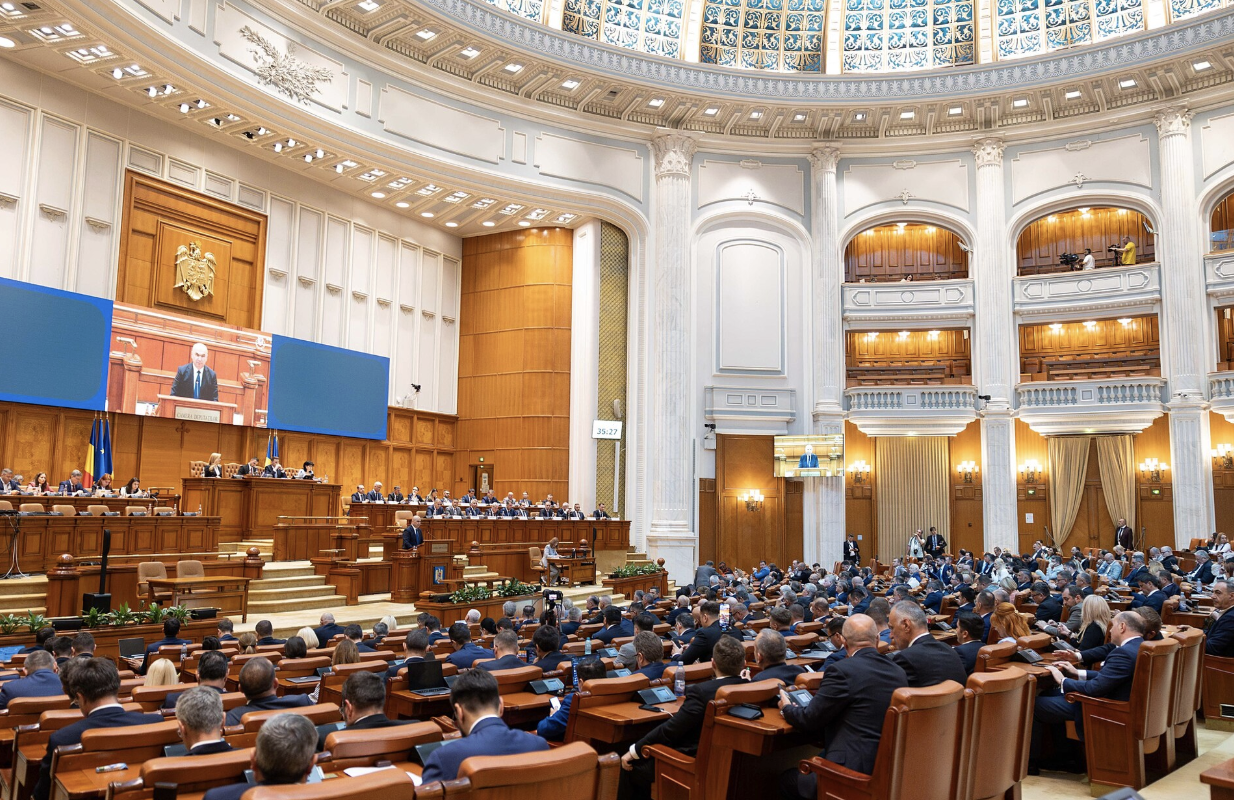
Romania’s Parliament convenes as electoral rules continue to shape the distribution of political power across the country’s geographic divides. Photo courtesy of the Romanian government via Wikimedia Commons.

At first glance, Romania’s 2024 parliamentary elections looked like a fairly ordinary contest. The Social Democrats (PSD) led with 22.44% of the Senate vote, while the ultranationalist Alliance for Union of Romanians (AUR) climbed to 18%. But the more important story was not just about the “who” behind the votes; it was about where those votes came from and why they ended up mattering so much.
Across rural regions like Western Moldavia and South Muntenia, campaigns revolved around national sovereignty, agricultural subsidies, and traditional values. In cities like Bucharest and Cluj, by contrast, the political conversation looked very different. This divide is often described in cultural or economic terms, but that explanation is only partial. The gap is also institutional, as Romania’s electoral system does not simply reflect differences between rural and urban voters; it amplifies them.
At the heart of this amplification lies malapportionment, the basic logic of which is straightforward: electoral districts with very different populations are still given similar representation. In Romania, this is not an accidental distortion but a feature built into the electoral rules, established by Romania’s 2008 electoral reform. According to this system, one deputy is allocated per 73,000 people and one senator per 168,000, while every county is also guaranteed at least four deputies and two senators. The result is a systemic malapportionment as small rural counties receive the same baseline representation as massive, hyperpopulated urban centers. Rural voters, essentially, have more power than their urban counterparts. As such, what may have been intended as an administrative compromise has, over time, hardened into a form of political inequality.
The numbers make the imbalance difficult to ignore. Bucharest, with nearly 2 million residents, elects 29 deputies and 13 senators. Conversely, Vâlcea County, with approximately 350,000 people, receives 6 deputies and 2 senators. After calculating the per-capita vote weight, the rural voters inherently carry more influence. In practical terms, a vote in Valcea carries more weight than a vote in Bucharest. In effect, geography begins to outrank the democratic ideal of one person, one vote.
Political behavior deepens the effects of structural overrepresentation. Rural turnout is consistently higher than in urban areas, and in the December 2024 elections, this pattern held: while overall turnout stood at 52 %, participation was stronger in rural counties. When those who already have more weight also vote in greater numbers, the imbalance compounds.
This higher engagement is anything but incidental. It reflects a politics of incentives in which parties appeal to material concerns through promises of subsidies, programs, and policies that speak directly to everyday life. In that environment, voting becomes a rational response to political offers that feel immediate and concrete. Marcel Ciolacu’s PSD campaigned on full interest subsidies for agricultural investment loans and irrigation systems, while Calin Georgescu (independent) promised an “awakened”, self-sufficient Romania that would be less reliant on imports and foreign corporations and, more generally, would challenge globalization. George Simion’s (Alliance for the Union of Romanians) top promise was €35,000 apartments with €1,000 down payments and zero-interest loans. In this context, electoral participation starts to look less like an abstract civic duty and more like a transaction.
Over time, the effect becomes self-reinforcing. Rural voters carry greater weight, so parties direct more attention, money, and promises to rural areas; in turn, higher turnout in those areas helps lock in the same advantage for the next round. What begins as an institutional bias becomes a political routine, one that parties adapt to and increasingly depend on. The result is not just a skewed system, but a stable one, because actors within it learn how to survive by working around the imbalance rather than challenging it.
Unsurprisingly, parties have adapted accordingly to these incentives. Instead of competing evenly across the electorate, they have increasingly concentrated resources where votes produce the highest return. The 2024-2025 election cycle made this dynamic especially visible. PSD continued to draw most of its support from rural voters, while AUR found fertile ground in the spaces where mainstream parties had already lost credibility. Support for far-right candidates is strongest in rural, economically strained areas marked by low ethnic diversity, migration, and younger populations. Nearly 49% of rural voters preferred the AUR compared to 30% in urban areas. The party consolidated support among economically strained rural areas marked by poverty and migration, where populist, patriotic messaging resonated with 18-35-year-old men disillusioned with mainstream politics.
The 2025 presidential election confirmed the same divide. Nicușor Dan (independent) secured victory in 2025 with 53.6% of the vote thanks to strong support in urban, multi-ethnic regions, notably Transylvania and Moldova. By contrast, George Simion (Alliance for the Union of Romanians) consolidated rural support. These patterns suggest that geography did not merely influence voter preferences at the margins; it structured the political competition itself. Electoral outcomes increasingly reflected where voters lived rather than simply their class, ideology, or party affiliation, revealing a political system in which territorial divisions shape representation and power.
Once this kind of imbalance is in place, its effects spread outward. First, parties with geographically concentrated rural support can convert modest national vote shares into disproportionate institutional power, as AUR did by translating 18% of the vote into nearly 21% of Senate seats (the equivalent of nearly 21% of the chamber). In that sense, location becomes politically decisive. Second, policy follows power: when rural votes count more, governments are more likely to prioritize agricultural subsidies, rural infrastructure, and socially conservative issues over rural ones. Third, polarization deepens because urban voters feel their pro-European and reformist preferences are being diluted, while rural voters see urban elites as dismissive of their economic grievances.
These conditions also cascade and heighten political instability. The annulment of the first round of the 2025 presidential election, following the unexpected rise of ultranationalist candidate Calin Georgescu, illustrates how fragile this equilibrium can be. Disinformation campaigns, including those linked to external influence from Russia, found traction in overrepresented rural areas. Electoral geography did not create these vulnerabilities, but it makes their consequences far more significant.
Romania’s case points to a broader warning for democracy. Elections are supposed to translate votes into representation on equal terms, but when the rules systematically give some votes more weight than others, that promise starts to fray. Rural voters are not asking for too much by demanding recognition; their concerns are real. But a democracy cannot solve one group’s underrepresentation by overrepresenting them.
The problem does not stay confined to technical electoral design. It shapes who wins, which issues matter, and which citizens feel heard. Romania makes this drift unusually visible, but the pattern is not unique to Romania. Across democracies, geography can become a political advantage, turning equality of citizenship into inequality of influence.
The principle at stake is simple: one person, one vote. Once geography starts to outweigh that principle, democracy does not collapse overnight. It erodes, gradually and almost imperceptibly, until unequal representation starts to look normal. That is the real warning from Romania: when the map matters more than the ballot, democracy begins to lose its way.
Alexia-Maria Puiu (GS ‘28) is a sophomore, part of the dual degree with Sciences Po Paris (Menton campus), studying politics and financial economics. Her interests center on politics, economics, and the study of how power operates in society.