Pride in Our Parks
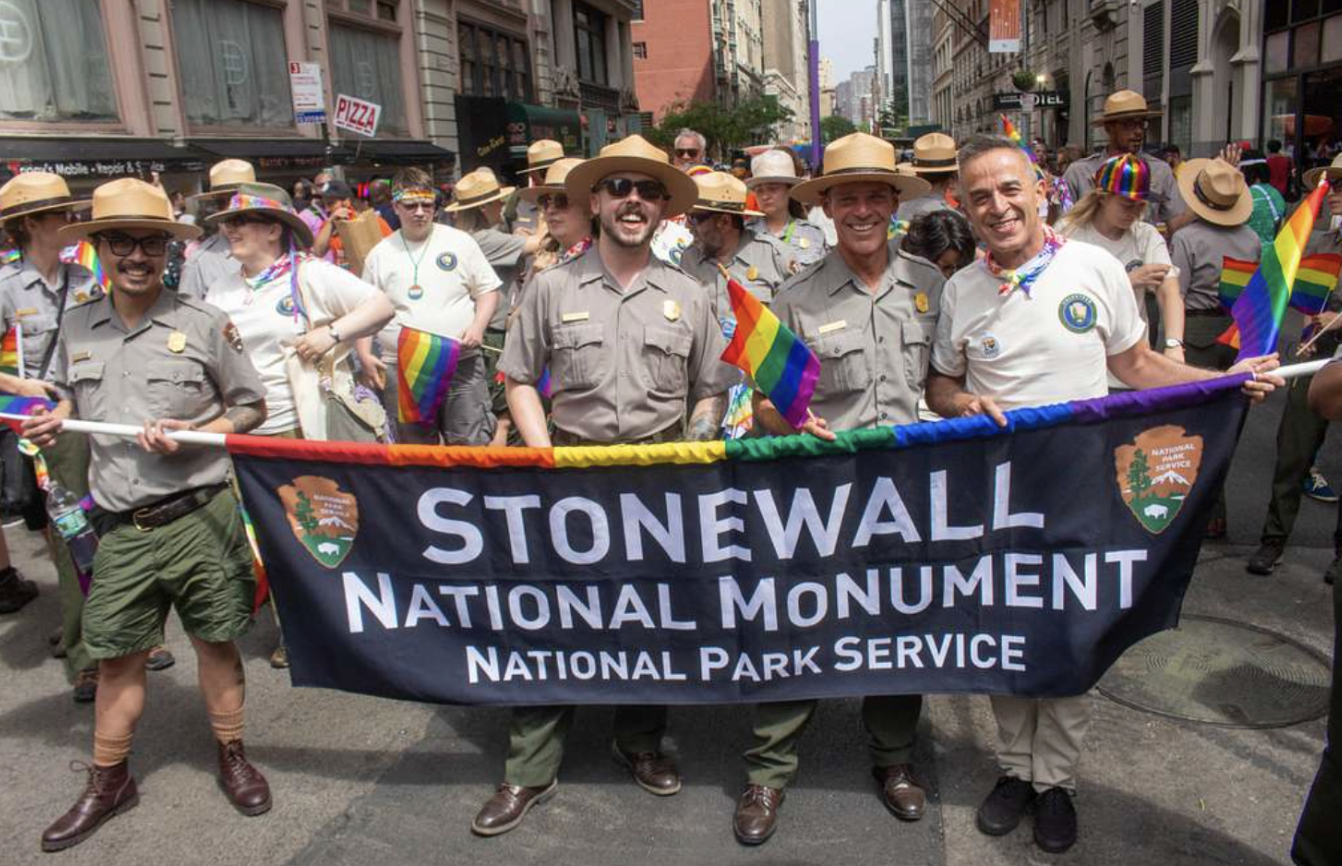
National Park Rangers and volunteers from the Stonewall National Monument march in the June 2019 New York City Pride March, celebrating the 50-year anniversary of the Stonewall uprising. Photo courtesy of Picryl.
Stonewall National Monument is a small park across the street from the historic Stonewall Inn, with a line of benches, a sculptural installation, and a fenced-in perimeter dotted with rainbow flags. The monument is just steps from the site of the June 1969 uprising that made Stonewall the focal point of the gay and trans rights movement and annual pride celebrations. In 2016, the Stonewall National Monument became the first National Park to be dedicated to LGBTQ+ history.
But walking through Greenwich Village the morning of February 7, you may have noticed an American flag waving in the center of the Stonewall National Monument, where just the night before, a rainbow pride flag had waved. The pride flag had been removed and replaced without warning on direct orders by the Trump administration.
In defense of the removal, the Park Service referenced regulations stating that only the US flag and other federally authorized flags can be flown in national parks, monuments, and historical sites. The Gilbert Baker Foundation sued to challenge this specification, citing an exception to the rule: other flags can be flown if they provide necessary cultural and historical context. This exception permits, for example, flying an “earlier version of the U.S. flag at a historic fort.” The stipulation notably allows the flying of Confederate flags in national parks and monuments.
Although the flag was officially reinstated in an early April court victory, the outrageous legal inconsistency of the removal remains and is almost guaranteed to recur. This action by the Trump administration cannot be dismissed as another brick thrown in a culture war. It is rather part of a larger concerted effort to cleanse historical sites of their shared memories and use them to propagate a particular, biased version of the American story.
Though he continues to identify as a free speech defender, Trump demands that the American people overlook his use of targeted censorship to rewrite the history of our communities to fit his narrative. Trump’s tirade against identity-based and historically critical materials in national parks and monuments began with an executive order in March 2025: “Restoring Truth and Sanity to American History.” The order condemns efforts to “rewrite history” as responsible for reconstruing America as “inherently racist, sexist, oppressive, or otherwise irredeemably flawed,” One example of these supposed cultural attacks is a program at Independence National Historical Park that trained park rangers to take “institutional racism” into account in their treatment of the site’s history.
Beyond identifying and rebuking current “liberal schemes” to divide American society, this executive order encourages erasure of the sensitive facts of history. Not only does Trump demand that America be made great again, but he insists that America was always great, with no exceptions and no room for acknowledgement of groups that may challenge that view.
Efforts to remove materials that “inappropriately disparage” America have reached far beyond Stonewall: a booklet discussing endangered turtles has been discontinued at Organ Pipe Cactus National Monument; “The Scourged Back,” a recognizable 1836 photo of the scarred back of an enslaved man was removed from the Fort Pulaski National Park; and content acknowledging the displacement of Native Americans was scrubbed from Bent’s Old Fort National Historic Site.
Meanwhile, Confederate flags remain displayed for historical context in monuments, graveyards, and historical reenactments in Shiloh and Gettysburg National Military Parks. Moreover, Trump has restored the names of nine military bases to honor Confederate generals and ordered the restoration of a statue of the Confederate general Albert Pike in Washington, DC, after it had been toppled in June 2020. In the restoration, the National Park Service cited “historic-preservation law and recent executive orders to beautify the nation’s capital."
It is, at this point, unfortunately trite to point out that the Trump administration deems Confederate history as less of a stain on the American image than the acknowledgement of the history of marginalized groups. That being said, it would be a mistake to dismiss censorship in National Parks as just another incendiary attack against “woke culture.”
National parks serve as public centers of education. Historically informative tours of Civil Rights-related national monuments positively impact young people’s historical understanding, and generate billions of dollars in educational value annually. Certainly, this same effect cannot be seen if relevant groups and contexts are ignored in favor of a sanitized version of American history. Parents and educators have time and time again expressed outrage over the distribution of textbooks in schools that censor the realities of American history, so why should we overlook censorship in national parks?
By purging these centers of education of their historical worth, the administration seeks to impose a nationwide ignorance. The lived experiences of generations of Black Americans, Native Americans, and LGBTQ+ Americans, and the symbols that represent the advancement of their civil rights, are written off simply as liberal virtue signals.
National parks and monuments represent the United States, and it is truly important that this representation is accurate. Monuments that insist that the American government has never done wrong in its 250-year history will only serve to pacify future generations. Compliance with removal of flags, exhibits, and educational programs creates an American population compliant with censorship in our schools and our media.
If symbols like the flag at Stonewall National Monument continue to be removed, the progress made by the LGBT+ community of the past will be lost to history. We cannot fully appreciate the site’s meaning if there is no reminder of what came of the protests that took place there—a distinct, vibrant community, free to represent itself on federal land.
Each transgression by the Trump administration on national parks must continue to be met with outcry, lawsuits, and persistent re-institution of flags, plaques, exhibits, and programs. We must hold the administration to its self-proclaimed standard of preserving “historical context” and preserve our federal lands not as a monument to American exceptionalism, but as a center for self-reflection and education.
Abra Cotner (CC ‘29) is a staff writer from Danville, Pennsylvania. She studies history and political science and can be reached at alc2336@columbia.edu.