The Gulf Has Been Struck. Now What?
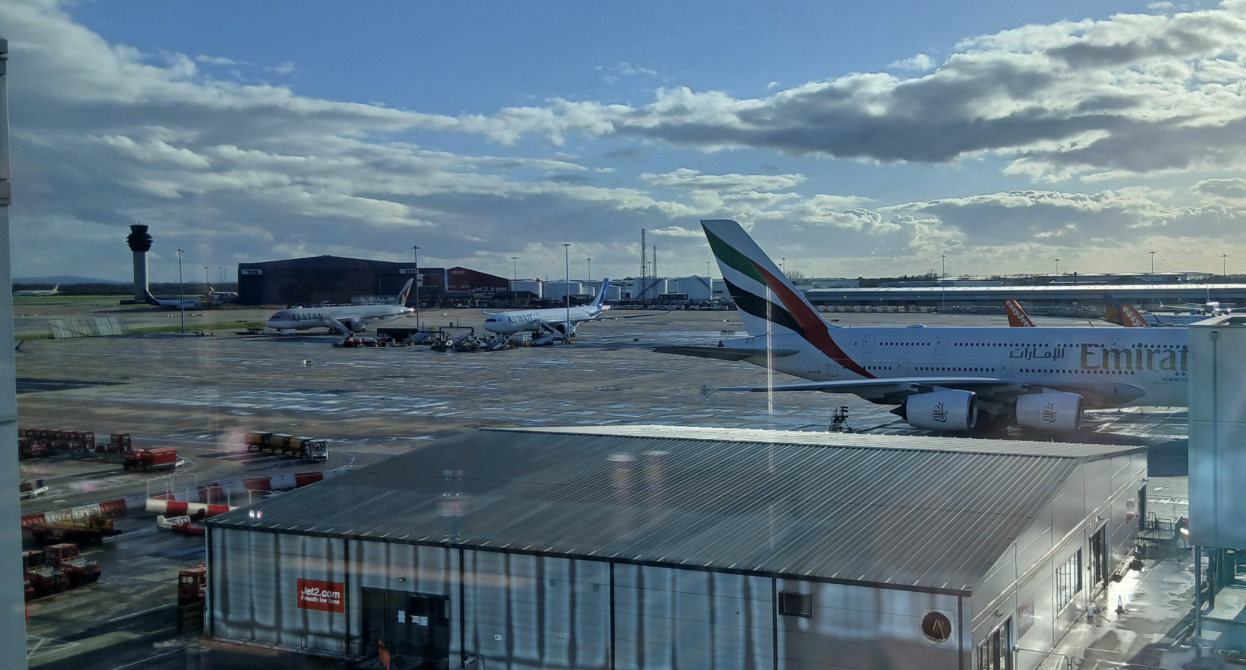
Prominent state-owned GCC airlines grounded in Manchester on February 28th, 2026, due to the start of the conflict in Iran, highlighting the immediate economic impact on Gulf countries. Courtesy of Wikimedia Commons.

In January 2026, the Gulf looked to be in a strong spot. With projected 4% annual growth in the Gulf Cooperation Council (GCC), steady rises in the oil and hydrocarbon industries, and further expansion and diversification in non-hydrocarbon sectors seemed to signal a continuation of the region’s economic trajectory.
The significance of the $2.25 trillion economic bloc is not only due to its vast mineral and hydrocarbon reserves that fuel global energy and manufacturing, but also because of its preeminent role as a regional economic and investment hub. Sitting on major cultural and geographic crossroads into the rest of the Middle East and Africa, the area serves as an important logistics, transportation, and shipping hub. The GCC’s large petrodollar surplus and sovereign wealth funds have allowed the region to expand and diversify in both the regional Middle Eastern and global capital markets, exerting economic influence, simultaneously a form of conflict insurance and a steady revenue stream for the bloc.
This growth was also, in a self-reinforcing fashion, the result of large flows of skilled and unskilled labor migration into the Gulf and foreign direct investment due to the region’s attractiveness as a stable and strategically significant one. This claim to stability is further strengthened by the bloc’s continued resilience in recent years; the 2017 Qatari diplomatic crisis, the global oil downturn of the same year, and the 2025 Israel-Iran War all proved major obstacles that the Gulf managed to overcome, maintaining its status as a global economic powerhouse. This resilience is a key reason the Gulf’s brand as a relative safe haven in the Middle East has held firm in a region so often facing turmoil.
But now, in April 2026, that vision has been shattered. The ongoing war involving Iran has shown that conflict can directly impact the GCC. Continued strikes on major industrial and transportation sites have disrupted key infrastructure across the region, and the closing of the Strait of Hormuz nearly fully suspended GCC oil exports in March, leading to losses of more than $2 billion per day. The 35 million-strong migrant workforce has now experienced the violence firsthand, and despite the assurances of Gulf officials, foreign investors have halted and renegotiated short-term contracts out of risk aversion.
While the Gulf, as always, is projected to rebound, it now faces a structural, fundamental question: what does it mean to be an economic power in a conflict-filled region? With new risks to the labor force, investment, and business, the Gulf’s resilience will face its truest test to date. So how will the Gulf build back, and how can it ensure a near-risk-free future?
One answer is to look internally. To restore the vision of Gulf safety, security must be at the forefront of strategic development in the post-war period. As of April 2026, much of Gulf defense is supported by the US Armed Forces, with 19 American military sites in the Middle East. Still, this defense apparatus is showing cracks. The war has exposed the flaws in the system; American defense was not able to deter Iran from successfully hitting major infrastructure in the region. To become more attractive to capital, business, and labor, who are now fearful of risk and conflict in the region, the Gulf should heavily invest in its defense framework.
The most direct way to create a risk-free future for all Gulf states would be to strengthen their defense coalition. The Unified Military Command, the Gulf’s current joint defense force, is small, with about 40,000 soldiers. Despite the massive $130 billion of funding from all six Gulf nations toward this collective force, interoperability issues linger as weapons and technology are sourced from different Western manufacturers, all with different operating systems and protocols. Further complicating matters are questions about insufficient practice and preparedness. Even following recent joint military exercises hosted by Saudi Arabia with the Unified Military Command, all six nations acted unilaterally and without coordination in response to Iranian strikes.
With US defense promises falling through, risk-aversion and prevention demand greater capacity within this joint force. While the Unified Military Command lacks the budget and scale of other military coalitions like NATO, regular, multi-annual joint exercises could prepare the Gulf to respond to threats without the need for American support. Further, to increase interoperability, the GCC can pursue joint ventures in domestic or third-party weapons manufacturing to boost cross-border defense and industrial capabilities.
Another aspect of the Gulf’s next steps is diplomatic. The GCC relies heavily on the US military for its security needs. This defense apparatus in the region directly results from the petrodollar recycling system, the 1970s agreement under which US-denominated securities would be used to conduct Gulf oil trade, whose profits would then be reinvested in purchasing US arms, technology, and assets. This would provide the US with overwhelming dominance in the Gulf energy market in exchange for American defense of the GCC. This dollar-backed oil exchange has led to a $800 billion store in GCC foreign reserves.
However, oil dynamics have shifted, and the war has proven that American defense is neither guaranteed nor total. The GCC cannot, and should not, have to rely on Washington. Gulf sovereign wealth funds (SWFs) now manage more than $6 trillion in capital, and while much of this is invested in US investments and securities, these positions are not tied to Gulf oil or American defense. These diminished securities and foreign reserves could harm future trade, as yearly trade with the US amounts to a fraction of the current $800 billion in reserves, and the capital and stock positions held by Gulf SWFs offer protection in any case. Though the US dollar has remained the predominant trade currency and will remain so for the foreseeable future, it is clear that dollar-denominated trade is no longer a strict necessity.
In a parallel process, this dollar-denominated trade may not be viable at all. As stronger bidders for Gulf energy, such as India and China, have emerged, there has been a marked shift away from the petrodollar. Oil surpluses have shrunk, and an increasingly smaller fraction has been accumulated in central banks, which has been key to the operation of the petrodollar system. Coupled with the clear deficiencies in American defense obligations, both sides of the petrodollar deal are beginning to collapse. The Gulf can, and should, look elsewhere to increase its strategic defense capabilities. As much of the US defense apparatus has been rendered untenable due to Iranian strikes, it is unlikely that the US will continue its presence in the Gulf after the war. Thus, the Gulf can take advantage of shifting international dynamics and reduced US leverage to pursue a strategic defense strategy centered on oil diplomacy.
This strategy involves courting two of Iran’s major allies, China and Russia. China, a manufacturing powerhouse, has become increasingly reliant on Gulf oil, with the GCC supplying nearly half of its hydrocarbon imports. While China is to some degree equipped to handle significant Hormuz disruption, an elongated oil shock hurts its capacity as a major world producer, and it has already had to make significant cuts. In a post-war scenario, facilitating and fueling this necessary relationship by dropping the petrodollar system and increasing Yuan-denominated energy trade could prove beneficial to both sides, especially as China exerts further control over a trade-strapped Iran.
As the Iranian regime buckles under pressure from Beijing, such as when they allowed some Chinese ships through Hormuz despite the overall closure, stronger China-Gulf relations could protect the Gulf from future security and economic risk. With Iran dependent on China, and China dependent on the Gulf, Yuan-denominated trade would allow the Gulf relatively greater leverage and sway over a tumultuous Hormuz, bolstering and securing its position as a steady and reliable hydrocarbon provider and maintaining its oil revenue. While it is unlikely, except in the case of a regime change, that Iran and the Gulf could ever find themselves with the same military or economic partnerships, it is through China’s financial and political influence over the country that the Gulf can maintain its strength in a post-war, post-American, and post-petrodollar GCC.
It is a similar story for Iran’s other major ally, but on the financial side. Russia, an energy exporter, does not need to rely on the Gulf for hydrocarbon imports. The Gulf is, however, a popular investment and business location for Russian capital, with over 150,000 expatriates and 14,000 registered companies operating in the GCC, though this capital influx has taken a major hit due to the war in Iran. As Putin has set his eyes on the Gulf as a lucrative economic partner with increased diplomatic relations and with stronger trade opportunities, such as the larger influx of Gulf tourists into Russia, this relationship is as strong as ever. Like with China, both Russia and the Gulf benefit from the protection of Gulf economic activity, whether through energy production or trade through the Strait of Hormuz. Given Russia’s similar influence over Iran as China, the Gulf could leverage business losses and financial risks if Iran remains a risk in the post-war scenario. These options, while still highly speculative and sensitive to geopolitical reorganization, present potential paths forward for the Gulf.
Both pathways require careful deliberation and planning by Gulf leaders. Building a safer, more risk-free future for Gulf capital and business requires making difficult decisions and confronting new realities that this war has created. Should the Gulf bank on the fact that American defense is out, or risk investing billions into unnecessary defensive shields? Should they continue to operate on the petrodollar, or risk making diplomatic and financial moves that could strain their relations with the West? Luckily for the Gulf, they have the leverage to consider any such option, and if the past is any indication of what is to come, the GCC will display its resilience.
Pracheth Sanka (GS ‘28) is a sophomore in the dual degree program with Sciences Po Paris at the Menton Campus, studying Political Science and Economics. He can be reached at phs2122@columbia.edu.