Who Really Runs Pakistan?
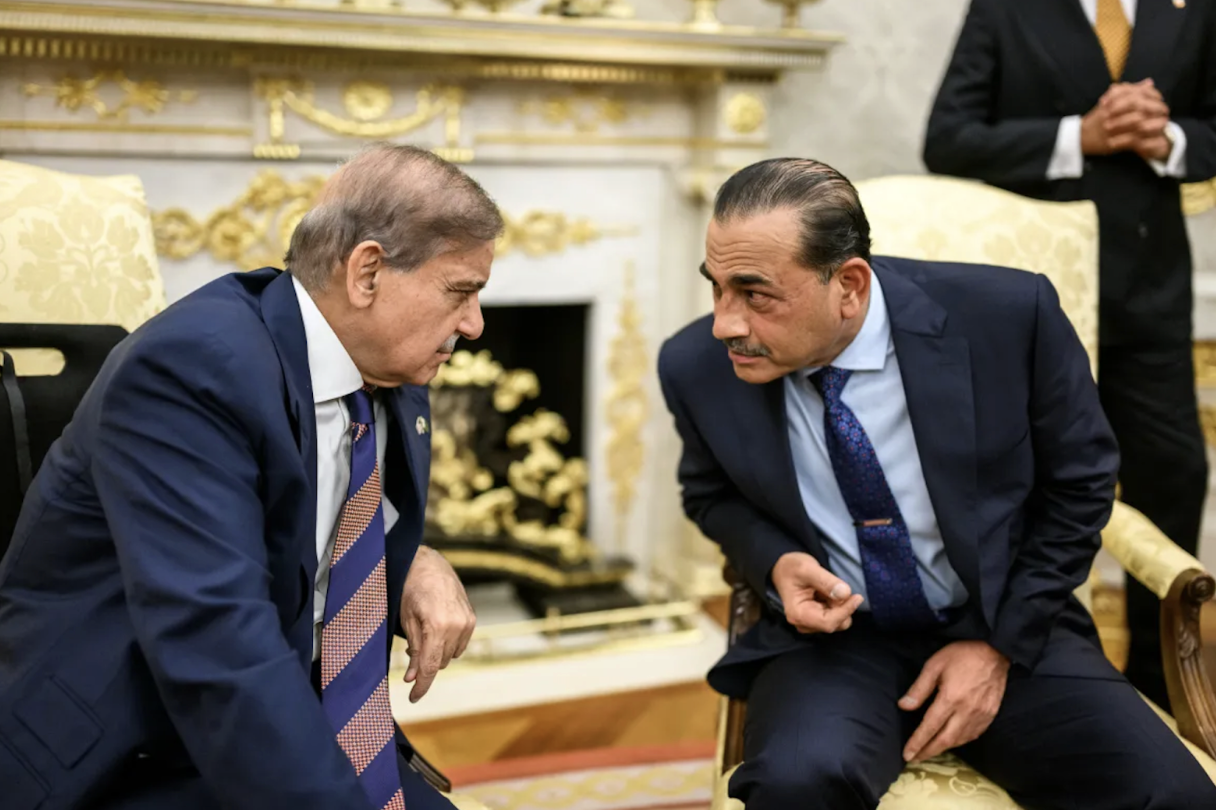
Field Marshal Syed Asim Munir is seen sitting with Prime Minister Shehbaz Sharif at the White House. Photo courtesy of the White house
Pakistan did not fail as a democracy. Democracy, as imported, failed Pakistan.
For decades, Pakistan has described itself as a democracy. It is a language the world understands and a label that reassures the West. It is the identity governments have projected with careful consistency. Though, behind this familiar vocabulary lies a complex political reality, one that has never aligned with the textbook model of democratic governance.
Seventy-nine years after independence, Pakistan has experienced over three decades of military dictatorship. Not a single prime minister has completed a full five-year term. Yet, Pakistan calls itself a democracy. The contradiction is no longer sustainable. The real question is not whether Pakistan is a democracy, but whether Pakistan was ever designed to function as a conventional democracy at all. In Pakistan, leaders are not born at the ballot boxes, they are refined in the laboratories of power.
This is a consistent pattern that runs through Pakistan’s political history. Every major civilian leader emerged with the backing of the military establishment. Zulfikar Bhutto (former Pakistani Prime Minister) rose under Field Marshal Ayub Khan, who appointed him as foreign minister and accelerated his political career. Nawaz Sharif (former Prime Minister) was politically cultivated during the rule of General Zia-Ul-Haq, emerging as a counterweight to Bhutto’s legacy. Imran Khan also rose to power in 2018 within a political environment shaped heavily by General Bajwa.
Once these leaders reached power, a transformation occurred. They began to centralise authority and challenge the same military establishment that facilitated their rise.
The consequences? They are remarkably consistent.
Bhutto was overthrown and executed. Liaqat Ali Khan was assassinated. Nawaz Sharif was removed and exiled. Benazir returned under the charter of democracy and was assassinated. Imran Khan, after building one of the most powerful political movements in Pakistan’s history, entered into direct confrontation with the establishment and was removed from office.
These are not mere coincidences.
Power in Pakistan has never been purely civilian or purely military. It has always been negotiated, and when the negotiation breaks down, so does the government.
The deeper challenge lies in Pakistan’s political culture itself. Elections are rarely fought on policy or ideological manifestos. Instead, they are driven by Dharabaazi (old family ties), biryani distributions, and gestures of religiosity. These political parties (Pakistan Muslim League, Pakistan Tehreek-e-Insaf, Pakistan People’s Party) lack internal democracy themselves as eadership is highly centralized, succession is dynastic, and decision-making is motivated by personal benefit. Hence, whenever crises emerge, these parties with weak democratic structures, fracture instead of adapting, thus creating a system where democracy survives as a formal procedure, but not as an embedded institution.
Pakistan’s geopolitical environment introduces an interesting and unique pressure dynamic that the country’s political system faces simultaneously. The country has fought many wars with India and remains in a constant state of tension along the eastern border, and has endured decades of terrorist attacks from Afghanistan, which requires a sustained military response. Operations like Zarb-E-Azb and Radd-ul-Fasaad were national survival strategies that required centralised command, intelligence, and continuity. Short-term political governance does not thrive under these conditions.
It is not a matter of power, but a matter of capacity. Political parties lack continuity and policy infrastructure, whereas the military maintains a meritocratic structure with a long-term planning capability. Foreign policy decisions, including relations with India and engagements with the United States, China, Russia, and Gulf states, cannot be made without consultation of the military establishment. Whether it be nuclear policy, counter-terror strategy, or regional security frameworks, they all operate within this structure.
This is Pakistan’s political reality. For decades, the country oscillated between fighting and denying its hybrid realities.
After decades of conflict between civilian governments and the military establishment, a new model has emerged: the hybrid system. It is nowhere codified in the Constitution, but it is an operational reality, a power-sharing arrangement in which civilian leadership and military establishment coordinate instead of competing with each other.
Under Chief of Army Staff and Field Marshal Syed Asim Munir and Prime Minister Shehbaz Sharif, there has been a shift from rivalry to strategic alignment. The long-standing ego battle between political leadership and establishment has been replaced, at least since 2022, by mutual understanding. Pakistan has stopped pretending that one side can govern without the other.
Defence Minister Khwaja Asif stated, “This is a hybrid model. It is not an ideal democratic government…so, this hybrid arrangement, I think it is doing wonders.” Even figures historically associated with anti-establishment politics have shifted tone. Bilawal Bhutto (Chairman Pakistan People’s Party), whose family paid the highest price in conflict with military rule, has now emphasized that “The PPP’s [Pakistan People’s Party] position is that the country must present a united front.” This marks a generational shift in political thinking. Pakistan is no longer attempting to fit into a Western democratic mold. Pakistan is designing a system that reflects its own realities.
The ultimate test of any governance model is performance. In recent years, Pakistan has shown signs of coordinated progress in every respective institution.
Under Chief Minister Maryam Nawaz, Punjab (the largest province in Pakistan) has seen significant progress. She revamped 1,217 health centers and provided 1,500 electric buses, which run at an extremely subsidized rate of 20 Pakistan rupees ($0.072). These buses are free of cost for women and students. As the first female chief minister of the largest province, she has broken societal norms on the expectations of whether she can deliver or not. Minister for Education Rana Sikander Hayat has collaborated with teachers like Muzammil Mehmood and delivered significant education reforms: integration of AI and digital learning tools in classrooms. These outcomes were delivered through the hybrid system. The civilian administration in Punjab operated with an unusual degree of political stability, free from establishment interference that paralyzed previous governments. That stability is a direct product of civil-military coordination under Asim Munir and Shehbaz Sharif, which cascaded downwards, giving provincial leadership the runaway to govern rather than survive. However, there is still room for improvement. The Ministry of Communication & Works under Minister Sohaib Bherth, called the form-47 minister (term used for winning a rigged election against Pir Farooq in 2024), faces serious corruption and inefficiencies. The Criminal Control Department also poses a threat to the well-being of citizens, as it has actively been involved in extrajudicial killings, which could set a dangerous precedent for the future. Maryam Nawaz must make amends to fully match the expectations of the masses.
At the military front, Pakistan stands tall after winning the recent escalation against India: 6 jets, including the new Rafael, were shot down and significant damage at airbases. The world has never seen Pakistan respond with such might before. This was possible due to the “highly respected Field Marshal,” as President Trump stated, Field Marshal Asim Munir and Air Chief Marshal Zaheer Babar. The Afghan Taliban’s terrorist goals are also being crushed, as per Ahmed Sharif on Pakistan’s western borders. Meanwhile, the federal government under the premier Shehbaz Sharif has been working on improving the economy with a 15.7% export increase, and saved Pakistan from expected bankruptcy by moving the foreign reserves to approx 21 billion dollars. The military’s operational effectiveness against India was enabled by a command structure that was not being simultaneously destabilized by a political crisis at home. The economic recovery equally required a civilian government confident to make fiscal decisions without the fear of a mid-term collapse. The hybrid system created the conditions for both.
Pakistan has demonstrated strategic balance in its foreign relations, which are working out brilliantly this time. Pakistan now maintains strong ties with the United States and China. It is taking the position of a security provider by deepening defense cooperation with Gulf states. The recent Pakistan-Saudi defense deal was a significant step toward slowly removing the US security guarantee. Pakistan is also the lead mediator between the US and Iran. It has facilitated peace, and secured a position of a country that stands for peace in the world. This multi-vector diplomacy by Asim Munir, and Shehbaz Sharif reflects effective, coordinated governance.
Nations under constant threat do not have the luxury of political experimentation. The military’s role in defending Pakistan’s sovereignty has reinforced its centrality in national decision-making. This is why a purely Western model of democracy has struggled to take root.
Let’s not miss one more important figure who is also a political reality of Pakistan’s political system: Imran Khan. It can be said without a doubt that Imran Khan remains the most popular political figure for a large segment of Pakistan’s youth.
His rise reshaped the political landscape. His fall revealed its limits.
Like his predecessors—Bhutto and Nawaz—his trajectory followed a familiar arc: alignment, consolidation of power, confrontation, removal.
The lesson from history is clear: no leader in Pakistan has sustained power through confrontation with the establishment alone. If Imran Khan is to return to the political center, it will not be through isolation but negotiation. A reintegration of Imran Khan into the system will not only stabilize political dynamics but also reflect a maturing of Pakistan’s hybrid model. It is because it will show that political opposition is a right which the country respects. This hybrid system can become one where popular legitimacy is recognized and incorporated through formal institutions.
The political system today stands at a point of deadlock. Breaking this impasse requires meaningful engagement with the military facilitated by individuals who possess not only political weight but also come from different walks of life and have the trust of the public: businessmen, religious figures, bureaucrats, and politicians. Such a process cannot be confined to a narrow circle, it must reflect the geographical and political diversity of Pakistan itself. It is not complete or perfect diversity, but it is a step forward. Representatives must emerge from across provinces and power centers who carry legitimacy within their regions to the tables of communication to present Imran Khan’s case to the hybrid regime.
From Punjab, individuals such as Shah Mehmood, Fawad Chaudhry, Pir Amin-Ul-Hasnat, and Pervaiz Elahi can articulate the political pulse of the heartland. South Punjab’s dynamics can be represented through Jahangir Tareen, Khusro Bakhtyar, and Yusuf Raza Gillani, each bringing administrative experience and political reach.
Sindh requires voices that understand both Federal politics and provincial nuance: Pir Pagara and Sherry Rehman. In Balochistan, leaders such as Mehmood Achakzai are essential to ensure the province is not sidelined in any national recalibration. Meanwhile, in Khyber Pakhtunkhwa, the political and religious landscape necessitates the inclusion of figures like Mualana Fazlur Rehman and Noor-ul-haq Qadri who command influence through grassroot connections.
Overseeing this process of negotiating with Imran Khan’s re-integration into the political system must be a neutral mediation body, one perceived as competent and above factional interests, whose role is to de-escalate tension as it arises, and ensure no single party can walk away or derail the process. This facilitation can serve as a platform to resolve any tension that arises during the talks. This includes seasoned bureaucrats, respected spiritual figures, business leaders, and credible journalists—Mohsin Naqvi, Pir Farooq Baha-ul-Haq, Faiz Chaddhar, Fawad Hasan Fawad, Rasikh Elahi—who can act as stabilizers in a volatile negotiation environment.
Only through such a broad-based and carefully mediated structure can Pakistan move beyond this stalemate. Dialogue, if it is to succeed, must not only happen, but it must be seen as legitimate and rooted in the collective reality of the state.
If the political deadlock surrounding Imran Khan—his imprisonment, suppression of his movement, and the unresolved standoff between PTI’s mass base and the establishment—is resolved through negotiation rather than force, Pakistan will progress faster. This is because Pakistan has finally found a system capable of ensuring stability, security, and governance in one of the most challenging geopolitical environments in the world.
Critics argue that what is being called a hybrid system is simply military rule with a civilian facade—that Shehbaz Sharif governs at the pleasure of establishment rather than by democratic mandate, and that the suppression of PTI exposes the system’s authoritarian core. These legitimate concerns. But the binary of “full democracy or dictatorship” has never mapped cleanly onto Pakistan’s reality. The hybrid system does not claim to be a democracy, it claims to be functional. And by the metric of institutional stability, economic recovery, and military effectiveness—metrics that eluded Pakistan under both pure civilian and military rule—the current arrangement has outperformed its predecessors. Imperfect systems, when they work, deserve to be understood on their own terms.
For the first time in decades, Pakistan is not oscillating between systems: it has created one that is not borrowed, not imposed but built through experience and necessity. The hybrid system is working.
Haris Shah (CC’29) is an International Students Representative at Columbia University. He is studying Financial Economics & Philosophy, and serves as the President of Lion’s Voice. You can reach him at haris.shah@columbia.edu