Refugees as Rhetoric: How Language Obscures US Immigration Policy
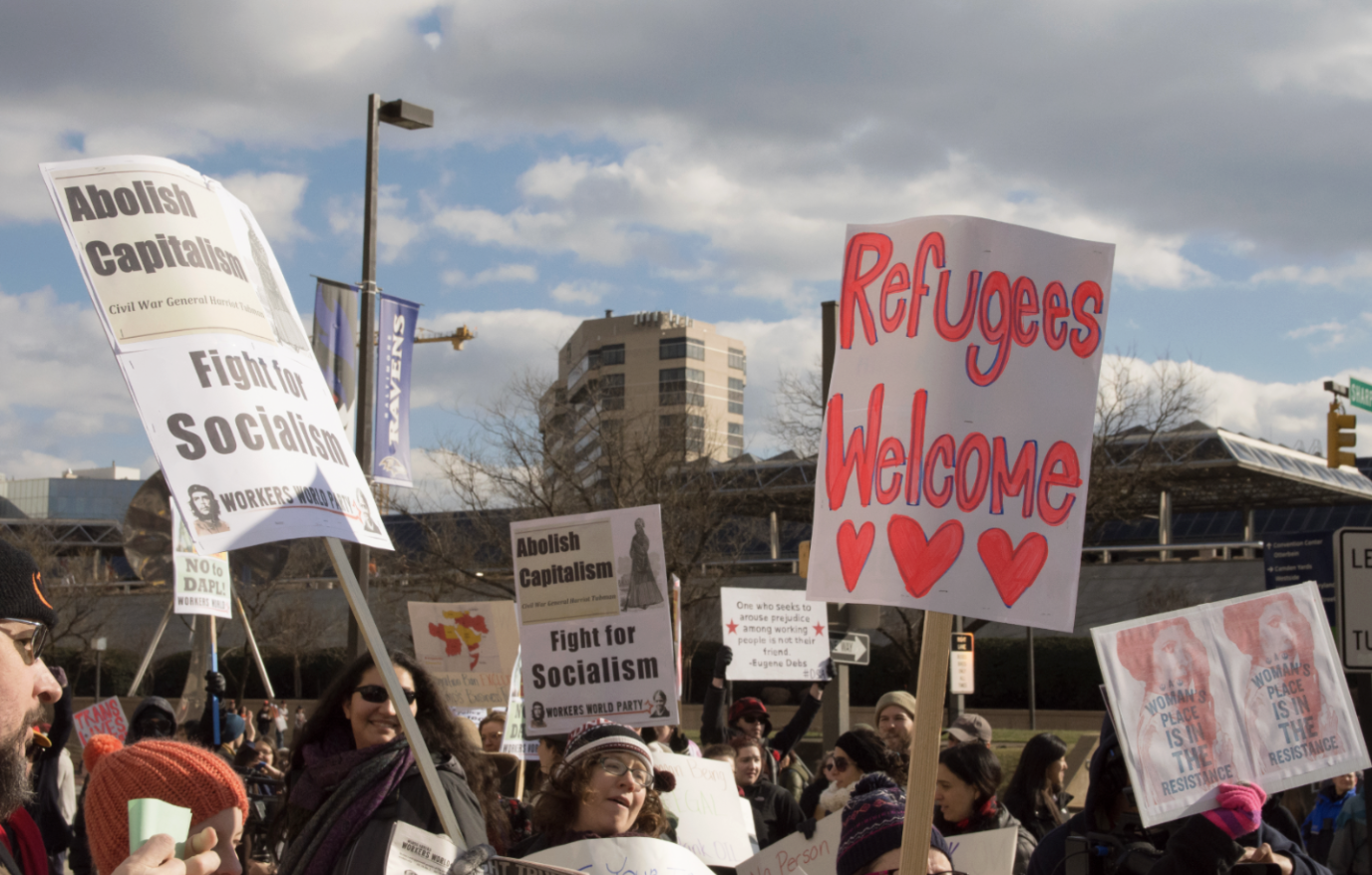
Anti-Trump immigration protesters in Baltimore advocate for a warmer welcome for refugees in early January 2017—the same year the Trump administration slashed the refugee admissions cap from 110,000 to 50,000. Photo courtesy of Bruce Emmerling and licensed under Creative Commons CC0 1.0 Universal Public Domain Dedication.
.jpg)
As tens of thousands of Afghans fled their country in the wake of the Taliban’s return to power in 2021, the American public turned to familiar terms like “refugee” to make sense of their displacement. Appearing across headlines, political speeches, and social media posts, the label offered a simple, intuitive way to categorize a rapidly unfolding crisis.
But for most Afghans, the word was never more than rhetorical. In actuality, only 11,411 Afghans were granted formal refugee status under US law. Instead, the greater majority—76,000—entered as humanitarian parolees, a designation that offers far fewer protections. These include limited or no access to public benefits, no pathway to family reunification, and, most importantly, eventual reliance on severely backlogged asylum courts after their two-year temporary status expires. Even a year later in 2022, the same was true. Similarly, the use of the word “refugee” statistically peaked during the Russian invasion of Ukraine, even though the displaced Ukrainians entering the US through the Uniting for Ukraine program entered as humanitarian parolees as well.
Taken together, both cases offer insight into a concerning trend in American rhetoric: the increased use of the word “refugee” is largely unreflective of the current decline in refugee admissions and formal designations. This is due in large part to the political homogenization of the word refugee, as modern media and political discourse often collapse categories like migrant, asylum seeker, refugee, and immigrant into a single, interchangeable identity. In doing so, this rhetoric flattens the distinct legal meaning and protections associated with that term.
However, it is a semantic difference that is certainly not made clear through the term’s complex history. Even though “refugee” originated from fleeing French Protestants in the 1600s, the category “refugee” was formally codified only after the rise of displaced persons after World War II. As formalized in the 1951 United Nations Convention Relating to the Status of Refugees, a “refugee” is someone with a “well-founded fear of persecution” based on race, religion, nationality, political opinion, or membership in a particular social group.
The United States has historically complicated the definition further by adopting different frameworks when and where it best sees fit, in line with its own political priorities. Rather than accept the United Nations’ previously described definition of “refugee,” the US maintained its own criteria until the passage of the Refugee Act of 1980 in the aftermath of the Vietnam War, which formally incorporated the Convention’s definition into US law. Today, the US Department of Homeland Security defines a refugee as “any person who is outside his or her country of nationality who is unable or unwilling to return to that country because of persecution or a well-founded fear of persecution.” By contrast, an immigrant is defined as “an alien admitted to the United States as a lawful permanent resident.”
While seemingly innocuous, this growing tendency in American politics to homogenize the “refugee” label arguably has consequences beyond just imprecision. Because refugee status carries specific legal protections, this linguistic flattening could potentially enable states to evade the obligations that classification is meant to trigger by obscuring when those protections should apply.
For example, the United Nations Convention Relating to the Status of Refugees enshrines the principle of non-refoulement, which limits state sovereignty by prohibiting states from returning refugees to territories where they would face persecution. Crucially, this uptick in rhetoric comes at a time when refoulement is already enabled. Specifically, Trump’s Migrant Protection Protocol policy—colloquially known as “Remain in Mexico”—forced non-Mexican asylum seekers to wait in Mexican border cities while their US immigration court cases were processed, forcing thousands back into the very high-risk areas they just fled.
In other words, the increased use of the word “refugee” makes us seem better than we are without ever needing to do any work. In reality, refugee resettlement through the US Refugee Admissions Program has been drastically curtailed under President Trump’s tenure, approaching a near blanket ban. As recently as early April, updated data on US refugee admissions revealed that six months into the fiscal year, the only individuals resettled via the program were 4,496 South Africans and 3 Afghans. By contrast, in the last full fiscal year of the Biden administration, more than 100,000 refugees from 85 countries were welcomed. Currently, the refugee admissions ceiling remains capped at 7,500 for the fiscal year 2026—the lowest in the program’s 45-year history.
That isn’t to say that the Biden administration was more committed or more successful in a precise use of the word “refugee,” but that the imprecision now comes into direct conflict with reality. Overuse of the words “asylum-seeker” or “refugee” obscures the true scale and structure of current restrictions by producing the subconscious impression of sustained humanitarian intake.
Beyond reshaping public perception, the misuse of the word “refugee” can also change the law by allowing arguments that even refugees should be subject to discretionary, merit-based filters. As first proposed in Trump’s 2019 immigration plan, which limited the number of people who could get green cards by seeking asylum, this rhetoric makes consequentialist immigration logic possible even when international or domestic law might otherwise prohibit such revisions.
Even though the term “refugee” emerges from a complex and inconsistently applied legal history, its misuse risks not only mischaracterizing displaced people but also mischaracterizing the false benevolence of our own immigration system. Distinguishing between “refugees,” "asylum seekers,” “migrants,” and “immigrants” matters for the sake of precision but ultimately as a form of accountability by being honest about when and whether those rights are actually being upheld.
Reagan Ricker (CC ’29) is a staff writer for the Columbia Political Review from Seattle, Washington. She hopes to pursue a career in immigration law, and her primary interests lie in Latin American and Caribbean history, immigration policy, and journalism.