Father, Son, and the Holy State: A Look At Putin’s Relationship with the Russian Orthodox Church
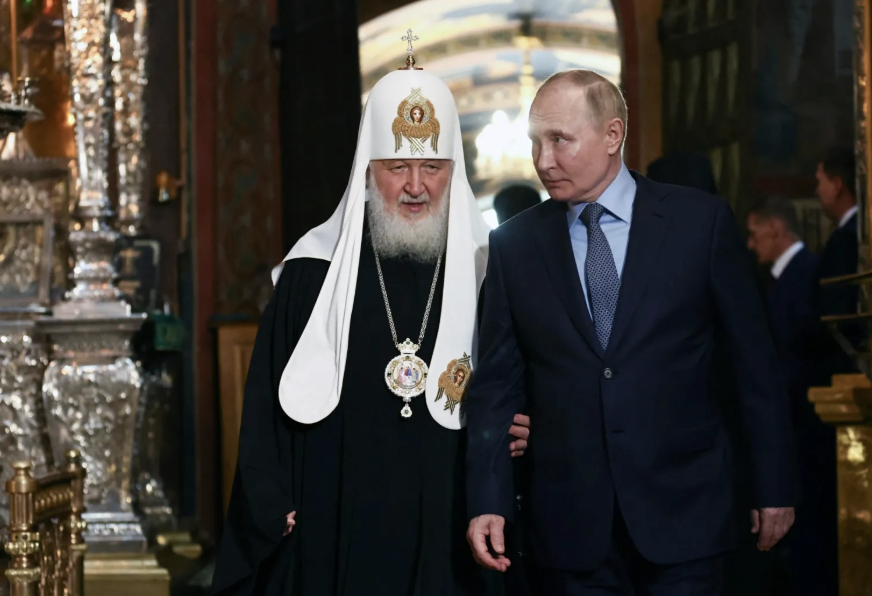
President Vladimir Putin pictured with Patriarch Kirill, head of the Moscow Patriarch of the Orthodox Church
On October 7th 2022, Russian Orthodox Church religious head Patriarch Kirill wished Russian President Vladimir Putin a happy birthday. Any religious official wishing a head of state a happy birthday may have already been viewed as questionable, but Kirill’s well-wishes were specifically more significant. The Patriarch framed Putin’s political authority as sanctioned by the Lord. “God put you in power,” Kirill stated, “so that you could perform a service of special importance and of great responsibility for the fate of the country and the people entrusted to your care.”
Kirill’s insinuation that Putin, who has held the highest Russian office for over 25 years, rules by a divine mandate, is not simply unorthodox, it is a verbal representation of the role the Orthodox Church has come to occupy within Russian society. Religious faith has become a political instrument––another method of advancing propaganda and encouraging submissiveness regarding Putin’s regime and the war in Ukraine. The operation of the Orthodox Church in contemporary Russian society serves as a case study for the adoption of a religious institution as a state body, and has resulted in a descent into nationalistic fundamentalism.
To understand the role of the Orthodox Church in the contemporary Russian state, it is important to trace its historical development. Orthodoxy has been instrumental to the construction of Russian nationalism since the Imperial days, dating all the way back to the 19th-century Tsar Nicholas I’s doctrine of "Orthodoxy, Autocracy, and Nationality." The only period of exception came with the 1917 October Revolution, which saw religion outlawed under the Bolshevik Party’s policy of atheism. The Orthodox Church under the Soviet Union maintained an uncertain relationship with the state. The 1920s and 1930s saw church leaders and theologians harshly persecuted through exile, arrest, and execution, but the Orthodox Church regained some freedom to act in a controlled and regulated manner from the 1940s onward. It is perhaps the church’s momentarily purgatorial state that explains the fruitful religious revival that sprang up after the Soviet Union’s collapse.
The post-Soviet religious reawakening permeated the private and public spheres. From 1991 to 2008, the number of Slavic Russians who identified as Orthodox Christians rose from 31% to 72%. Moreover, the 1990s saw the development of a burgeoning partnership between the Moscow Patriarchate––the largest and most influential denomination of the Russian Orthodox Church––and the newly formed Russian Federation. A series of agreements were signed to expand the Orthodox Church’s presence in Russia; placing Orthodox chaplains in thousands of prisons across the nation, churches were constructed for military installations and units, and increased efforts were made to educate the youth in “in the spirit of high moral values.” These agreements demonstrated an urge to center the Orthodox Church as a key ingredient in the rebirth of the Russian nation that existed prior to Putin’s ascent to power. Religion was positioned as the ideological and moral goalpost of a “new” Russia, forming a precedent that Vladimir Putin could build upon when he became president in the year 2000.
The strength of the partnership between the church and state only deepened with Kirill’s inauguration as the new Patriarch in 2009, because he and Putin had a personal history. Soviet archival material revealed that Kirill had previously worked as an agent for the KGB, just like Putin, and his public statements make his ideological alignment with Putin clear. In 2012, as Putin faced protests and backlash for corrupting elections to secure a third-term as president, Kirill openly backed Putin and called him a “miracle of God” that had saved the country from the “systemic crisis” of the 90s. He also leveraged his authority as a religious leader to further his point: “I should say it openly as a patriarch who must only tell the truth, not paying attention to the political situation or propaganda, you personally played a massive role in correcting this crooked twist of our history.”
Kirill has also closely aligned himself with Putin when it comes to his stance on the LGBTQ+ community. Kirill has characterized same-sex marriage as an immoral threat to “family values”, and has even gone so far as likening them to Nazism on multiple occasions. These statements not only further position the Orthodox Church as a defender of “traditional” Russian identity and morals, they also go hand-in-hand with the Putin regime's persecution of LGBTQ+ individuals. Russia’s “gay propaganda” law was passed in 2013, penalizing any “individuals, businesses, and organizations that disseminate information that can be perceived as “normalizing” same-sex relationships.” In 2020, a law was introduced that banned same-sex marriages and legally de-recognized transgender as an identity. A pattern emerges in these examples that is telling of Kirill and Putin’s relationship: the former provides potent, extremist religious rhetoric that justifies the latter’s oppressive and authoritarian methods.
Perhaps most relevant to the ongoing war in Ukraine is Patriarch Kirill’s adoption of the doctrine of the Russkiy mir, which directly translates to the “Russian world.” The “Russian world,” in essence, is a nationalistic myth, which contends that there is a great Russian civilization uniting Russians, Belarusians, and Ukrainians. Sometimes this narrative even extends beyond to other territories with a significant Russian-speaking population, such as Kazakhstan and Moldova. The assertion that these independent states should actually be incorporated under a single Russian banner diminishes the sovereignty of these peoples. The “Russian world” claims to stand for traditional values that contrast a corrupt West that is always looking to attack Russia. It is unsurprising that, following the illegal annexation of Crimea in 2014 and initiation of a proxy war in the Donbas, both Kirill and Putin regurgitated the myth of the Russkiy mir to sanction these imperialist actions.
It is hardly surprising that the Russian Orthodox church fully committed itself to spreading fundamentalist and nationalistic propaganda in the wake of the full-scale invasion of Ukraine in 2022, taking into account all of this context. Shortly following the invasion, Kirill pronounced Russia’s attack against Ukraine to be a “Holy War.” The rhetoric of the Russkiy mir has unsurprisingly been weaponized in full force by both church and state. Religious practice within the Russian Orthodox Church has become inseparable from support of state violence. Patriarch Kirill introduced a prayer for God’s strength to aid in a victory against Ukraine, and mandated it to be recited at every Mass. He also claimed that any soldier who died while fighting in Ukraine would be considered an act of sacrifice, referring to the Christian understanding of the term embodying a total acceptance of God and the atonement of sins. It is cruelly ironic that Kirill has become so dedicated to glorifying violence in his sermons, when one of the Bible’s Ten Commandments is that “Thou shalt not kill.” In each of these instances, the language and practice of faith is blurred with justifications of state violence.
The irony of Kirill’s rhetoric directly opposing Christrian values has not been lost on other Orthodox religious leaders, many of whom in turn have been vilified for dissent. Priests, bishops, and clerics who have expressed even a modicum of objection have faced persecution. For instance, one priest was stripped of his holy title after changing the wording of the “Prayer for Holy Rus” to call for “peace”. This internal repression has not been limited to the church itself; Orthodox Christians in Ukraine have also been directly targeted. As of February 2023, available data reveals that the Russian military “had destroyed, damaged or looted at least 494 religious buildings, with the figure estimated to be far higher today.” Russia’s Foreign Intelligence Service even called Patriarch Bartholomew, the spiritual leader of Orthodox Christianity, the “antichrist,” further exposing the Russian Orthodox Church’s estrangement from any credible religious authority. Yet, none of these contradictions between Christian faith and political violence have weakened either Putin or Kirill’s rhetoric. In a Christmas speech earlier this year, Putin compared Russian soldiers to Jesus Christ, praising them for their would-be heroic sacrifices and for “saving the Motherland and its people.”
The Russian Orthodox Church has reached an apogee in its relationship with Putin’s state, propagating and justifying the regime’s violence. But to categorize such a trend as being wholly unique to Russia would be a mistake. Even in America––where the boundaries between church and state have historically been well-defined––the current Trump administration has been following the same playbook, making good on their 2024 campaign promise to “bring back Christianity.” Recently, Secretary of War Pete Hegseth invoked religious language to frame the war in Iran as “divinely sanctioned” and as following “God’s almighty providence,” and called on Americans to pray for victory “in the name of Jesus Christ.” This appeal to a Christian faith directly parallels Kirill and Putin’s framing of the war in Ukraine. The story of how the Russian Orthodox Church became an institution devoted to an authoritarian state is not a miraculous exception, but an omniscient warning: a world where faith does not seek to transcend worldly desires, but instead justify their existence.
Aida Kasparova (CC’29) is a staff writer for CPR who is studying History and Slavic Studies.