
Halftime, Hashtags, and Hypocrisy
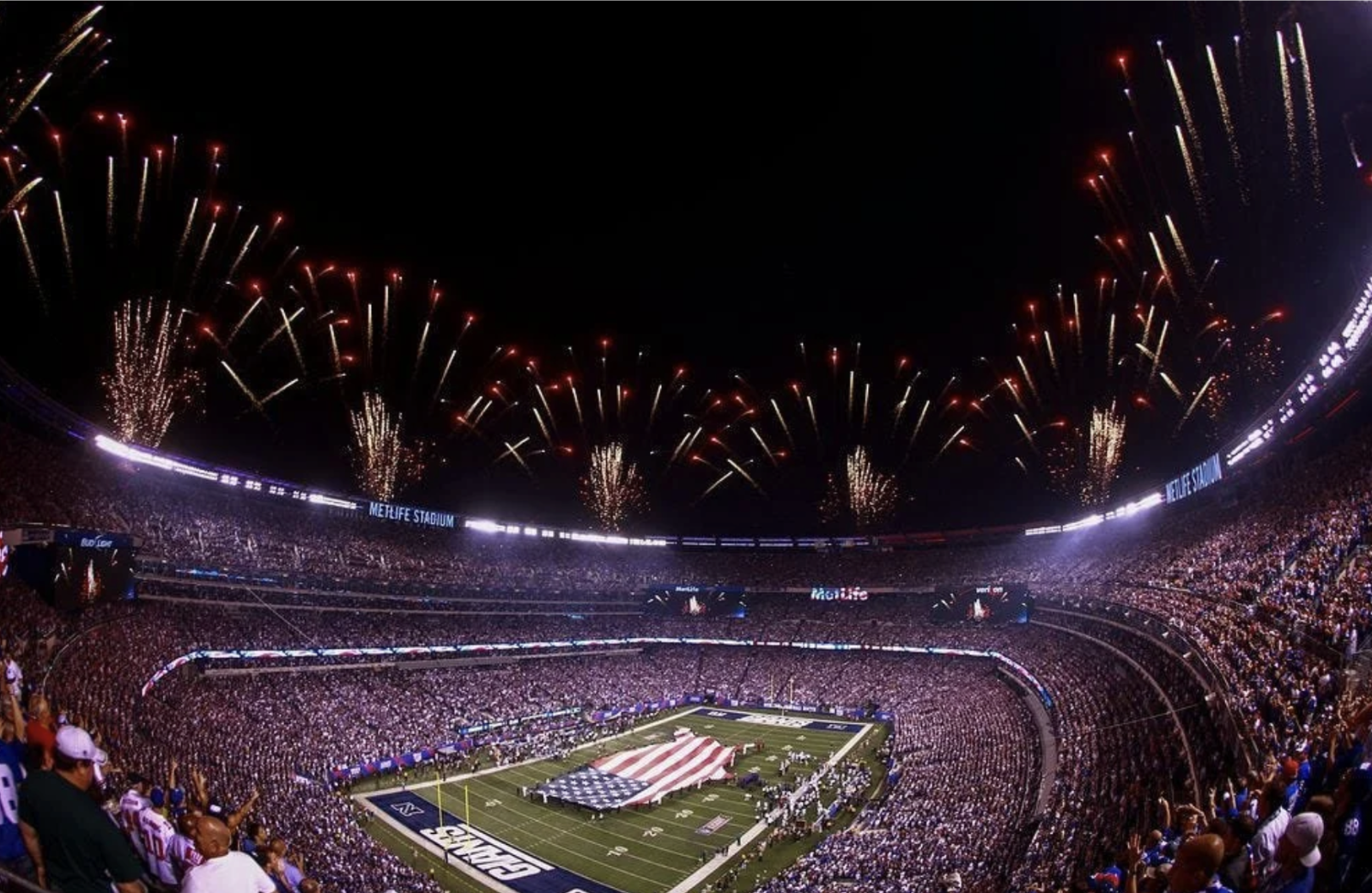
Fireworks at the 2014 Super Bowl opening ceremony, one of America’s most nationally unifying events. Photo courtesy of Google Open Source.
While displays of cultural visibility for racial minorities have entered the American mainstream, the dissonance in social and political attitudes have grown. Though the “you met me at a very Chinese time in my life” trend has been going viral, Asian Americans are still reeling from the racism they experienced throughout the COVID-19 pandemic. Similarly, this past February, Bad Bunny’s Super Bowl halftime show garnered both staunch support from those who considered it to be a prime example of “wokeness,” and resistance from conservatives, who labeled the performance as “anti-American” leftist propaganda. Simultaneously, the mainstream cognizance of this year’s Lunar New Year, with many influencers and people adopting classic Chinese traditions, starkly contrasts with how Americans received a Puerto Rican who sings in Spanish headlining the halftime show. Despite the Super Bowl’s normally unifying role, this year it became a divisive spectacle, drawing attention from progressives who felt the show was the epitome of “woke” and from conservatives who considered the performance a stain on America’s red carpet. As racial minorities receive increasing visibility and surface-level acceptance in popular American culture without corresponding improvements in quality of life, many people of color have become disillusioned with liberal politics, fueling a growing political shift to the right.
The Super Bowl is one of the US’s most patriotic displays: national television, capitalism, American football, and an intensely high-energy halftime performance by a pop star. Played in clubs and cars all across the country, Bad Bunny’s universal fame and fan base certainly qualify him to be the Super Bowl’s chosen one. His halftime performance spotlighted an all-encompassing Latin American culture, which has historically been excluded from the country’s main stage. But between his Latino heritage and continuous outspoken remarks directed against the United States Immigration and Customs Enforcement and the Trump administration, he subsequently became a martyr for the left and a scapegoat for the right.
Conservative American organization Turning Point USA held what it dubbed “The All-American Halftime Show” in protest, attracting 6.1 million YouTube viewers. A uniting tradition of American pride and grandeur was transformed into a polarizing political statement—one that unfortunately distracted from the real issues endured by American people of color. Many saw the halftime performance as the perfect opportunity to show their wokeness: support for the famed singer is perceived by some as equivalent to speaking against the discrimination that immigrants and Latino Americans have undergone. Instead of being appreciated for what it was––a celebration of cultural differences––it inflamed white conservatives who doubled down on culturally homogeneous rhetoric and enabled white liberals to somehow prove their wokeness instead of advocating for tangible benefits for people of color. The show quickly morphed into a cultural distraction, a controversy that overshadowed the political struggles that American people of color have endured.
The origin of “woke” can be traced back as far as a century ago to the 1920s, where it was used in the Black community as a reminder to stay wary of the deeply rooted systematic racism in American society. Today, the term has been taken by leftists to describe the awareness of racial and social justice, but is often weaponized against liberal politicians and advocates. The Democratic party has long been the party of racial politics, pushing progressive leftists to become champions for social equality. In this shift, they have channeled their views into a “woke” movement that has been whitewashed and distorted from its original meaning in the Black community. The modern use of “woke” has completely different connotations from its conception, its gentrification raising the question whether or not its true intention is truly being achieved. This driving political principle of gender, race, and sexuality-based equality has increasingly gotten stale in the eyes of many American people of color who have become restless with the performative nature of the party’s promises: for a party so dedicated to the advancement of racial minorities, it hasn’t given much to these demographics other than advocacy and empty promises.
Culturally, many racial minorities have undergone whiplash in American society, their lifestyles changing from being viewed to strange and alien to cool and trendy in a matter of years. Just five years ago, Asian Americans were enduring all-time highs of hate crime rates. Today, many East Asian cultures are being praised for their zen cultural qualities, with their foods and beliefs going viral on TikTok. This past Lunar New Year, countless non-Asian Americans posted and followed the now globally trending practice of Chinese zodiac signs and other rituals, such as washing your hair on New Year’s Eve. Courtney Cook (@courtneylcook), a white English teacher, uses Korean recipes for her packed school lunches, accruing 3.2 million TikTok followers for her unique and healthy “inventions.” These creators establish a one-way relationship between themselves and the cultures they derive their content from––taking traditions under the guise of open-mindedness for praise and views, but not promoting equity to these communities––embodying cultural appropriation, which occurs when majority groups take an aspect of a minority culture and simplify or adopt it to their own preferences, distorting its original form. Although not always blatant, this internet phenomenon exposes the strain between modern cultural appropriation and appreciation, as creators often do not give proper credit to marginalized communities despite profiting from their traditions.
This cultural stain can be seen in political backlash from people of color who witness this appropriation. In the 2024 election, Trump received approximately 40 percent of the Asian American vote and nearly 50 percent of the Latino vote. Similarly, more young Black voters than older ones are voting Republican, a trend that contradicts the typical pattern of conservative voting behavior increasing with age. For a party that claims to be so aligned with racial equality and justice, the Democratic party has been home to liberal elites who have cherry-picked aspects of racial diversity to integrate into their own lives, without real appreciation for the people they are taking from. As a result, this has instilled bitterness in American people of color of having their heritage stolen in fad-like phases. The social strife is even further exaggerated by Democratic politicians who advocate their commitment to party diversity but ultimately miss the mark on their various socioeconomic promises to minority communities.
Throughout the Obama administration, some Black Americans criticized him for not condemning the injustice of police brutality towards the Black community as aggressively as he should have. Many were left disappointed, believing that the political progression of the Black community as high as the President’s office would pave the way for significant socioeconomic advancement. Instead, his term yielded only marginal improvements for the Black community. The issue of police brutality towards Black Americans came to a head during the Black Lives Matter movement which followed the publicized murders of George Floyd and Breonna Taylor in 2020. This was just three years after America’s first Black president left office without adequately acting against the discrimination in the American justice system.
Certain foundational policies and tenets of the Republican party, like the belief in the American Dream and support of individualistic economic and social values, seemingly resonate with many racial minorities, worsening the rejection of the new era of “woke.” While many newly minted Republicans of color are not necessarily MAGA, they are drawn to the party for the independent and hardworking outlook they have on policy that affects the average American. One such case was the controversy over affirmative action, which drove some Asian Americans to the right. In many Asian countries (and others globally), the idea of hard work and prioritizing self-improvement to achieve a better life is emphasized as a core value, aligning directly with conservative Republican ideals and opposing the liberal idea of equity for all through initiatives such as affirmative action. Despite conservatives historically not making their politics appeal to people of color, they seem to be doing so, regardless.
The rise of conservatism can certainly, in part, be attributed to the movement of American people of color from the left to the right, due to the cultural insensitivity of American liberals, fostering dissatisfaction in racial minorities and pushing them away from the Democratic party. Despite well-meaning intentions behind the woke movement, liberals are not “woke-ing” correctly, inadvertently burning bridges with some of their base voters. The Democratic party needs to develop cultural understanding beyond performativity and fetishization in order to fully adapt and successfully achieve its value of racial equality. More education on distinguishing cultural appropriation from appreciation, as well as media literacy for netizens are needed to tell which aspects of cultural politics are truly important to pay attention to. Whether or not the Democrats will recover depends on a multitude of factors, but if cultural understanding beyond performativity and fetishization can be reached, a centuries-old chasm between white Democrats and the people of color of America may begin to close.
Madeline Lee (BC ‘29) is a staff writer at CPR studying political science. She can be reached at mpl2160@barnard.edu.