Capitalism is the Root of All Evil: Trump’s Purse Strings in the Republican Party
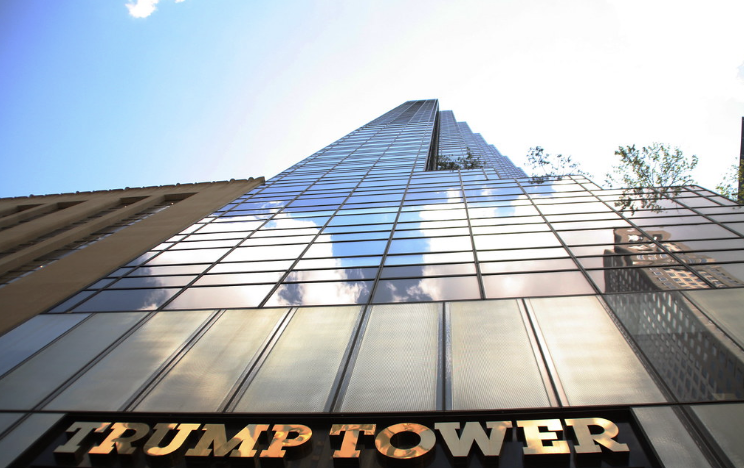
Donald Trump and his family have made almost $4 billion just a year into his presidency. “Trump Tower” Photo courtesy of Brad_T, licensed under CC BY 2.0.
Donald Trump’s seemingly endless power grabs continue to erode the foundation of American democracy, yet no one seems to question him, not even his own party. His policies throughout his second term have grown increasingly dictatorial. Key highlights include his increasing control over mass media, filing lawsuits against coverage opposing him, and more. His administration has also unraveled significant institutions, including the Department of Health and Human Services and the Department of Education. Trump has also pressured non-partisan and independent agencies, such as his recent discord with former Federal Reserve Chair Jerome Powell.
For a self-declared “president of PEACE” who made foreign policy a central part of his re-election campaign, Trump’s actions in Iran show otherwise. What has the Republican Party done in response? Despite the anti-war rhetoric of MAGA, Republican opposition to the war with Iran remains sparse. Instead, party elites, such as the Republican House Speaker Mike Johnson, spoke in support of bombing Iran, noting that Iran is “facing the severe consequences of its evil actions,” and that the Trump administration has attempted diplomacy.
Additionally, in the first few weeks of the new year, Trump and his administration illegally kidnapped former Venezuelan President Nicolas Maduro. Rather than facing any legal consequences, members of the Republican Party defended his actions. Republican Sen. Tom Cotton argued that Trump’s actions are “not the kind of thing that you expect advance notice to Congress for.”
Though Trump’s actions seem to be the antithesis of much Republican ideology, and at times illegal, the Republican Party fails to keep him in check. Why is this so? There is a straightforward answer to this conundrum: Trump’s financial influence.
Trump’s super PAC MAGA Inc. has raised more than $100 million in recent months and now stands at $304 million in total. To put this wealth into perspective, the total money raised for Republican and conservative PACs from 2023 to 2024 amounts to a little over $10 million. Furthermore, Elon Musk, the world’s richest man, has regained favor with the president by donating millions of dollars. Trump himself is also a businessman, amassing a revenue of almost $4 billion only a year into his presidency.
One instance of Trump’s financial influence is the $1.7 million he provided to Republican Matt Van Epps, his preferred candidate for Tennessee’s 7th Congressional District. The New York Times called Epps’s resulting victory a “Trump-Led Rescue Mission.”
This overwhelming financial prowess that Trump holds gives him a disproportionate amount of influence in the Republican Party, even for a sitting president. When a relationship comes with purse strings, it restricts the freedom of the beneficiary.
A year into his second term, we know Trump prizes loyalty above all else. Musk, for instance, was handed his DOGE position after being one of Trump’s biggest campaign donors. Additionally, according to research done by Campaign Legal, Trump favors friends and donors over experts for ambassadorships. His pick for UK ambassador, investment banker Warren Stephens, donated $4 million to Trump’s inauguration. These instances set a precedent of bending the knee to the president in exchange for one’s aspirations.
To Trump, financial loyalty matters, but so does outspoken support. Mike Johnson, or “Maga Mike,” was able to garner enough support and win the speakership through his ardent allegiance to Trump. Before, Johnson was a lesser-known lawmaker, but he loudly supported Trump and tried to help him overturn the 2020 election. Gunner Ramer, the political director for the Republican Accountability Project, said that Johnson’s win “speaks to the total disregard that the Republican party has had and still has for democratic institutions and the rule of law.”
The recent news of Sen. Bill Cassidy’s primary loss further speaks to this. NBC notes that his loss was “ultimately defined by tensions with President Donald Trump.” Cassidy voted to convict Trump on impeachment charges following January 6th, and consequently lost to Trump-backed Rep. Julia Letlow.
While Trump’s decisions are driven by loyalty, his money is the way of enforcing it. If you need something from Trump, as long as you demonstrate undying loyalty, he has the financial might to support you. The opposite holds. If you go against Trump, he also has the financial might to cripple you.
In Origins of Strongmen, political scientists Erica Frantz, Andrea Kendall-Taylor, and Joseph Wright assert that a party built around its leader—a “personalist” party—is more likely to get the majority of its funding from them, thereby giving more leverage to the party leader. Such parties have a weak foundation, with much of their authority hinging on the leader’s charisma.
Along with Trump’s extensive financial influence, the ideological transformation of the Republican Party aligns with Frantz’s definition of a personalist party, with Trump centered as its personalist leader. This path was paved by the populist and nationalist Tea Party, and as Republicans diverged, one faction emerged as an extreme right-wing: MAGA. As a result, party members have increasingly aligned closer to Trump and MAGA values, rather than “traditional” Republican values.
In applying Frantz’s framework, Trump’s personalist party opens the floodgates towards democratic erosion and authoritarianism. A Republican Party elite could stand up to Trump, but with his financial power, Trump could threaten to withhold funding and potentially cripple their political career. Once money is factored into the equation, the fight against Trump’s injustice seems hopeless.
Hence, to check a personalist leader’s power, you must begin by reducing their financial influence.
The Campaign Transparency Act and the Stop the Super PAC-Candidate Coordination Act, co-led by Congresswoman Summer Lee, promise greater transparency as it relates to financial contributions in federal elections. Additionally, Virginia lawmakers introduced a law that fights back against the decisions of Citizens United and other deregulatory court opinions. This bill would establish campaign contribution and expenditure limits for party benefactors.
These bills are still working their way through the courts, but they give us an idea of where to start. Only by cutting Trump’s “purse strings” can the Republican Party regain its ability to check his power.
June Ying Liu (BC ’29) is a staff writer from Hong Kong and New York City, majoring in Political Science and Biology. She can be reached at jl7042@barnard.edu.