Darfur, Again. When Will the UN Learn?
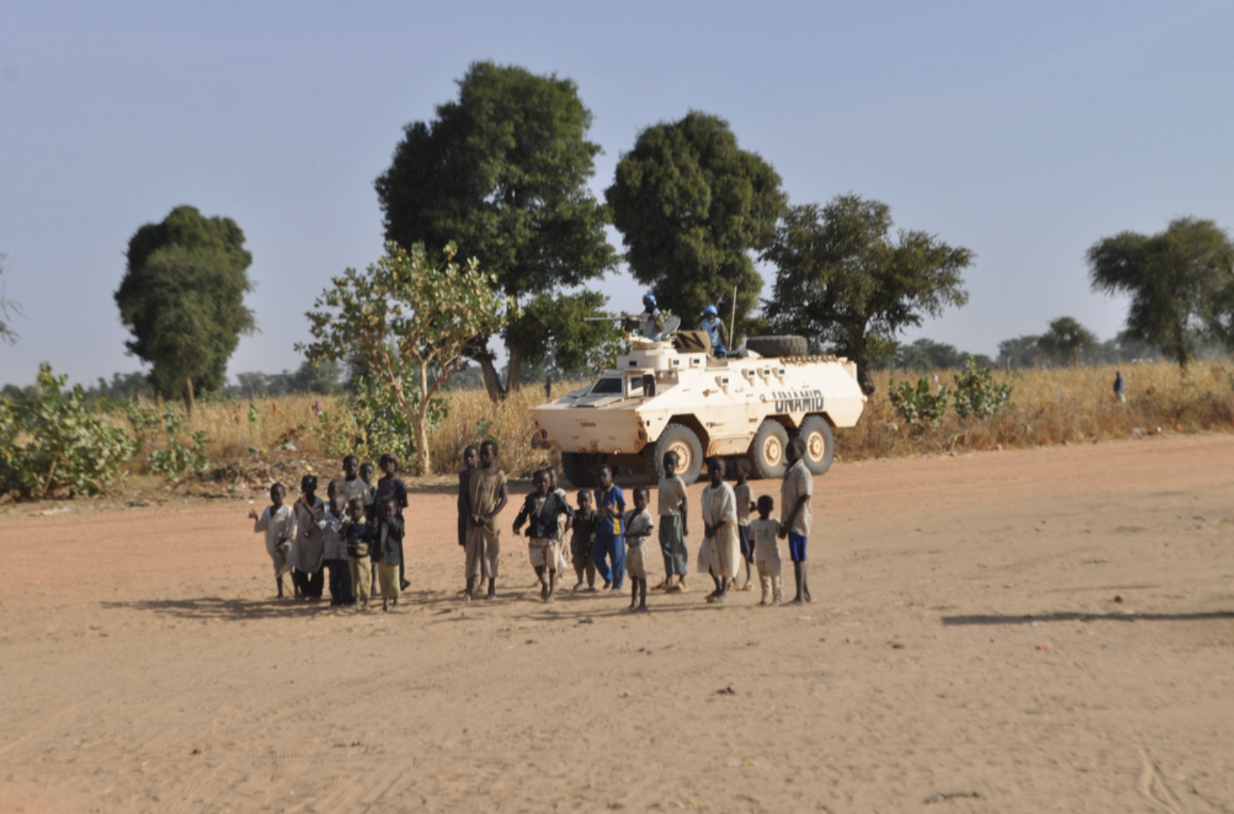
Photo of UNAMID forces with Sudanese children in 2011. Photo courtesy of the Sudan Envoy.
There is a common theory in China-US relations known as the “lost chance.” Scholars argue that if the US had behaved differently in the 1940s, it could have prevented a “loss of China” to communism. Similarly, 2020, the international community lost its chance to prevent the crisis we see in Sudan today. The current genocide in Darfur was not inevitable, nor is it newly emergent; it’s perpetuation is intrinsically tied to the international community’s underfunding of aid, general lack of engagement, and discomfort with sustaining presence of international forces.
A few months ago, a satellite image showing visible blood covering the sands of Sudan went viral. For much of the international community, especially those in the west, this was the first time they had heard about the country Sudan, let alone the crisis unfolding within it. Many people were left with the impression that the human suffering occurring in Darfur is something new. But, Sudan has faced this kind of destruction before, and it happened under the auspices of the international community. In 2004, the US explicitly declared that “genocide has been committed in Darfar.” Once again, on January 7, 2025 the US declared that the RSF forces (a paramilitary group operating in Sudan) had committed genocide.
Currently, Sudan is facing the worst humanitarian crisis in the world. By 2005, more than 2 million people were killed, more than 4 million were displaced, and more than 3.5 million were in need of humanitarian aid. Today, more than 400,000 people have been killed, more than 11 million have been displaced, and more than 33.7 million people are in need of humanitarian aid. In both, cases starvation and rape occurred (and are occurring) on a massive scale. This begs the question: how could the international community let this happen twice?
The world has failed Sudan in many ways—from lack of media coverage to lack of aid deliverance—but when it chose to abandon the country in 2020, it lost its chance to save it from, what many experts now consider to be, irreparable damage to regional political stability.
In 2004, the UN engaged with the African Union to develop its main form of peacekeeping in the Darfur region of Sudan, African Union Mission in Sudan (AMIS). The mission was replaced in 2007 by the United Nations-African Union Mission in Darfur (UNAMID), which was created to serve the same purpose as AMIS but was larger and had greater international involvement. Both missions intended to provide humanitarian aid to Sudan, but failed on account of underfunding, disorganization, lack of involvement by groundtroops, and a desire from observing nations to wrap up involvement in Sudan and reach a quick end to the civil war.
Since then, even as Sudan has been on the UN’s radar, the UN has failed to prevent human suffering. One might attribute AMIS’ failure in the early 2000s to the relative novelty of peacekeeping missions in the post-Cold War period; one cannot say the same for the following decade: the UN was aware of the crisis in Sudan, declared it would do something to prevent it, and failed. In the aftermath, the UN refused to analyze the reasons behind its failure and make necessary changes.
The 2020 peace talks created a key opportunity to help the people of Sudan, when the involved parties approved a peace agreement. This agreement, brokered by the UN and military forces in Sudan, advocated for a government that shared power between civilians and the military. However, this was not supported by the civilian population, who wanted to implement a government that was entirely run by civilians. In this sense, the issue was not the UN engaging in discussion over a potential peace agreement, but the fact that it treated the act of brokering it as sufficient in itself. Simply supporting an agreement without considering its broader reception, outcome, and long term sustainability was a wholly inadequate intervention on the UN’s part.
Afterwards, the UN made its biggest blunder yet: pulling peacekeeping troops out of Sudan and failing to adequately fund any subsequent aid projects. For context, the UN had been slowly pulling its troops out of Sudan due to pressure from the Sudanese military and government leaders, but decided to terminate its presence entirely in 2020. This measure was taken despite warnings from NGOs and civil society that feared the withdrawal would result in slaughter and continued conflict. The UN’s decision to withdraw in 2020 represents a modern “lost chance”—a moment where, despite clear warnings and historical precedent, the international community failed to act in a way that could have prevented catastrophic outcomes.
Many human rights organizations and Sudanese civil society groups feared that the UN withdrawal would leave Sudanese civilians without any hope of assistance. Additionally, they were concerned that this would essentially remove all possible watchdogs from Sudan, allowing the militia to engage in mass murder without facing restraints and consequences. A prime example of personnel vacancy leading to increased conflict occurred in Al Geneina, West Darfur, where, following UNAMID withdrawal, fighting between Arab and Masalit communities erupted and intensified. In the wake of the 2020 agreement, many UNAMID bases that were decreed to be repurposed for civilians, were overtaken by RSF forces. Most importantly, many residents emphasized that they faced increased vulnerability following UNAMID withdrawals.
Despite backlash, UN officials continuously stressed that they were not abandoning Sudan, but their actions spoke louder than their words. If the agreement was meant to serve as a foundation for a functional government—as it was advertised—it required sustained financial and institutional backing to succeed. The peace agreement didn’t even receive funding until 2021, when the military forcibly removed the civilian cabinet from the government. Once funds started flowing, they were extremely meager. This delay is not simply a logistical failure, it reflects a deeper issue with the UN’s approach: presenting a peace agreement as a meaningful solution but failing to provide the material conditions necessary for its implementation.
And humanitarian assistance to Sudan continues to be critically underfunded. The UN has claimed that it would need somewhere between 2.9 billion and six billion dollars to meet the humanitarian needs of Sudan. Despite pledges from multiple nations, Sudan’s aid appeal is only 35% funded. In light of this pattern of underfunding, in 2020 Western nations promised to provide around 600 million dollars in assistance to Sudan, but they failed to meet their pledged amounts. In 2004, the UN’s humanitarian mission met only 40% of funding requirements and, indicating that they lacked the necessary resources to fully support Sudan, the UN went through with the withdrawal. By withdrawing troops while failing to fund humanitarian efforts, the international community removed both the physical and financial mechanisms required to protect Sudanese civilians.
The civil war presents a major recurring issue: the theft and misappropriation of aid by warring factions. At the beginning of the recent April 2023 conflict, more than 13 million dollars worth of food aid was looted by the RSF. As a result, it has been extremely difficult to ensure that the limited aid provided actually reaches citizens. It is precisely because aid delivery is so vulnerable to interception that the withdrawal of peacekeeping troops proved especially catastrophic. In a state where aid already struggles to reach the people who need it, removing personnel responsible for monitoring, securing, and distributing aid does not solve the problem of misappropriation; it guarantees it. Any claim forwarded by the UN that it is aiding Sudan is unsupported if the aid is not actually getting to the hands of the people.
To be clear, aid distribution in active conflict zones is inherently imperfect. Armed groups often intercept resources, and the line between civilians and combatants is often fluid. These complications consistently make it difficult for aid organizations to ensure that assistance reaches only non-combatants. However, this complexity does not undermine the value of aid delivery, it instead underscores the need for international organizations to implement greater oversight and protection for aid workers. Even if some aid is diverted, the presence of peacekeeping forces increases the likelihood that at least a portion reaches civilians caught in the crossfire.
The sequence of events here is critical. Nations declared genocide was occurring in Sudan’s Darfur region in 2004; the UN engaged in a peacekeeping mission that failed miserably to protect the civilian population; instead of changing tactics and attempting to work alongside the civilian population, the UN pulled all its troops in 2020 when pressured by the transitional government of Sudan. Granted, across Sudan and much of Africa, skepticism toward the UN is rooted in a longer history of foreign intervention and colonial domination. As a Western-led institution, the UN is often regarded as advancing external political and economic interests, rather than making the needs of local populations its priority. In this context, both Sudanese officials and civilians have perfectly legitimate reasons to question the presence and intentions of international peacekeeping forces.
However, acknowledging this distrust does not entirely justify the scale or timing of the UN’s withdrawal. In a context where genocide had already been declared and mass atrocities were ongoing, the absence of any meaningful international presence left civilians with fewer mechanisms for safety. Notably, many Sudanese civil society groups expressed concern that troop withdrawal would increase their vulnerability, suggesting that skepticism toward the UN did not equate with a desire for complete disengagement. Moreover, the UN’s decision to withdraw appears less as a careful response to legitimate concerns and more as an effort to reduce financial and political strain on the UN caused by the conflict. Rather than engaging seriously with local populations and adapting its approach, the UN opted for a rapid exit. Had the UN not withdrawn its forces and had it stressed the severity of underfunding earlier, we would not be witness to the destruction being inflicted today.
Although the historical contexts are distinct, applying the “lost chance” lens to Sudan highlights how the failure to act at key moments shapes the trajectory of a crisis. There is a normative lesson to be taken from this. International organizations, who pride themselves on being constructed for the purpose of maintaining and encouraging peace across the world, should avoid making hasty military and peacekeeping decisions to quell the concerns of powerful leaders, especially in places where humanitarian crises are abundant. In order to do this, coverage of such crises should increase, need for funding should be highlighted, and discussion with important figures should be intensive and active, not passive as it has often been in the past. For the sake of civilians, the UN cannot afford to fail once more.
Emma Arsić-Wills is an incoming sophomore at Columbia College. She is pursuing a co major of Political Science and Statistics and planning on minoring in History, with a focus in SouthEast Asia in the 20th century.