Power Cuts and Power Struggles: How Sectarian Politics Fuel Lebanon’s Electricity Crisis
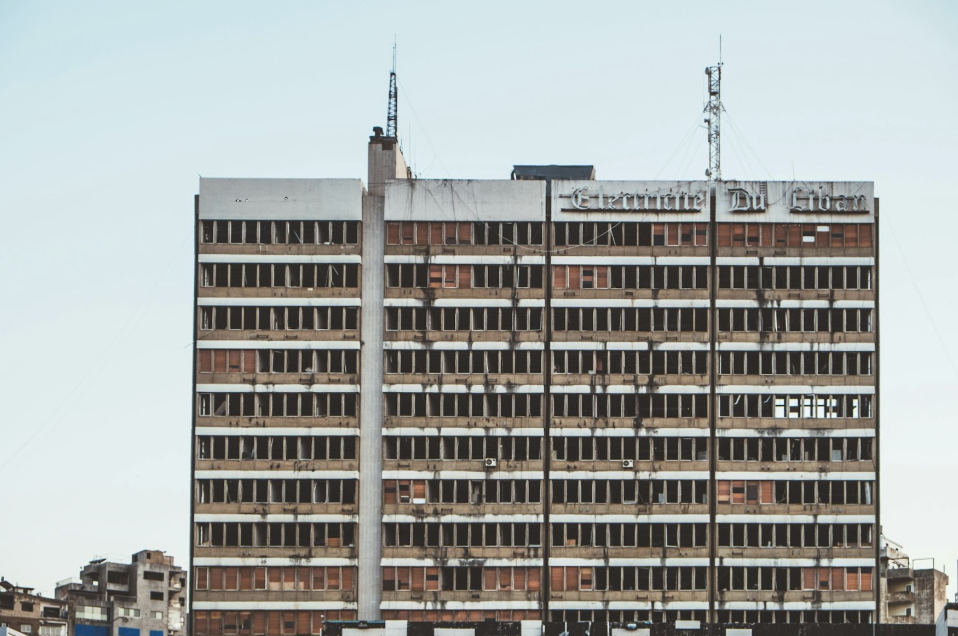
The Électricité du Liban building, damaged in the 2020 Beirut Port explosion, stands as a stark symbol of the collapse of the country’s public institutions, crumbling infrastructure, and inability to provide basic services. Photo by Jo Kassis.
Between November 2021 and January 2022, Électricité du Liban, the public company responsible for provisioning electricity in Lebanon, provided the median household with just two hours of electricity per day. Before the electricity crisis in summer 2021, which prompted widespread power blackouts, households reported receiving an average of 12 hours of electricity per day. The intensification of Lebanon’s electricity crisis has been exacerbated by deeply rooted conflicts between political actors, which have caused the perpetual mismanagement of public institutions responsible for providing power to Lebanese households. Lebanon’s sectarian power-sharing political model amplifies parties’ incentives to control the Ministry of Energy and Water and Électricité du Liban by allocating ministries through elite competition and negotiation, rather than technical skill. Political contestations in the electricity sector limit accountability and independent oversight, enabling persistent mismanagement. In turn, electricity shortages increase reliance on patronage networks and strengthen sectarian parties, creating a self-sustaining cycle that paralyzes the state’s capacity to provide basic services. The electricity crisis and the social divisions in Lebanon therefore reinforce each other, leading to continuing governmental dysfunction. While privatization and partnerships between the public and private sectors in electricity production could be a solution to the electricity crisis, it needs to be implemented under an extensive framework of reforms to avoid the deepening of existing economic and political challenges.
Between 1975 and 1990, Lebanon experienced a civil war between groups divided along sectarian Christian and Muslim lines. In order to end the war, the Taif Agreement, adopted in 1989, created an equal power-sharing structure, organizing cabinet distribution according to a principle of parity between the religious communities. As political parties were themselves organized along sectarian lines, ministerial appointments became in large part the result of negotiations between religious sect leaders. Since the agreement, elite confessional bargaining has caused expertise and merit to become secondary to political and community representation in ministerial positions. Even though technocratically competent ministers are sometimes appointed, the process is dominated by the importance of party affiliation, negotiation, and political actors’ will to control public institutions.
The Civil War destroyed Lebanon’s infrastructure, leaving Électricité du Liban unable to provide electricity to residents for 24 hours per day. Yet, Lebanon’s continuing electricity cuts result from years of mismanagement of the electricity sector. Lebanon has failed to rebuild its electrical infrastructure, repay foreign debts (which led to fuel shortages and the shutdown of power plants), or implement reforms that would unlock donor funds that would have enabled access to renewable energy. Alleged corruption has also contributed to the electricity crisis. For example, in 2020, an investigation discovered that fuel importers associated with the ruling class had bribed civil servants in the Ministry of Energy and Water and government laboratories to sign a secret agreement with what was thought to be Sonatrach, the Algerian national oil company. The company, which turned out to be another company registered under the same name in the British Virgin Islands tax haven, sold faulty oil to Lebanon that damaged its power plants.
A 2023 Human Rights Watch report on Lebanon’s electricity crisis states that “corruption, negligence, [and] mismanagement” are “emblematic of failures of post-war state-building and political confessionalism.” Indeed, in addition to appointing ministers and directors based on party affiliation more than merit, political parties refused for more than two decades to even appoint members to the independent Electricity Regulatory Authority (ERA), created in 2002. The ERA was to be tasked with providing distribution, generation, rates, and licensing for power plants and large solar and wind installations. However, without agreement on the appointment of its members, the Authority was unable to fulfill these duties. The failure of political actors to implement these measures in a timely manner reduces trust in public institutions and makes the risk of continued corruption more prominent. It took until the end of 2025 to appoint members to the authority, though it is now functioning with support from international institutions.
Typically, when the state fails to provide basic services such as electricity to the population, political parties step in. However, in this case, public efforts still have not met the needs of the population, and households have become increasingly reliant on private generators to supply electricity. As a result, political parties have begun to act as intermediaries between the population and the state to provide diesel to generators. Their intermediary role has been especially important during fuel crises, such as the 2021 shortage that put the country in a 24-hour blackout and intensified the insecurity of electricity provision.
The use of these extra-governmental workarounds by political parties has raised concerns that politicians will prioritize improving electrical access for only their own sects to build electoral loyalty rather than help the entire population of the regions they represent. Professor Bassel Salloukh of the Doha Institute for Graduate Studies argues that the political elite has, in fact, created Lebanon’s dependence on private fuel importation by refusing to develop the state’s infrastructure. According to Salloukh, Lebanon’s crumbling renewable energy sector informally privatizes the domestic production of electricity in a way that reinforces clientelism and patronage ties, allows concessions to highly pollutive oil-based generators, and prevents the state from generating revenues from the production.
The collapse of Lebanon’s capacities to provide essential power services to its citizens and its informal replacement by private actors with party ties is self-reinforcing, perpetuating state paralysis, corruption, clientelism, and patronage networks, while further deepening sectarian divisions. The state’s inability to meet its citizens’ needs strengthens communities’ loyalty to their political parties: they become reliant on party-organized private electrical production. Meanwhile, since party affiliation is heavily reliant on religious identity regardless of political efficacy, political elites have little accountability or incentive for performing well when in office. Indeed, these trends not only limit Lebanon’s capacity to provide such services but also propel distrust in the government among the population.
A possible solution to Lebanon’s electricity crisis is the formal privatization and decentralization of electricity production to overcome political obstacles and resource limitations in the public sector, prompting debates about its effectiveness and potential limitations and risks. International economic institutions have encouraged this process. For instance, the International Finance Corporation, a member of the World Bank Group, announced in November 2025 new investments in the Lebanese energy, finance, and manufacturing sectors. The corporation insists on the importance of strengthening the private sector in the country’s economic recovery and encouraging public-private partnerships in the country’s economic recovery. The recent appointment of members to the ERA could indeed allow for the licensing of private electricity producers and distributors, fostering competition and increasing the effectiveness of formerly independent actors along with Électricité du Liban, instead of relying on informal generator businesses. Proponents of privatization point to the successful example of the private utility company Électricité de Zahlé in the Bekaa Valley, which operates during gaps in Électricité du Liban's electricity provision and ensures 24-hour electricity in the region.
However, the potential benefits of privatization rely on effective regulation and governance. Privatization should not simply be viewed as a tool to bypass the necessity for political reform. An extensive regulatory framework promoting transparency, good governance, and regulating procurement practices is required to effectively attract investors and ensure healthy competition. Columbia University economist Joseph Stiglitz warns against the harms of the privatization of infrastructure, highlighting the necessity of a strong regulatory framework to prevent market abuses and avoid further inequality and political unaccountability. He argues that infrastructure production is costly for private actors and that the latter prioritize profit over public interest, risking bigger losses for the government if the business does not end up being economically beneficial. Privatization also reduces democratic accountability and increases unequal access to services, particularly when it is largely unregulated. Moreover, privatization alone doesn’t fundamentally address the deeper structural issues of Lebanon’s crisis, such as social divisions and the mismanagement of public institutions. The electricity crisis is not an isolated failure, but a symptom of a wider state dysfunction, which also manifests itself in different sectors such as access to clean water, healthcare, transportation infrastructure, and security. For privatization and decentralization to be an effective solution to ensure the provision of electricity to the population, it needs to be accompanied by the establishment of regulations for its distribution and by broader reforms to address the state’s limited capacity in different key sectors.
UN Special Rapporteur on extreme poverty and human rights Olivier De Schutter warned in a 2022 report against Lebanon being a “failing state,” calling for efforts to “strengthen the Central Inspection, free the National Anti-Corruption Commission from potential political interference, ensure independent oversight of Électricité du Liban, and ingrain accountability and transparency into the recovery plan.” With the state’s inability to provide minimal services and maintain governing control over the public sector’s activities, damaged infrastructure, and increased corruption, Lebanon’s political context resonates with the concept of a “failed state.” Lebanon ranked 153rd out of 182 countries in Transparency International’s Global Corruption Barometer in 2025, highlighting how the country’s broader governance crisis shapes energy production and shedding light on the urgency of the issue. Solving it requires rethinking the structure of Lebanon’s political scene to prioritize government accountability and institutional performance over elite interests. For this to be possible, Lebanon must build oversight mechanisms to strengthen decisive institutions, ensure the judiciary’s independence to hold officials accountable, and develop and implement a framework and regulations for potential privatization and public-private partnerships opportunities.
Sandrine Sader (Sciences Po ‘26) is an exchange student at Columbia College, studying political science with a focus on Mediterranean and Middle East politics. She aims to pursue a career in international affairs, starting a Dual Master’s degree next year in International Energy Transitions and International Political Economy. She can be reached at ss7597@columbia.edu.