Under the Nuclear Shadow: Proxy Warfare and Escalation Dynamics Between India and Pakistan
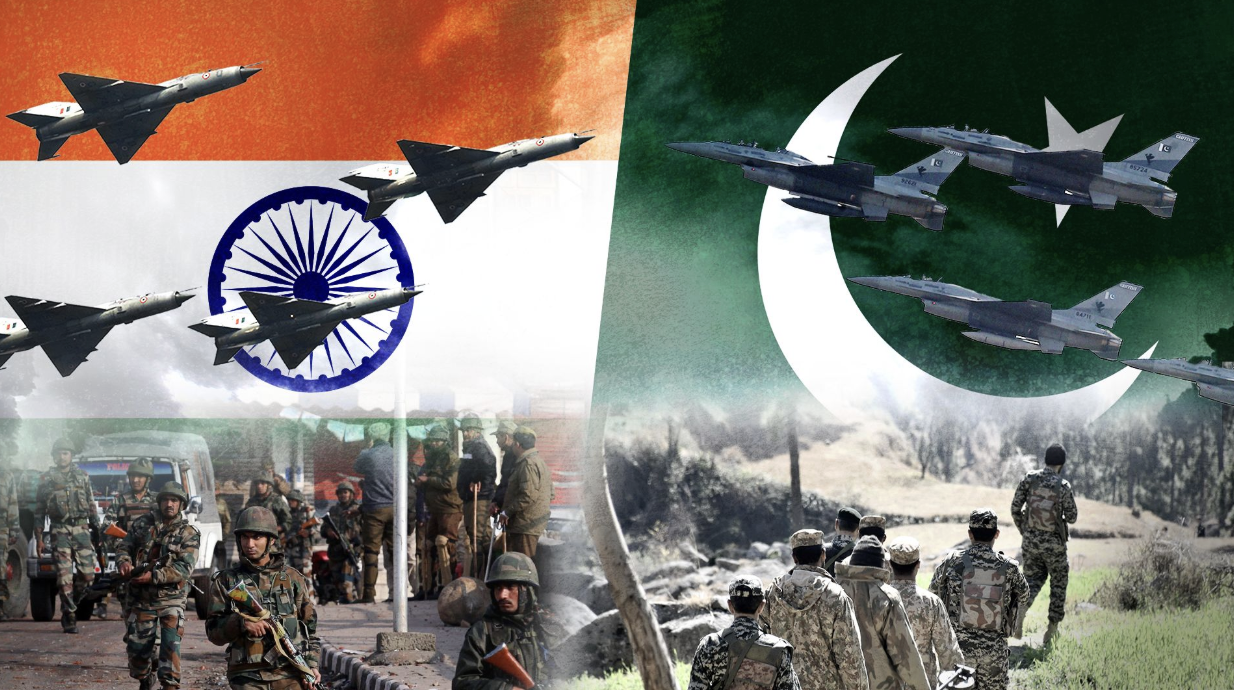
So long as terror proxies acting under the Pakistani state’s nuclear umbrella continue to threaten India’s sovereignty and territorial integrity, future conflict is inevitable. Photo courtesy of CNN.
Following the events of Operation Sindoor—India’s May 2025 missile strikes on terror infrastructure in Pakistan and Pakistan-occupied Kashmir—Prime Minister Narendra Modi gave a televised national address in which he identified three key pillars of a “new normal” for India-Pakistan relations: First, any act of terror perpetrated against India will be met with a fitting response; second, India will not tolerate “nuclear blackmail” or cower in the face of Pakistan’s “nuclear saber-rattling” (i.e., threats of nuclear escalation); third, India will no longer differentiate between terrorists and the states that sponsor them.
These declarations mark a significant shift in South Asian nuclear dynamics. For decades, the “stability-instability paradox”—where nuclear weapons prevented all-out war while simultaneously emboldening Pakistan to prosecute low-intensity conflict through terrorist proxies—has defined escalation dynamics between India and Pakistan. Prime Minister Modi’s proclamation suggests that India is no longer willing to accept this arrangement. However, the prospects for peace and stability under this “new normal” remain uncertain.
The Modi Doctrine Takes Shape
The articulation of this “new normal” can be considered a natural evolution of India’s military posture toward Pakistan, particularly in light of its response to the 2016 Uri attack, where Jaish-e-Mohammed militants killed nineteen Indian soldiers. Ten days after the incident, India crossed the Line of Control and launched surgical strikes targeting terrorist training camps in Pakistan-occupied Kashmir. Official statements following the attack emphasized India’s desire to maintain “peace and tranquility” and its lack of intent to escalate matters further. According to Karthika Sasikumar, the statements signaled that cross-border terrorism would be punished while reassuring Pakistan that India did not wish to incite nuclear escalation.
A similar sequence occurred in 2019, when a suicide bomber killed 40 security personnel in Pulwama. India responded by conducting air strikes on Jaish-e-Mohammed camps in Balakot, crossing the international boundary for the first time since 1971. Pakistan retaliated with its own air strikes and even captured an Indian pilot before tensions eventually calmed. The most recent escalation came in April 2025, when terrorists from The Resistance Front—an offshoot of the terror group, Lashkar-e-Taiba—murdered 26 civilians in Pahalgam, explicitly targeting them for their Hindu faith. In response, India struck nine terror-infrastructure sites across Pakistan and Pakistan-occupied Kashmir. Though the Indian government characterized the retaliation as “measured, non-escalatory, proportionate, and responsible,” Pakistan construed it as the opening salvo in a new conflict and responded with missile strikes on Indian military bases. After four days of attacks and reprisals, a ceasefire was declared on May 10.
It is worth re-emphasizing that the Modi government’s responses to each of these terrorism incidents signal a marked departure from the status quo ante in regard to Pakistani provocations, where the prospect of nuclear escalation heavily circumscribed, if not precluded, an Indian response. As Pranab Dal Samantha observed, based on interviews he conducted with senior government officials after the 2008 Mumbai terror attacks, “the unpredictability on the Pakistan side and the fear that its decision makers could opt for a disproportionate response, including the nuclear option, stymied any possible chance of military action.” In contrast, the current dispensation has sought to shift from inaction to firm but carefully calibrated action.
Pakistan’s Nuclear-Backed Terror Strategy
That Pakistan deliberately employs nuclear weapons as cover for cross-border terrorism is not simply speculation but an openly articulated strategy. In an essay published in 2008, Pakistani Major-General Shaukat Iqbal explicitly “recommend[ed]” that the army employ its intelligence agencies to “train, prepare and organize the ‘guerillas in combat units to fight a guerrilla warfare’ to bleed the enemy forces and disrupt its supply line.” He suggested these guerrillas can be drawn from Mujahideens—non-state actors cultivated to fight Soviet forces in Afghanistan. Most importantly, he contended that this strategy “requires retention of credible nuclear deterrence throughout.”
Iqbal’s vision has been realized many times over, perhaps most notably in 2016, 2019, and 2025. His words reveal a clear intent to weaponize non-state actors to fulfill the strategic ambitions of the state, as well as the indispensability of hiding behind a nuclear shield while prosecuting cross-border attacks. Indeed, in 2016, Pakistan’s defence minister Khawaja Asif threatened to deploy nuclear weapons against India if it retaliated for the attack on its army camp in Uri. “We have not made an atomic device to display in a showcase. If such a situation arises, we will use it and eliminate India,” said Asif in a televised interview. Of course, India did conduct surgical strikes despite Asif’s threat and presented evidence of the involvement of terrorists from Pakistan-occupied Kashmir in the Uri attack, which the Pakistani government dismissed out of hand. India’s willingness to respond, however, does not negate the “nuclear cover” the Pakistani state sought to provide to terror groups. It is also worth mentioning that particularly damning evidence of the Pakistani government’s close association with terror groups emerged during last year’s conflict, when a photo circulated of Pakistani soldiers in attendance at a funeral for terrorists killed during Operation Sindoor. The individual leading the procession was Hafiz Abdul Rauf, a Lashkar-e-Taiba commander.
Many notable scholars have also corroborated the existence of a state-terror nexus in Pakistan, as well as the “emboldening” effect of nuclear weapons on their strategic calculus. Manpreet Sethi notes that “it is a rather unique feature of Southern Asia that one nuclear-armed country [Pakistan] resorts to the use of cross-border terrorism against another nuclear-armed State [India].” She observes that Pakistan has “used the weapon of ‘jihad’ to continually mount low-intensity conflict against India through terrorist organizations that it nurtures and sustains as its proxies” and that its possession of nuclear weapons has “further emboldened it” by shielding the country from a major Indian response. Similarly, Christine Fair asserts that “Pakistan, from the beginning of its existence, has created, nurtured, supported, trained, financed, and deployed Islamist proxies.”
Additionally, in an interview with Sky News in April last year, Khawaja Asif admitted to the existence of such a nexus when he spoke of the “dirty work” his country had facilitated for the last three decades. Further, a statement released by the Financial Action Task Force—an international organization that monitors terrorist financing—acknowledged that the Pahalgam attack could not have transpired without terrorist financing, which, given the scale and sophistication of Pakistan’s proxy network, could only have been state-sanctioned.
Deterrence in an Age of Unchecked Power
India’s “new normal,” as articulated by the Prime Minister, is a welcome change for the country to the extent that it substantially raises the cost of any effort to undermine its sovereignty and territorial integrity. Yet, the risk of nuclear escalation still looms large and cannot be taken for granted as a benign threat. As Vipin Narang notes, Pakistan’s nuclear threshold is deliberately unspecified, making it impossible to tell when it might be considered breached.
Domestic political developments in Pakistan are also cause for concern. In November 2025, the Pakistani parliament ratified the 27th amendment to the constitution, elevating Field Marshal (FM) Asim Munir, the country’s Chief of Army Staff, to the position of Chief of Defence Force. Under this new mantle, FM Munir will be in full command over the Strategic Plans Division—the entity responsible for Pakistan’s nuclear stockpile. The amendment also grants him lifetime immunity from legal prosecution.
The virtually unchecked power conferred on FM Munir is particularly disconcerting given his belligerent and divisive rhetoric. Four days before the Pahalgam attack, FM Munir delivered a blistering speech reiterating the “two-nation theory,” which posits that Hindus and Muslims are two separate nations and therefore cannot coexist—the ideological basis for Pakistan’s founding. In August, while on a visit to the United States, he delivered another speech in which he declared, “We are a nuclear nation. If we are going down, we will take half the world down with us.”
In light of such rhetoric and FM Munir’s newfound constitutionally protected power, the prospect of another Pakistani attack against India—whether prosecuted by the state itself or one of its many proxies—is simply a matter of time. Further, the explicit ideological animus harbored by FM Munir against India does not bode well for the continued efficacy of nuclear deterrence in preventing dramatic escalation if another conflict were to break out.
The limitations of nuclear deterrence as a bedrock for preventing major conflict are discussed by Jeffrey W. Knopf in his paper, “The Inherent Unpredictability of Nuclear Deterrence.” When viewed in the context of Pakistan’s asymmetric first-use nuclear posture and the bellicosity of its new Chief of Defence Force, the central argument put forth by Knopf—that the efficacy of nuclear deterrence is an uncertainty as opposed to a risk that can be reliably calculated upon—suggests that the notion of “nuclear stability” in South Asia is becoming increasingly tenuous. In other words, to borrow a phrase from S. Paul Kapur, the future of the region may very well see the stability-instability paradox mutate into the “instability-instability” paradox, if it has not done so already. With over a quarter of the world’s population living in South Asia, the consequences of such a devolution would be nothing short of catastrophic.
Vyas Nageswaran is a fourth-year student at Middlebury College, with a major in economics and double minor in political science and South Asian studies. He can be reached at vnageswaran@middlebury.edu.