Short-Term Integration for Long-Term Resilience
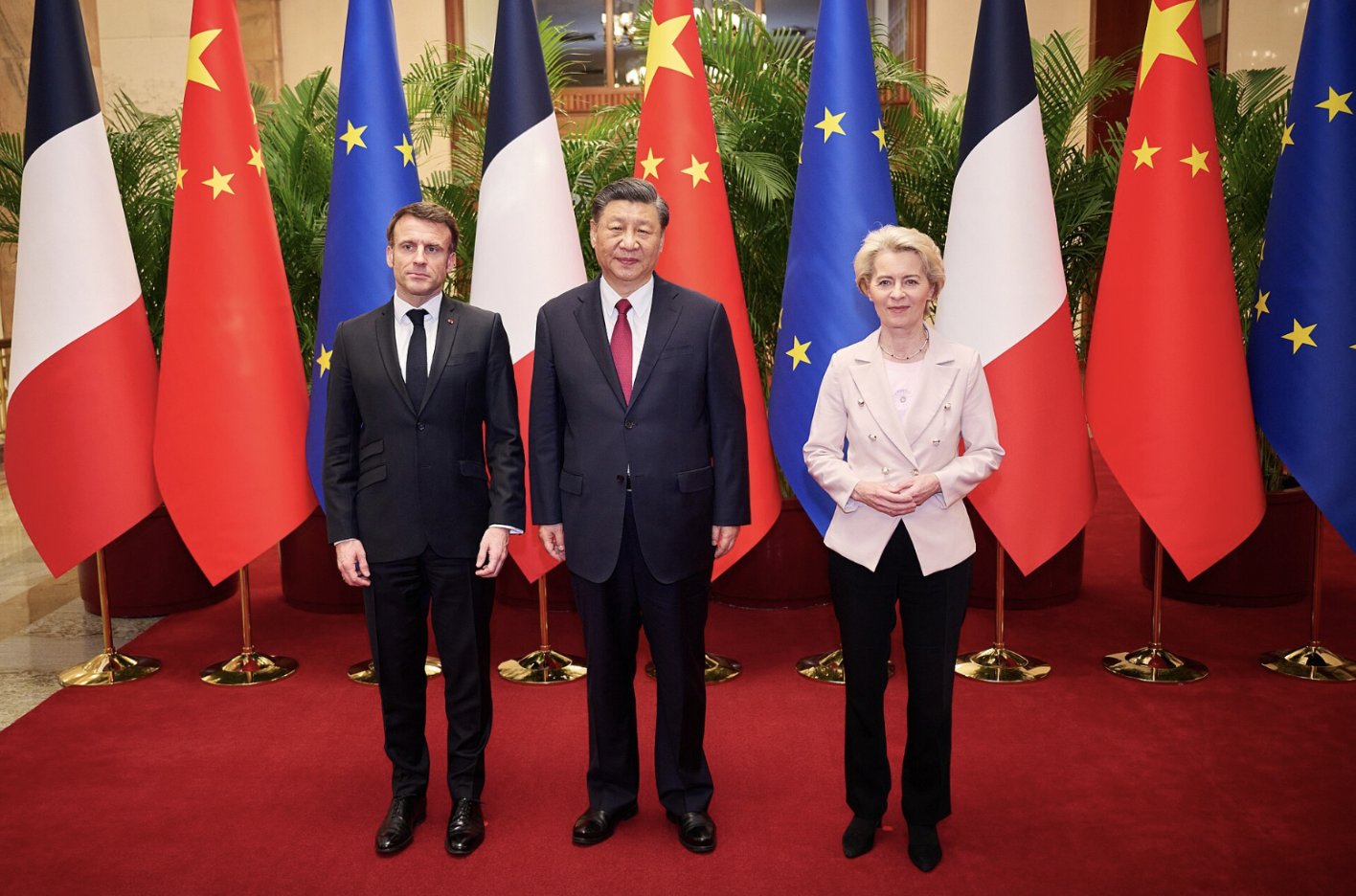
Visit of Ursula von der Leyen, President of the European Commission, to China. Photo courtesy of Dati Bendo.
According to the European Commission’s Annual State of the Energy Union report, the European Union (EU) will need to achieve a 3.6% annual cut in greenhouse gas emissions to realize the 55% reduction from 1990 levels benchmarked under the Fit for 55 initiative. With emissions decreasing at 2.5% annually as of 2025, the EU would need to accelerate its decarbonization pace by roughly 44% to stay on track. Amidst these pressing demands, the EU navigates a triumvirate of challenges: Russia’s invasion of Ukraine continues to disrupt regional supply chains, aggressive tariffs by the Trump administration threaten to upend market stability, and stagnating growth continues to hinder Europe’s long-term financial security. At the same time, China has surpassed expectations in renewable energy development, successfully transitioning domestic green technology growth from subsidy-reliant to market-driven and achieving emission cuts unprecedented for a middle-income nation. Given its dominance over the global renewable technology market, economic coordination with China will be an unquestionable factor in Europe’s efforts to achieve the climate targets set out in the 2015 Paris Agreement. To meet its climate targets, the EU must pursue a dual strategy: short-term coordination with China to secure supply chains and long-term investment in domestic capacity building.
The most prominent avenue by which collaboration with China will make or break Europe’s ambitions for green development is the energy sector. China’s low-cost material components for clean technologies are critical to the European Union’s efforts at building energy security. Currently, Beijing accounts for 70% of the global rare earth minerals supply, while the EU relies entirely on imports. These materials are critical to the construction of renewable energy infrastructure, but experts predict that developing its own refinement facilities would take the European Union a decade at the earliest. Securing bilateral agreements in the short term is a much more practical way to stay on track with the 2050 deadline. Moreover, globally low manufacturing costs for renewable energy technologies are driven entirely by China’s industrial sector, which over the past decade has cut solar costs by 85% and battery costs by 87% through targeted innovation and investment. Attempting to implement the green transition without Chinese exports would immediately drive up these costs, rendering today’s pace of decarbonization infeasible. If the EU cannot reconstruct China’s green industrial sector from the ground up, it must instead coordinate with China to secure critical component supply chains for developing import-resilient clean energy systems.
There exist legitimate fears that deepened trade integration with China may “exacerbate the EU’s dependence” and “impede” development in a region already heavily reliant on imported energy. Concerns over excessive import dependence are especially salient in the context of the Russian invasion of Ukraine, during which Europe suffered major supply shocks after Russia cut key gas pipelines in an attempt to coerce political support. However, the key difference between gas and green technology is that the latter develops local energy capacity that can sustain itself without the continuous flow of imports. Indeed, according to analysis from the Heinrich Boll Foundation, “the domestic value-add from clean energy technologies is around three times as large as the value of the imports. It lies not in manufacturing technologies but rather in their deployment, integration, grid services, and system innovation—areas where Europe has unique expertise.”
Short-term reliance on Chinese manufacturing will not hinder Europe’s ambitions for energy independence. Rather, Europe can ‘have its cake and eat it, too’ by leveraging Chinese imports to facilitate its green energy transition while also driving economic development through regional infrastructure and capacity building. Policies like the Net-Zero Industry Act are excellent examples of how European leadership can balance fostering a competitive and self-sustaining renewable sector with reaping the benefits of China’s green technology innovation: the legislation outlines comprehensive guidelines for member states to collaborate bilaterally with China on short-term energy goals while building the foundations for long-term domestic manufacturing.
Joint ventures with Chinese clean technology firms that promote localized development, coupled with intergovernmental coordination to establish common sectoral regulations, could build long-term competitiveness in Europe’s green manufacturing sector. These actions work in tandem to drive domestic productivity and nurture innovation. Regulatory coordination—the development of standard rules on product specifications, quality standards, and operational efficiency—creates an optimal environment for healthy competition. Establishing uniform trade policies nullifies the need for duplicate testing and certification processes across participating countries, streamlining market access and reducing export costs that would otherwise be offset by consumers. Thus, implementing common regulations between Europe and China on clean technology would improve the ability of European solar energy, wind energy, and battery manufacturers, especially small- and medium-sized enterprises, to sell to the Chinese market, given the steeper barriers to entry they face due to limited capital. Scaling up sales to Chinese buyers would, in turn, drive European firms to increase their supply to meet overseas demand, reducing per-unit production costs. Increasing European competitiveness in this area would directly address anxieties about the asymmetric market access European firms experience with Chinese competitors.
Ensuring products are interoperable is also an achievement of regulatory diplomacy. For example, common global product specifications for freight containers established by the International Organization for Standardization allow them to fit into trains, trucks, and shipping vessels in nearly any country without requiring additional infrastructure adjustments, making them cheaper to use and accommodate. Improved interoperability rules could benefit the EU by improving the implementation of Chinese tech in domestic grid management. Smart grids, for instance, are energy transportation networks that optimize electricity distribution and decentralize power plants, minimizing electricity overloads and wasteful fossil fuel expenditure. European climate planning incorporates the development of smart grid technology into long-term decarbonization strategies, but incompatibilities between local infrastructure and the imported components from China used to construct the grids stall their adoption. Regulatory coordination to facilitate interoperability, in combination with best practices from Chinese manufacturers on extending smart grid reach across rural areas with unique geographical challenges, could significantly streamline this process. Similar challenges are also faced in battery swapping for heavy-duty electric trucks. Moreover, common regulations that level the playing field between domestic firms and Chinese exporters force stagnant European manufacturers to innovate. Automotive manufacturers, for instance, are often accused of lagging behind their Chinese counterparts because they rely on Europe’s anti-subsidy tariffs to keep them afloat. Increasing market access for competitors clears similar protection-induced market distortions and allows sectors with underlying competitive advantages to emerge, which the European Union can nurture with strategic investments rather than spreading resources across inefficient production.
Whereas regulatory coordination works to indirectly ease the burden of the green transition on European firms, joint ventures with Chinese investors in the clean industrial sector can provide firms with the critical skill transfers and funding needed to catalyze regional renewable-sector development. These partnerships involve Chinese companies that invest in local manufacturers to produce both material components and finalized technology, decreasing the exporters’ costs by circumventing trade duties on goods manufactured overseas. While this form of investment might appear at face value to disproportionately benefit Chinese exporters over the domestic industry, it can also serve as a lucrative mechanism for regional economic growth. If member states can rally behind uniform business standards that enforce the inclusion of local firms and human capital at each stage of production, European companies can receive training, high-value jobs, technology, and operational efficiency strategies that would fast-track green development. The added value from the resulting sectoral infrastructure development and strengthening of local supply chains would lay critical foundations for long-term clean industrial expansion. In addition, the enhancement of firm productivity achieved through knowledge transfers could further boost European competitiveness, as could the increased pressure on local competitors to innovate.
Though deepened trade with China is by no means a risk-free endeavor, it will behoove Europe to find opportunities in its inevitable dependence on Chinese exports and capital in meeting its climate goals. Such collaboration comes at a critical time: as of 2025, a sizable, America-shaped hole has opened up in the landscape of international climate diplomacy. By taking concrete steps to facilitate mutually beneficial trade integration, Europe and China can preserve the momentum of global climate coordination, preventing other nations from following America’s footsteps. Beyond this, increased renewable-sector independence could have positive spillover effects on other aspects of international diplomacy: China might be more hesitant to assist Moscow if its pocketbook is intertwined with Europe’s. With so much at stake, it is imperative that the European Commission make every effort to negotiate productively.
Tazia Mohammad (CC ‘27) is a junior studying Economics and Political Science.