
The Hollow Center
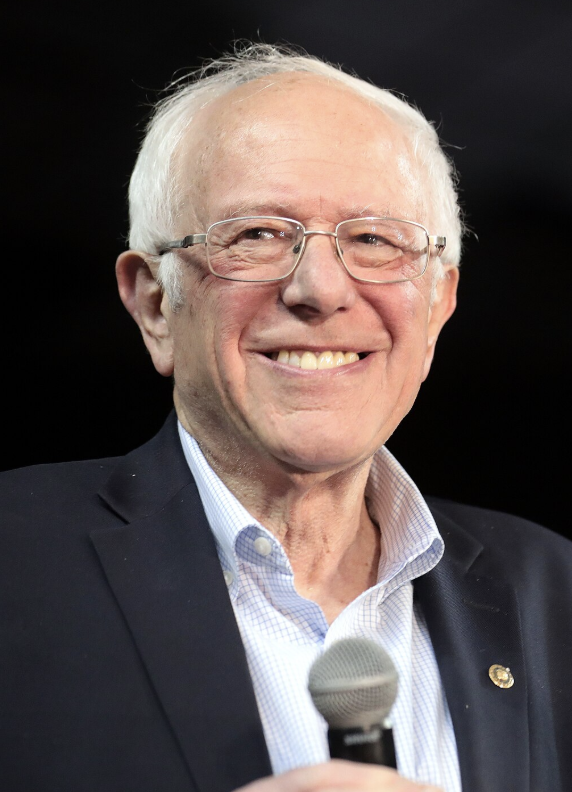
Although he’s an independent, Senator Bernie Sanders is one of the most prominent progressive influences on the Democratic Party. Photo courtesy of Gage Skidmore.
As Trump’s second administration continues to cross line after constitutional line, and the president himself has abandoned any pretense of bipartisanship, the United States stands at a crossroads. To prevent democratic backsliding, the public must fight to preserve individual freedoms and equal rights. For many, the Democratic Party appears to be the only major party committed to defending liberty, albeit imperfectly. However, the Democratic Party is on the precipice of shifting away from those values, leaving the people without a mainstream party standing against authoritarianism and conservatism.
In 2016, the Democratic Party faced a similar dilemma as it tried to decide its future. The party was torn between established centrist leaders and an emerging progressive wing as it entered the primary election. The leading candidates–Hillary Clinton and Bernie Sanders–embodied this divide: one of the most well-known Democrats against an independent who had amassed significant support through grassroots efforts. Although he eventually lost, Sanders attained unexpected success. He had shocking upsets in states like New Hampshire, where he unexpectedly led with 59.9% to Clinton’s 38.5%, and Michigan, where he won a close race by only 1.5%.
Soon after the primaries, the Democratic National Committee (DNC) faced a massive email leak. While the DNC was supposed to remain neutral, the emails revealed that many party leaders had made derogatory comments about Sanders and even discussed ways to weaken his campaign. Congresswoman and DNC chair Debbie Wasserman Schultz—who resigned shortly after to join the Clinton campaign—called Sanders “scummy,” and DNC national press secretary Mark Pautenbach suggested pushing a narrative that “his campaign was a mess.”
Most of the emails were sent after Clinton won the primaries, but the controversy made it clear that the Democratic Party’s leadership was not interested in a shift to the left. Although Sanders proved popular among young voters and the party’s more progressive wing, party leaders discounted this, fearing he was too leftist. Sanders himself called the leak “outrageous,” but he wasn’t shocked—this was neither the first nor the last time the Democratic establishment would decide against change.
Despite his 2016 loss, Sanders ran again in the 2020 primaries. Once more, his ability to mobilize support was unparalleled. By January, he had amassed more funding than any other Democratic candidate, having received over four million individual donations in the shortest time in history. For a brief period, he was even the frontrunner. Yet Sanders eventually lost to another former member of Obama’s cabinet, President Joe Biden. Then, in 2024, Sanders declined to challenge Biden in hopes of uniting the party before a tough general election, even endorsing Biden outright and urging other progressive candidates to stay out of the race as well. Despite this, Biden’s popularity continued to plummet; after a disastrous debate and pressure from his Democratic colleagues, he dropped out and endorsed Vice President Kamala Harris. And although Sanders was more hesitant and worried that her policies wouldn’t be bold enough, he would eventually endorse her as well. He warned, however, that in order to win she would need to “focus a great deal of attention on the plight of the American working class.”
Unfortunately for the Democratic Party, Sanders was sidelined once again. In her prior presidential run in 2020, Harris had endorsed progressive policies such as felon enfranchisement, increased gun control, and the elimination of private health care corporations. In 2024, however, she walked back many of these positions to stay in line with the more moderate policies of the Biden administration. For instance, she shifted her position on fracking from supporting a total ban to echoing the position of the Biden campaign—that the government does not “have to ban fracking” to pursue clean energy. Trump’s campaign wasted no time in calling Harris out; she responded by claiming mischaracterization. Still, the ideological shift was real.
On the other hand, the Trump campaign entered the 2024 election appealing more strongly than ever to dissatisfaction with the economic and political status quo. Neither Trump’s conviction for 34 felonies nor his widely disproven claims about fraud in the 2020 election prevented him from capitalizing on the perceived ineffectiveness of the Biden administration and the supposed erosion of American values of nationalism and individualism. Perhaps the primary promise of his campaign was that of a new wave of “Trump tax cuts–the biggest in the history of our country.”
When the smoke cleared, Trump swept seven swing states and won back the presidency. Republicans also captured the Senate and retained control of the House. Compared to the 2020 election, the results were staggeringly conservative, as over 90% of U.S. counties shifted towards Trump.
Some Democrats blamed the Harris campaign for committing to the status quo rather than progress. As Sanders put it, the “Democratic Party… abandoned working class people,” and the working class seemingly caught on. Others, however, argued that Harris’s campaign had not distanced itself enough from progressive—or leftist—ideals. Congressman Richie Torres blamed the loss on the progressive wing of the Democratic Party, claiming that “Donald Trump has no greater friend than the far left.” This sentiment was echoed by many think tanks and organizations, and issues such as transgender rights came under fire for being too far left for potential voters.
The rise of this centrist push is reflected in the history of the Searchlight Institute. Founded in mid-2025, the think tank aims to persuade the Democratic Party to adopt what it claims are broadly popular positions, hoping to lay a foundation for the 2028 election and appeal to voters who were supposedly put off by progressive ideals in 2024. Searchlight blames Harris’s failure not on her abandonment of progressive stances on issues like climate change and LGBTQ rights, but on the party values that pushed her to take those positions in the first place. Altogether, Adam Jentleson, the founder of the institute, aims to counter the “far-left” positions that hurt Democrat candidates in general elections.
Yet looking at recent electoral history, it would seem that Sanders was right. Zohran Mamdani’s mayoral campaign in New York shocked Democratic elites and, following in the footsteps of Sanders, overturned beliefs about whether leftist policies and values can resonate with a wider American audience. He engaged younger voters with unprecedented success for a Democrat—a demographic that shifted toward Trump in 2024—and defeated former Governor Andrew Cuomo, an establishment Democrat. Likewise, Anililia Mejia, a labor organizer who served as Sanders’ national policy director in 2020, recently won the congressional primary to replace Governor Mike Sherrill. Her campaign took a firm stance against ICE and corporate funding, and she ended up narrowly defeating former Congressman Tom Malinowski, in what was a surprise victory to many.
Alexandria Ocasio-Cortez (AOC), another notable member of the party’s left-wing faction, exemplifies not just the effectiveness of progressive campaigning, but policymaking as well. A self-proclaimed democratic socialist, AOC became the youngest woman elected to Congress after winning a major primary upset. An emphatic social democrat, many of her policies center around workers rights and she is often characterized as far-left, even by her Democratic colleagues. Yet rather than alienate voters, her tenure has seen her rise as one of the most popular American politicians. With a positivity rating of 46% compared to a negativity rating of 44%, she was one of only three American political leaders that had a positive public image in 2025—ahead of Harris, Biden, and Trump.
The success of politicians like Mamdani and AOC has only exposed the Democratic Party’s misperception of what its base is looking for. Harris’s attempt to appeal to centrist voters by avoiding radical breaks from Republican policy proposals failed to swing voters toward her or away from Trump. Instead, it helped create a widespread sentiment, especially among young voters, that both parties are out of touch and not behaving in the interest of the people.
The Democrats clearly need to reconsider their direction. The failure of 2024 illuminated the party’s internal divides and questionable commitments. Many within the party are trying to portray progressivism as a hindrance to the party’s success. Jentleson blames “college-educated elites” and “race and group-based identity politics,” arguing they are out of touch with voters. However, what has proven to be effective for getting Democrats elected is not centrism, but commitment to progressive ideals, especially on economic issues that affect people across demographic lines. It’s true that Democrats are out of touch—but what is truly limiting the party is its failure to address people’s material needs.
When Harris reversed course on her earlier views, many voters didn’t see it as proof that she had been out of touch originally, but rather that she was willing to abandon the interests she had claimed to champion in order to appeal to a wider audience. If Democrats want to win back America, they have to stop seeing progress as a liability and start truly fighting for the people they represent. As Sanders said during his recent “Fighting Oligarchy” tour: “If we stand together as one people… there is nothing that we cannot do.”
Oscar Uhalde (CC ‘28) is an editor for CPR and a sophomore in Columbia College, majoring in sociology and political science. He is most interested in learning and writing about how social movements form around collective identity – especially today.