There’s No Narco in Trump’s ‘Narco-Terrorism’
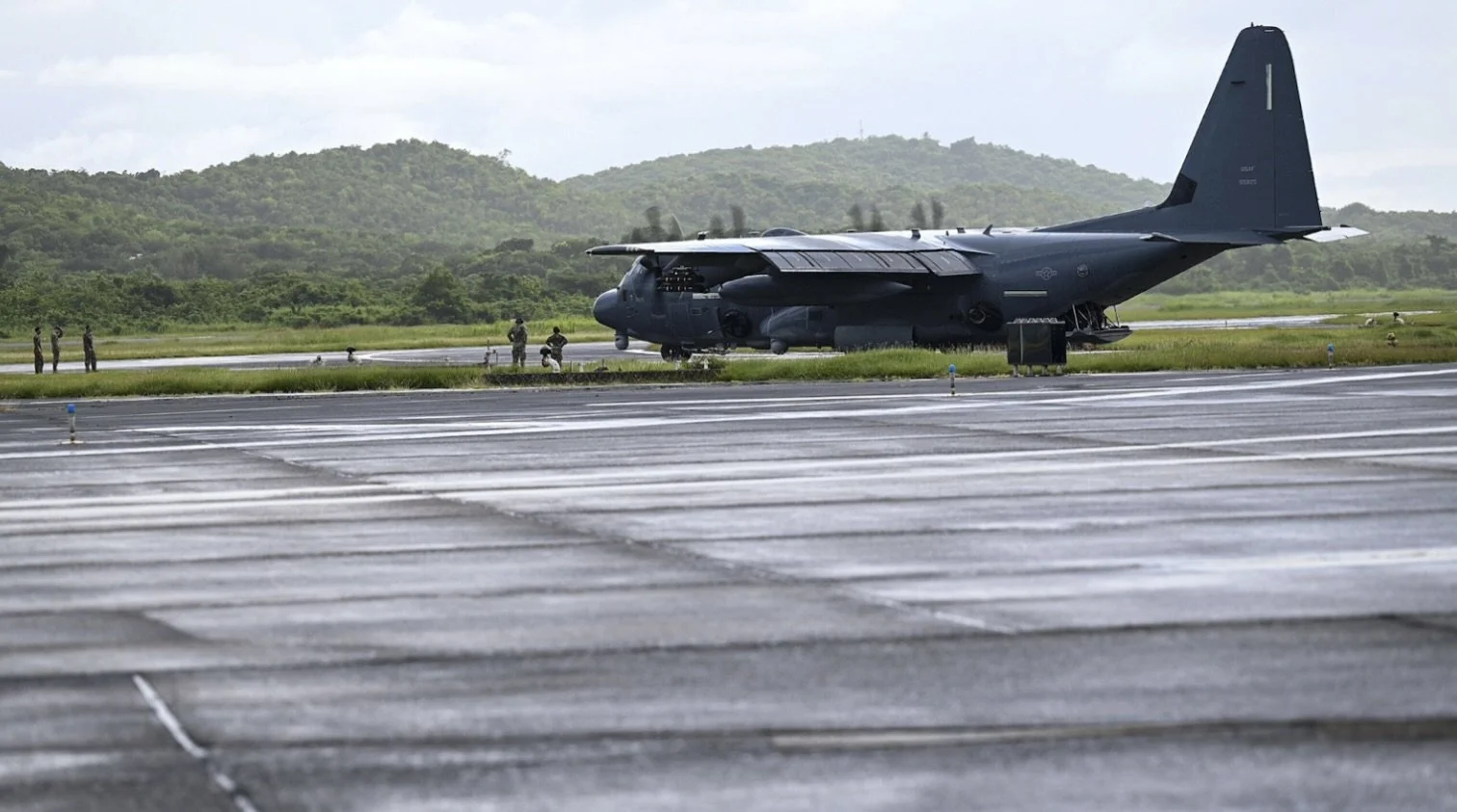
A U.S. Air Force AC-130J aircraft parked in Puerto Rico, photo courtesy of Senior Airman Gabriel Jones of the U.S. Air Force.

On September 2, 2025, the United States military struck a Venezuelan vessel in international waters, killing the 11 individuals on board. This strike was the first of a volley of attacks President Trump made against alleged narco-terrorists in the waters surrounding Latin America. Two months later, on October 27th, Trump’s strikes broadened to include regions of the eastern Pacific. Trump justified his attacks as necessary to defend against the importation of fentanyl into the United States, an act that he labeled as narco-terrorism, but his invocation of the term contrasts its historical origins. In 1983, President of Peru Fernando Belaúnde, first used the term when responding to cartel violence against police. Within the past twenty years, the term narcoterrorism has broadened from just narcotics-oriented groups engaging in terror to now including terror-oriented organizations trafficking narcotics for profit. Narcoterrorism’s broadening scope demonstrates the term’s increasing complexity.
Despite this historical nuance, Trump’s counter-narcoterrorism policy reflects a narrower outlook. In his term-one response to the Taliban, President Trump failed to stem their then-thriving narcotics trade by underemphasizing a counter-narcotics approach. Trump’s recent terrorist designations and boat strikes have overemphasized and misrepresented Latin American cartels’ ties to terrorism. Both instances demonstrate how Trump conflates vastly different narcoterrorist organizations under the general, ambiguous framing of ‘terrorism.’ Domestically, this conflation muddles counterterrorism responses by precluding effective inter-agency cooperation. Because the US plays a formative role in international counter-terrorism efforts, Trump’s weaponization of terrorism’s definitional malleability could have unintended consequences.
Terrorism is inherently hard to define, as indicated by the failure of international institutions and states to reach an agreement on how to understand the term. The United Nations’ 2011 Special Tribunal in Lebanon began to outline a few foundational elements to partially define terrorism:
(i) the perpetration of a criminal act (such as murder, kidnapping, hostage-taking, arson, and so on), or threatening such an act; (ii) the intent to spread fear among the population (which would generally entail the creation of public danger) or directly or indirectly coerce a national or international authority to take some action, or to refrain from taking it; (iii) when the act involves a transnational element.
The Appeals Chamber of the Lebanon tribunal determined that this definition provides “more than a mere concordance of laws,” suggesting a broader consensus. However, scholars find the tribune’s rulings “dubious” at best because they mix domestic and international terrorism as well as conflate criminal and non-criminal definitions, oversimplifying and diluting the nuances of terrorism. Though not included by the Tribunal, religious, political, or ideological motivations often factor into various states’ definitions of terrorism. Motivation-based approaches to defining terror also complicate the construction of a comprehensive definition because states’ cultural, political, and social differences influence what they consider legitimate and justified.
A derivation of terrorism emerging from this unstable lack of international consensus, narcoterrorism is also an inherently malleable term. Political science researcher Tamara Makarenko’s 2004 concept of the crime-terror continuum begins to outline the complex, dynamic relationship between narcotics trafficking and terrorism. Terrorism and organized crime assume either side of the continuum, incrementally approaching a true nexus at its center. Because of the seemingly innumerable variations on crime and terror, assigning one term — narcoterrorism — to disparate groups carries inherent ambiguity. Coupled with the lack of international consensus on defining terrorism, much less narcoterrorism, this ambiguity offers a place for domestic exploitation. Without an international standard to use as a reference point, states’ definitions matter even more. President Trump’s generalized interpretation of narcoterrorism foreign policy condenses it into a strategic label that weaponizes the malleability of both terms, terrorism and narcoterrorism.
Trump’s first-term policies against the Taliban in Afghanistan underemphasized how the narcotics market underpinned their terrorist operations. Political and economic turmoil after the Soviet-Afghan war and years of civil conflict historically catalyzed Afghanistan’s opium cultivation investments, making them responsible for 95% of heroin in Europe by 2021. However, President Trump’s initial plans for military involvement in Afghanistan largely ignored opium and its profits for the Taliban. Instead, Trump’s Operation Iron Tempest concentrated strikes on several of the Taliban’s heroin laboratories. Although an ostensibly impressive and effective show of force, Operation Iron Tempest wasn’t successful in practice. Trump’s 200 strikes did not stem the Taliban’s profits, and researchers from the London School of Economics discovered that the ‘laboratories’ struck by the U.S. were little more than mud huts. Trump’s minute impact relative to the military’s praise and robust military technology deployed suggests that this terror-oriented response was a tactical mismatch for the drug trade. By ineffectively using militaristic counterterrorism policy as a one-size-fits-all approach to narcoterrorism, Trump seems to focus more on the ‘terror’ than the ‘narco’.
Just as Trump’s first administration ignored the Taliban’s ‘narco’, his second administration now focuses on the ‘terror’ of Latin American cartels. Trump’s Executive Order 14157, “Designating Cartels And Other Organizations As Foreign Terrorist Organizations And Specially Designated Global Terrorists,” newly identified the narcotics cartel Tren de Aragua (TdA) as a terrorist organization. This redefinition escalates President Biden’s 2024 designation of TdA as a transnational criminal organization. In response to this escalation, scholarly critics pushed back, arguing that Trump’s designation was incorrect because TdA seeks profit without an ideological or political basis. By highlighting the ‘terror’ of cartel organizations, Trump weaponizes narco-terrorism and its definitional malleability to associate the visceral ideological and legal reactions of ‘terrorism’ with Venezuelan cartels.
Even when Trump engages with the ‘narco,’ he simplifies its complexity. Just as EO 14157 redefined TdA, Trump’s invocation of the Alien Enemies Act newly classified the “Cartel of the Suns” as a narco-terrorist organization. However, the label “Cartel of the Suns” mischaracterizes the non-centralized network of drug trafficking in Venezuela as an official institution. These designations prefaced Trump’s narcoterrorism charges in March against Venezuela’s President Nicolás Maduro, which accused him of being the long-time leader of the elusive Cartel of the Suns. By mischaracterizing Venezuela’s criminal networks as a unified body and terror-oriented syndicate, Trump’s definitions reshape rather than describe reality.
This conflation, then, compounds Trump’s ability to justify terror-level responses to Maduro and Venezuelan drug trafficking. Trump’s term-one response to the Taliban’s drug facilities and ongoing strikes near Latin America show similar military might. Like his attacks against the Taliban’s mud huts, the recent strikes seemingly target defenseless individuals operating with lower levels of technology relative to their assailants. During Trump’s first term, the Air Force Secretary disapproved of using F-22 fighters against the Taliban’s narcotics factories. It seems that unarmed boats in international waters would be a lower order target. Yet, as Trump’s strikes continue into November, reporters speculate that the military has employed manned AC-130J gunships and unmanned AC-130J MQ-9 Reaper drones using Hellfire missiles. Trump equalizes terror-oriented and narcotics-oriented groups through his rhetoric and military response.
Comparing President Bush’s response during the War on Terror with Trump’s narco-terror conflation reveals how weaponizing definitions blunts domestic counterterrorism. Like Trump’s attitude toward Latin American cartels, President Bush also emphasized the ‘terror’ in his campaign against weapons of mass destruction (WMDs). Steven Casteel, the DEA chief of intelligence during Bush’s first term, criticized Bush for refusing to link the War on Terror to drug trafficking financing. Indeed, Bush steered clear of using the term “narcoterrorism” when referring to various “terrorist” organizations. In a 2002 discussion with the President of Colombia, Andrés Pastrana, President Bush repeatedly referred to Latin American narco-terrorists by withholding the term “narco” while Pastrana instead labeled them as “narco terroris[ts].” Centering a federal response around terrorism versus narcoterrorism matters because it reconfigures inter-agency coordination against the threat. Bush’s aversion to using the term “narcoterrorism” led to the DEA’s exclusion from the interagency table for the War on Terror despite their advanced intelligence capabilities and traditional terrorist organizations’ involvement in drug markets. Acknowledging this convergence becomes a prerequisite for implementing effective coordination between the CIA, DEA, and State Department.
Following this definitional conflation, the US becomes less equipped to deal with important goals like stopping WMD proliferation among terrorist organizations. A core tenet of Bush’s invasion was to eliminate a terrorist “axis of evil” with nuclear capabilities, through the destruction of supposed WMDs in Iraq. Similarly, Trump’s rhetoric accuses Venezuela of weaponizing cocaine as a chemical “weapon” of mass destruction. In 2019, James F. McDonnell, a President Trump-appointed official of the Countering Weapons of Mass Destruction Office (CWMD), issued a memorandum to classify fentanyl as a WMD. This memorandum suggested the reallocation of counter-WMD resources for the interdiction of fentanyl when smuggled and preventing its use as a weapon. A product of narco-terror conflation, trade-offs from counter-WMD resource reallocation diminish the ability to assess higher-order risks like nuclear proliferation.
Trump’s conflation of narcoterrorism and terrorism also demonstrates how weaponizing ‘terrorism’ hinders counter-terrorism discourse in the international community. The United States’ Foreign Terrorist Organization (FTO) list is a “beacon” for other states’ terrorist designations globally. Even though the US’s allies often do not consider criminal organizations FTOs, Trump’s narco-terror conflation might, at best, complicate counter-terrorist coordination with these other countries. Because FTO designations and terrorism’s definitions formulate a state’s approach to counter-terrorism, discrepancies between coordinating parties might hinder their collective capabilities. At worst, the US’s conflation of narcotics organizations and terrorist groups could set an adverse precedent for countries that look to the US’s norms to do the same.
Trump’s weaponization of definitional malleability reinforces militaristic responses, convolutes domestic counter-terrorism, and sets an adverse precedent for the international community. Returning once more to the crime-terror continuum clarifies how policymakers might reframe counterterrorist policies. Because of seemingly infinite variations between narcotics and terrorism, every organization seems to be unique. As the US navigates the ever-shifting atmosphere of narcotics trafficking, terrorism, and their nexus, policymakers must consider the domestic implications of organizational exclusion and the US’s role in setting international standards for counter-terrorism. Advancing an international focus on defining terrorism remains important, but states must also acknowledge divergences in national definitions and FTO lists — not weaponize these gaps. Because terrorist organizations increasingly mobilize transnationally, a multilateral, international coordination is a necessary response. As Trump continues the campaign of strikes against ships in the Pacific and Caribbean, it is imperative that the country recognizes how weaponizing ambiguous definitions at home can swiftly morph into entangling conflicts abroad.
Jack Bradner (CC '29) is a junior editor for the Columbia Political Review studying English and Political Science. He can be reached at jab2503@columbia.edu