The University Senate: Columbia’s Sisyphus
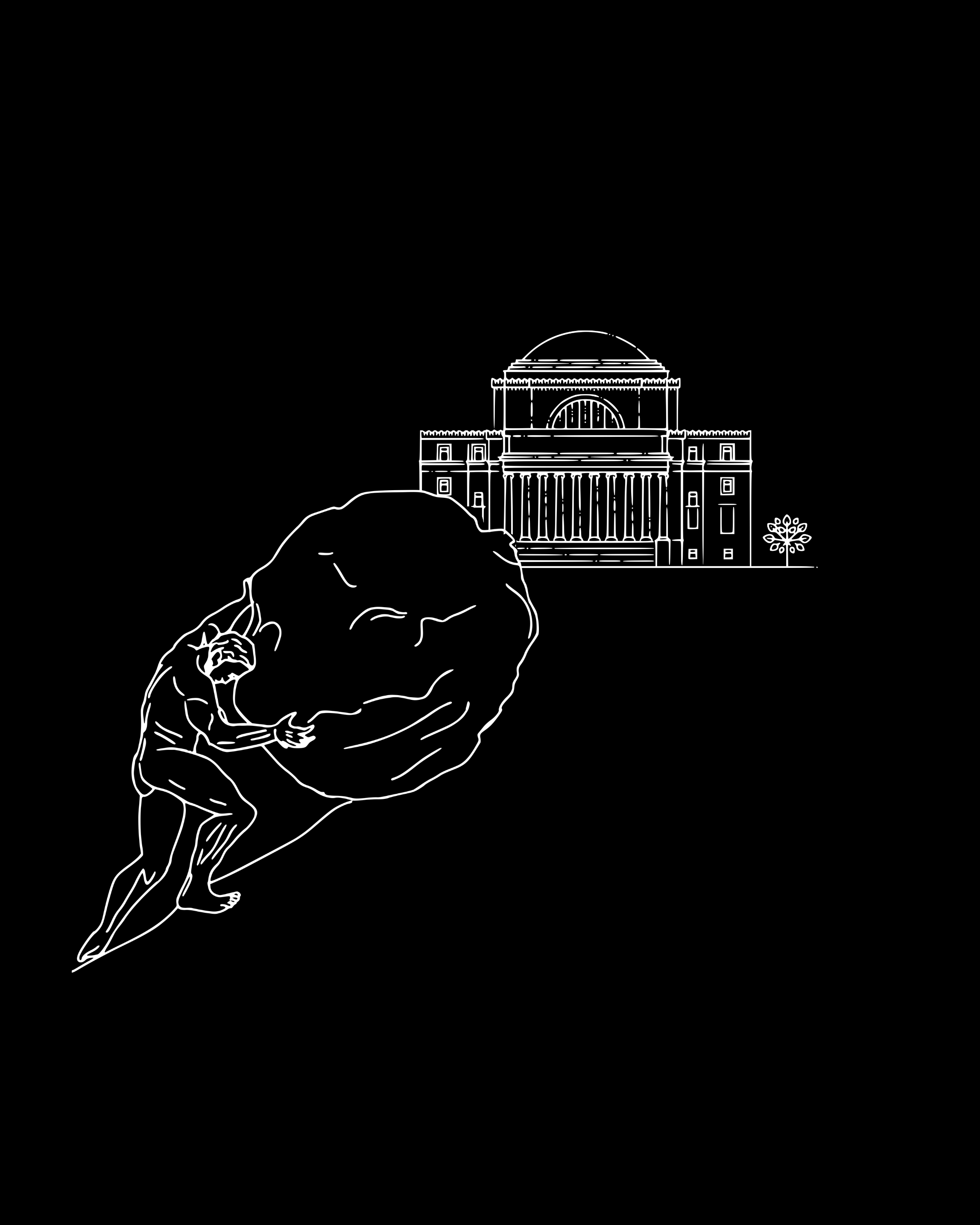
Despite the often futile work before them, the University Senate continues to push Columbia University forward towards the ideal of shared governance. Original image courtesy of Andrew Puthumana.
Columbia University is perhaps the only university in America where the simple act of taping a flyer to a door isn’t seen as decorating, but rather as just cause for a disciplinary hearing.
Yes, it sounds extreme, but this was a legitimate free speech concern raised by University Senator and Associate Professor David Lurie at the December 2025 Senate Plenary. He pointed out that Columbia had quietly changed its interior posting policy on August 14th, 2025, banning “unauthorized banners, posters, and other signage placed in the interior of University buildings, including doors” and threatening disciplinary action against violators. When asked if the administration was aware of this harsh policy and whether the Senate was consulted before the change, Acting President Claire Shipman deflected, stating that the administration was not aware of its own new policy against doorposting. No formal policy action or acknowledgement was made after Professor Lurie’s concern was voiced, but Columbia did retroactively amend its door policy a few weeks later…
This is the reality of today’s University Senate. Senators aren’t exactly pushing policy, but instead are fighting for any inch of leeway towards individual freedoms for their constituents. They’re forced to do so, in part, because they face an administration that pencils in new restrictions at whim and is intent on eroding shared governance without students noticing.
In the administration’s eyes, the University Senate is meant to be “a policy-making body which may consider all matters of University-wide concern.” It is composed of senators representing Columbia’s administration, administrative staff, alumni, faculty, librarians, research officers, and students. Membership spans the University’s 17 schools and 3 affiliate institutions, and all 111 senators meet once a month for the aforementioned Senate plenary meeting. In addition, the body is split into 20 independent committees and commissions that cover various functions, from student affairs to management of the University budget and endowment.
The Senate was formed in the aftermath of the infamous 1968 campus protests to promote shared governance of the University, or the idea Columbia ought to be governed by the trustees, the administration, and the Senate equally. In reality, though, the Senate was built to repair broken trust between the administration and students and faculty.
Nearly 60 years later, it’s pretty clear why our senators are having trust issues with Columbia’s administration yet again.
Ironically enough, at the end of the same December plenary session where the lack of transparency on putting flyers on doors came to light, President Shipman argued that the process towards improving trust in the administration must be a “bottom-up” approach, with the Senate leading the way to improve campus morale.
To be sure, the Senate has created some meaningful policies for the good of its constituents, such as expanding access to gym facilities beyond Dodge through a new partnership with fitness platform WellHub, announced this past January. But how can the Senate work to be a bridge of transparency and trust between students and the university when it continually finds itself subverted by higher administration?
For one, our student senators routinely start the fight for progress from a losing position, outside of the rooms where actual decisions are made. Just look at two conflicts from this past semester: the 2026 commencement location and the expansion of the undergraduate population. This past February, commencement was moved from the usual location at Morningside Campus to Baker Athletic Complex with virtually 0 student input, removing decades of tradition for a location 100 blocks north of Columbia University. Columbia’s administration would eventually move the ceremony back to campus, but only after weeks of negotiations with senators, student council members, and the University Commencement team.
As for university expansion, the final plan was dramatically reduced from the initially planned 20 percent increase in class size. It came with promises of significant facility investments, a new gym under Lerner, and new student spaces in Carman Hall, but the overwhelming lack of student input throughout the entire process remains.
Only after a policy receives massive student backlash does the University reluctantly allow students into negotiations, when they should’ve been in the room from the beginning. This is all without mentioning how the University has systematically stripped the Senate of its right to oversee judicial proceedings for student violations of University conduct. This was a key part of the University’s deal with the Federal Government that was signed over the summer (without the Senate consenting to the deal, unsurprisingly). This takes away one of the Senate’s key powers, created at its inception specifically because of the administration’s bias in overseeing student adjudications following the 1968 protests.
Meanwhile, on the “top-down” side, this past March was marked by the landmark release of the Hadden Report. The 156-page external report (that took nearly two and a half years to release and was delayed several times, might I add) details how lower-level administrators failed to investigate Dr. Robert Hadden, a former Columbia University OB-GYN who horrifically sexually abused more than 1,000 patients during his nearly 25-year career. Even after the release, moreover, the Senate publicized a set of scathing criticisms on how the report excluded decisions that directly enabled Hadden and were made by University leadership aware of his abuse from early on.
The most outrageous comment from the administration at that end-of-year plenary was when President Shipman noted that international students seem “quite afraid to often take leadership roles and [positions] that they think will be controversial.” Certainly, it makes sense why international students, not to mention our own student senators, might feel this way about speaking out on controversial topics. After all, Senator Helen Han Wei Luo found herself being doxxed, stalked, and racially harassed online for merely voicing her opinion in a November plenary meeting on suspending student groups following the 2024 student protests. Most of the harassment and online hate speech against Luo came from Columbia students and affiliates circulating a recording of her speech on the plenary Zoom, leading Senator Luo to file a complaint with the University’s Office of Institutional Equity (OIE). The OIE ruled that, with respect to the hostile speech, the complaint did not meet the threshold for actionable discrimination.
Everything I’ve just said would lead any rational person to be extremely pessimistic towards the Senate’s capacity to enact change. Nevertheless, I do, maybe too hopefully, believe in a future for the Senate where it can be the bridge it was meant to be and restore trust between the Columbia community and administration. However, it is imperative that, for once, trust is rebuilt from the top down, with the administration proving that they’re willing to protect shared governance, promote student voices on bodies like the Board of Trustees, and be transparent about their policy agenda with students and faculty.
For our senators, they must continue to expose egregious errors by the University and fight for students to be heard, regardless of the cost. Those aligned with the University’s perspective oppose creating tension with the administration over seemingly unrealistic ideals like total shared governance. They claim that such criticism harms campus morale and continues to detract from the Columbia experience. However, to those parties, I say this:
Our senators care about their job because of the risks, the tension, and the stress it entails. They roll up their sleeves, knowing there’s a new President on the way with a track record of not taking questions during Senate plenaries. They still go to committee meetings and put in countless hours behind the scenes just to make our campus marginally better with the little power they have left. They still voice the concerns of their constituents openly, even under the threat of being harrassed with little institutional support behind them.
Pushing the boulder of progress up the hills that Columbia University’s administration creates, time and time again, is a thankless and, quite frankly, terrible job. Yet, regardless of all of the frustrations found in the pursuit of shared governance and a seat at the table, our senators keep on going to work. They, like all of us who are frustrated with Columbia’s administration, understand that the deepest form of love we can have for our university––our home––is to acknowledge all of its flaws, and fight for it to be better anyway.
Andrew Puthumana (CC ‘28) is a candidate for the University Senate and is majoring in economics with minors in history and sustainable development. He is interested in expanding dialogue around student restoration of trust and the idea of shared governance–especially in Columbia’s current environment.