The Hijacking of the EPA: Inside the Repeal of the Endangerment Finding
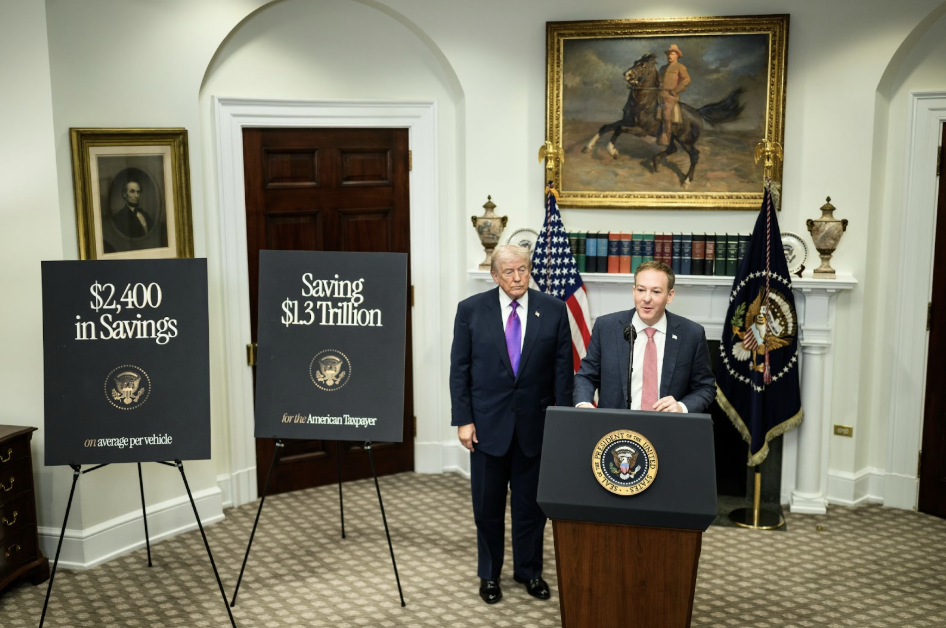
President Donald Trump and EPA Administrator Lee Zeldin make an announcement in the Roosevelt Room on rescinding the 2009 Environmental Protection Agency endangerment finding, Thursday, February 12, 2026. Official White House Image by Daniel Torok, courtesy of Flickr.
On November 11, 2024, Lee Zeldin was announced as Trump’s pick for the 17th Administrator of the US Environmental Protection Agency (EPA). Considering his relatively scant background in environmental and public health issues, the world was taken aback by the appointment. But with a deeper look at his past campaign record, powered by over $400,000 of oil lobby money and grounded in a relentless call for the allowance of fracking, Zeldin proves to be the quintessential harbinger of Trump’s America-first pursuit of ‘energy dominance.’
Zeldin came into office the subsequent January with the honorable mission of “protect[ing] human health and the environment.” Exactly 7 months later, he proposed striking down one of the core pillars that allowed the EPA to do just that: the Endangerment Finding.
The 2009 Endangerment Finding gave the EPA the legal foundation and obligation under the Clean Air Act (CAA) to regulate greenhouse gas (GHG) emissions by formally enshrining the scientific consensus that they endanger public health and welfare. The CAA, which has long required the EPA to regulate polluting substances, has a prerequisite condition embedded in its statutes: a substance must be “reasonably anticipated to endanger public health or welfare” to fall under its purview. A repeal of the Endangerment finding, therefore, absolves and prevents the EPA from overseeing all GHG emissions, be that from vehicular, industrial, or power plant sources. It also rescinds all present regulations made pursuant to the finding, the primary ones comprising environmental standards on fuel-powered vehicles and engines.
While the repeal has been framed as a cost-cutting measure that eases burdens on American consumers, this claim quickly unravels under scrutiny, revealing something far deeper than the long-standing Trumpian distaste for climate policy. We are observing a deeper shift within the EPA itself, where legally dubious processes and selective reasoning are being actively weaponized to justify pre-determined outcomes. What emerges is a clear throughline: the gradual transition of the fossil fuel industry from peripheral actors to puppet-masters, with Zeldin’s long-standing ties serving as a strong blueprint for the agency’s realignment.
This February, it was made official. The EPA declared greenhouse gas emissions neither a historical, present, nor future threat to human health, hailing the move as the “single largest deregulatory action in US history.”
Naturally, this action immediately triggered a lawsuit from some of the largest environmental and health groups in the US. While we cannot project its resolution with certainty, legal scholars expect the final decision to be rendered only in 2028 after several rounds in court. Until then, the implications of this policy change are expected to be pervasive and multifaceted. Some critics fear the economic and health impacts of increased pollution on American citizens, some grieve America’s loss of credibility among allies and its erosion of technological advantage among competitors. Others feel cautious about the deference of regulatory responsibility toward states, caused by the vacuum now created at the federal level.
Lurking in the background of this grand political theater is a group that calls itself the ‘Climate Working Group’ (CWG). Contrary to its title, this group consists of five infamous climate minimizers, cherry-picked by former founder-CEO of Liberty Energy (one of the largest fracking companies in North America) and present US Secretary of Energy, Chris Wright. Under the shared belief that the world adopts an “exaggerated or incomplete” view of climate change, the CWG authored the report that constitutes the supposed scientific underpinning of the EPA repeal.
While this paper has gone far from unnoticed by the scientific community, a detail that few people are privy to is Zeldin’s brazen, direct coordination with the Department of Energy (DOE) throughout the report, shaping it with the explicit goal of undermining the Endangerment Finding in the future.
Another lesser-known detail: just two weeks before the repeal was finalized, the formation of this group was declared a legal violation. At the District Court of Massachusetts, it was ruled that the Energy Department had violated the 1972 Federal Advisory Committee Act, which requires advisory committees to conduct open meetings, enable public access to their records, and be composed of a diverse range of viewpoints. Documents released in the case revealed that the DOE had intentionally kept the existence of the CWG a secret, emphasizing the importance of handling its meetings with “silence and restraint pending completion of [the report’s] process.” The release of documents also found several internal DOE review comments flagging scientific failings in the report, most of which went unaddressed after the EPA encouraged minimal revisions.
Those comments were not without reason. The paper engages in a vigorous battle against scientific consensus, concluding that elevated CO2 enhances plant growth, future emission trends are overstated, and extreme weather events have shown no increase in frequency and intensity. Most importantly, it declares that US policy actions will have “undetectably small direct impacts on the global climate” and that “excessively aggressive mitigation policies could prove more detrimental than beneficial [for the economy].”
Zeldin takes this last claim very seriously. In the news release of its final ruling, the EPA focuses almost exclusively on the economic benefit of the repeal, specifically its trickle-down effect on net savings for the average American consumer. Further, although the initial proposal for the repeal heavily touted the DOE scientific report, the EPA betrays itself as nearly self-aware of the paper’s illegitimacy by making absolutely no mention of it in its final ruling. Clearly, this change in framing was made purely to improve the repeal’s chances in court, for its rationale still entirely rests on the paper’s ‘discoveries,’ especially its call to bring in costs as an iron constraint to the climate discussion.
But it doesn’t take too much examination to bust the cost-cutting myth, either. Across its news releases, the EPA heralds the figure of $1.3 trillion in savings between 2027 and 2055, estimating $1.1 trillion from the reduced costs for new vehicles, and $200 billion from the avoided costs of EV chargers and related equipment. If this figure seems too good to be true, that’s because it is. The EPA conveniently excludes half of the standard equation required for a net savings analysis: it completely nullifies all the costs of the repeal.
This is not a mere calculation error. The EPA is entirely aware of these costs and displays them bright and bold in its Regulatory Impact Analysis. Here, a chart displays four modelled scenarios to calculate the net savings of the repeal. The first scenario projects nearly $1.5 trillion in costs through 2055, associated with higher fuel purchases, vehicle maintenance costs, and future energy insecurity, among other factors. This results in a net loss of $180 billion to American consumers. The other three scenarios, which use varying combinations of lower fuel prices and 2.5-year fuel cost periods, still show a much lower figure of net savings than $1.3 trillion. And even here, the EPA betrays itself once again. It projects a 29% increase in gasoline prices by 2050 as a result of the repeal, implicitly declaring scenario one the most legitimate, and therefore the net loss the most likely. What we see here, therefore, is a deliberate lie to the public to represent the repeal as a policy that benefits them.
What makes everything worse is that the costs above represent only the tip of the iceberg. One can only imagine the compounded health and environmental costs caused by the resulting increase in global warming. The Environmental Defense Fund has attempted to estimate this, calculating a whopping increase of $4.7 trillion in public and private expenses by 2055, tied to the climate damage caused by the repeal.
So, what’s left? If neither science nor economic logic can fully justify the repeal, what remains is its political function. The most illuminating lens to use here is one situated within the broader goal of Trump’s energy-dominance agenda, which, much to most experts’ chagrin, he defines as inherently anti-climate-action. To this end, the EPA has seen a complete hijacking, beginning with the firing of almost 400 staff at the beginning of Zeldin’s term, the enforced administrative leave of the Director of the Greenhouse Gas Reduction Fund, and the cancellation of $1.7 billion in environmental justice grants. The list goes on, the most recent action being the rollback on MATS, which relieves several standards on mercury emissions and other air toxins. This rule covers some of the emissions that the Endangerment Finding’s repeal could not touch, together reducing regulation on polluting sources to a frail slap on the wrist. Announced at a massive coal-fired power plant in Kentucky, it is clear who this new rule caters to, despite, again, the EPA’s justification hinging on consumer cost savings.
None of these actions have ever been aimed at correcting science or improving affordability. They have hardly been about long-term energy dominance either, as any macroeconomist and energy expert will confirm. At its core, the hijacking of the EPA centers around Trump making good on his promises to the oil industry, which contributed over $75 million to his 2024 campaign in exchange for getting everything they wanted on their policy wishlist. Together, Trump and Zeldin have kept their scout’s honor—a worthy cause to sacrifice American interests, isn’t it?
Nayantara Alva (GS ‘26) is a columnist with a special interest in energy issues. An economics major across Sciences Po Paris and Columbia University, she is focused on the intersection of markets, policy, and power, particularly as they shape climate outcomes.