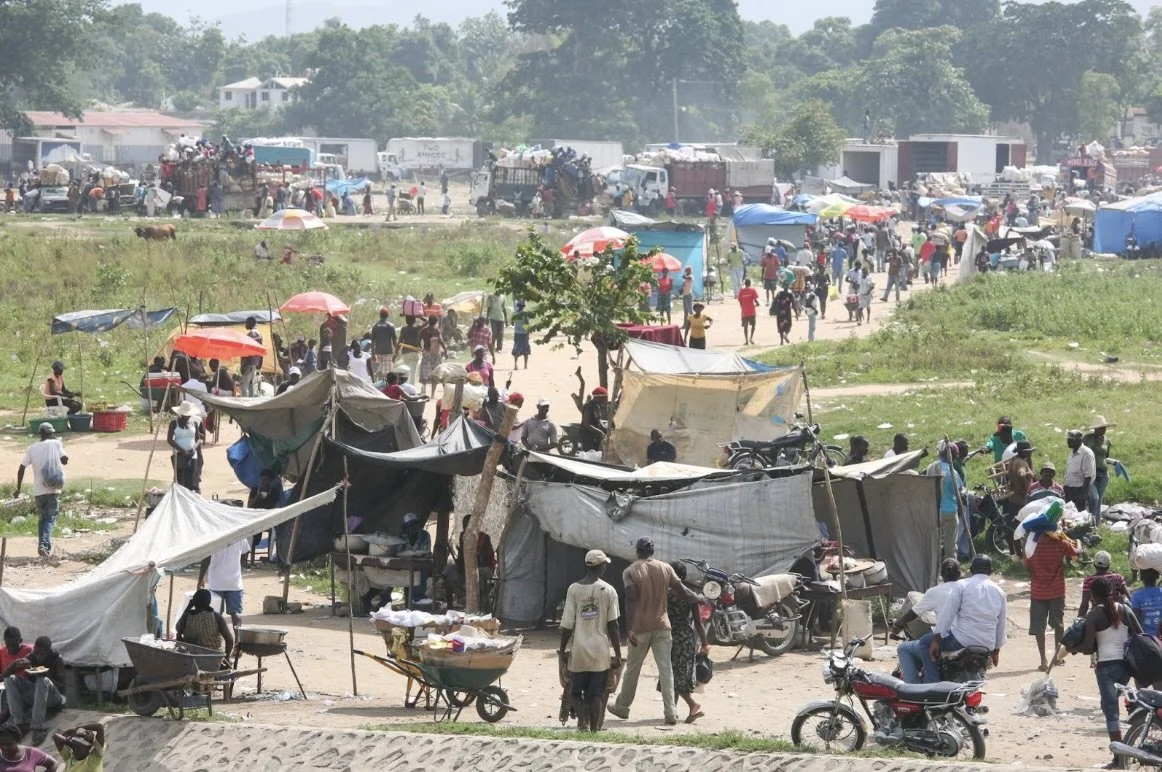
Haitian migrants gather at the border of Haiti and the Dominican Republic in Dajabon in September, 2012, almost exactly a year before the Dominican Supreme Court will overturn birthright citizenship in September of 2013. Photo taken by Alex E. Proimos and licensed under CC BY-NC 2.0
Castillo Javier Police had never set foot in Haiti, but that didn’t stop the Dominican Republic from deporting him there in 2023, after officials arrested him during his nightly grocery run. The fact that he was born in the Dominican Republic or that he had his birth certificate on him didn’t stop them either.
When President Trump announced his plans earlier this year to overturn birthright citizenship in the United States, American citizens saw it as a shocking escalation of nationalist politics threatening a constitutionally-recognized legal right. But for many in the Dominican Republic, that threat has long been realized. In a court decision in 2013, the Dominican Supreme Court overturned jus soli—birthright citizenship—for the children of foreign-born parents, retroactively stripping citizenship primarily from Dominicans of Haitian descent, dating back to 1929. While Public Law 169-14 would attempt to provide a path to citizenship through naturalization processes for the Haitian Dominicans, many eligible candidates have been unable to obtain naturalization. The Court’s decision has adversely affected as many as 245,000 Dominicans and left between 120,000 and 130,000 stateless. But more than just a humanitarian crisis, the DR’s state-led campaign to proclaim its own citizens as “stateless” reveals another crisis entirely: the failing of a modern liberal state, which relies on exclusion to define national identity.
While national identity may seem theoretical, the human cost of this exclusion is immediate and material. Rejected by their home country, and with no legal claim to citizenship in Haiti, individuals affected by the ruling are barred from exercising the basic rights of a citizen like education, healthcare, employment, and the right to own property. While these are relatively new exclusions, the issue is a longstanding one, especially between the DR and Haiti. With a majority Black population on both halves of the island, the tense racial and national relations between Dominicans and Haitians are often lost on a foreign audience. But they have existed throughout the history of both of these countries, dating back to Hispaniola’s dual colonization by both the French in modern-day Haiti and the Spanish in modern-day DR. Haiti’s independence in 1804, which made it the first Black republic in the world, laid the groundwork for the perceived threat of Black independence to the Spanish mixed race elite—something that has fueled the DR’s anti-Haitianism ever since. This came to fruition most memorably in 1937, when US-backed dictator Rafael Trujillo ordered the Parsley Massacre, killing thousands of Haitians near the border provinces in an effort to “dominicanize the border.”
Statelessness campaigns like these not only reveal unimaginable humanitarian crises but also pivotal contradictions inherent within the idea of a liberal nation-state. What those contradictions leave us with is hypocrisy masquerading as liberal democracy: the state cannot make commitments to universal equality and other democratic principles while privileging one ethnic group at the same time. When states organize themselves around ethnic belonging or an identity tied to one particular group—as in the case of white nationalism in the Dominican Republic, rooted in its Spanish mixed race elite history—exclusion isn’t accidental: it is a structural necessity.
Inevitably, the casualties of this contradiction are whoever the state doesn’t represent. Dominicans of Haitian descent aren’t the only victims: the Dominican Republic only follows a long list of state actors using statelessness to legally exclude minorities. In Buddhist-majority Myanmar, the 1982 Citizenship Law rendered roughly 3.5 million Rohingya, a minority group, stateless before later launching a genocidal campaign in 2017. Consequently, when hundreds of thousands fled, fearing the persecution that comes from statelessness, countries like Bangladesh or Malaysia refused to recognize them as refugees due to their stateless status. The same is true for the Bidoon in Kuwait, a stateless Arab minority facing abuse from a state that has deemed them “illegal residents” even though they were born on Kuwaiti soil. Despite these various groups having legal and cultural ties to the countries restricting their citizenship, all three countries make the claim of “foreignness” to justify their exclusion, whether it’s a foreignness of race, religion, or language.
Thus, statelessness becomes a way for countries to create the exclusion upon which its ethnic nationalism depends. It’s a dangerous truth: once a state proves it can strip citizenship from one group, it reveals that at any given time, the state can override the laws that protect membership under the social contract. Statelessness not only delegitimizes citizenship for those stripped of it, but it also undermines the concept as a whole, turning it into a conditional privilege instead of a universal right. The current reality in the DR is threatening—if a government can so easily revoke the protection of its people while benefiting from their participation, then the social contract collapses, and all that liberal democracy promised along with it.
This crisis of statelessness—which also might be construed as a crisis of ethnonationalism—is not an isolated phenomenon. Surges in identity politics are deeply linked to economic insecurity, social disruption, and the failures of globalization. When people feel left behind economically, socially, or politically, or feel as if the benefits of growth or democracy are unevenly distributed, identity becomes a fallback to reclaim a sense of belonging that the state couldn’t provide them with. Just as with a dominant mestizo Spanish identity in the Dominican Republic, states’ culturally-formed identities take priority over universal equality.
Ultimately, the DR’s reliance on statelessness to promote a national Dominican identity grounded in whiteness reveals a contradiction at the heart of the modern state: the liberal nation-state project promises equality, but that equality will forever be defined by the inequality of others.
Thus, the nation-state fails not because it has abandoned its liberal-democratic ideals, but because those ideals of equality will always remain structurally at odds with the ethnic and racial boundaries that define the modern state. In the case of the DR, where the state should expand its sense of equality against ethnic nationalism, it chooses instead to minimize it by retracting citizenship. The result is a democracy that may survive in form (for now), but one that dies in substance.
So, what can we do as ethnic nationalism causes a collapse of the nation-state? Unfortunately, the DR’s own hand in creating statelessness limits the usual menu of policy solutions. In most contexts, the first step would involve addressing recommendations for streamlining their immigration system—for example, by resolving the cases of Dominicans who qualify for citizenship, but haven’t been processed, or by providing temporary refugee status within the country to children of foreign immigrants. But a state that manufactures statelessness has little internal incentive to reverse it, and those solutions only deal with the consequences of a failing nation-state, not its root causes.
The most meaningful pressure to reverse statelessness must come from outside. International recognition still matters—especially to a country like the Dominican Republic, whose “Dominicanization” campaign is, in part, trying to rid itself of Haiti’s illegitimacy on the world stage. Organizations like the UN Human Rights Council and state actors like the US should use their presence to bring awareness to the issue and take in Haitian immigrants, all while imposing sanctions or conditioning aid. But authority remains an issue in both cases—the UN rarely commands sustained geopolitical attention, and with the US hoping to overturn birthright citizenship itself, it’s more likely to follow in the Dominican Republic’s footsteps rather than condemn its actions.
While ethnonationalism is resurging, the model of states defining belonging through ethnicity, religion, and identity is old. When global and cultural forces combine to fan the flames of exclusion, enforced statelessness erases the identity and lived reality of people who were simply born to the “wrong” parents. Justifying the erasure of so many of his own citizens, former Dominican President Dr. Leonal Fernandez said that “[t]here do not exist, nor can there ever exist, descendants of either Dominicans or Haitians who are stateless.” While he may be able to deny the truth of hundreds of thousands of stateless Dominicans, we cannot. The liberal nation state is structurally regressing before our eyes, at the expense of democracy. And if one person is erasable, we are all erasable.
Reagan Ricker (CC ’29) is a staff writer for the Columbia Political Review from Seattle, Washington. She hopes to pursue a career in immigration law and her primary interests lie in Latin American and Caribbean politics, immigration policy, and journalism.