The Corner zionism has Forced the Lebanese People Into
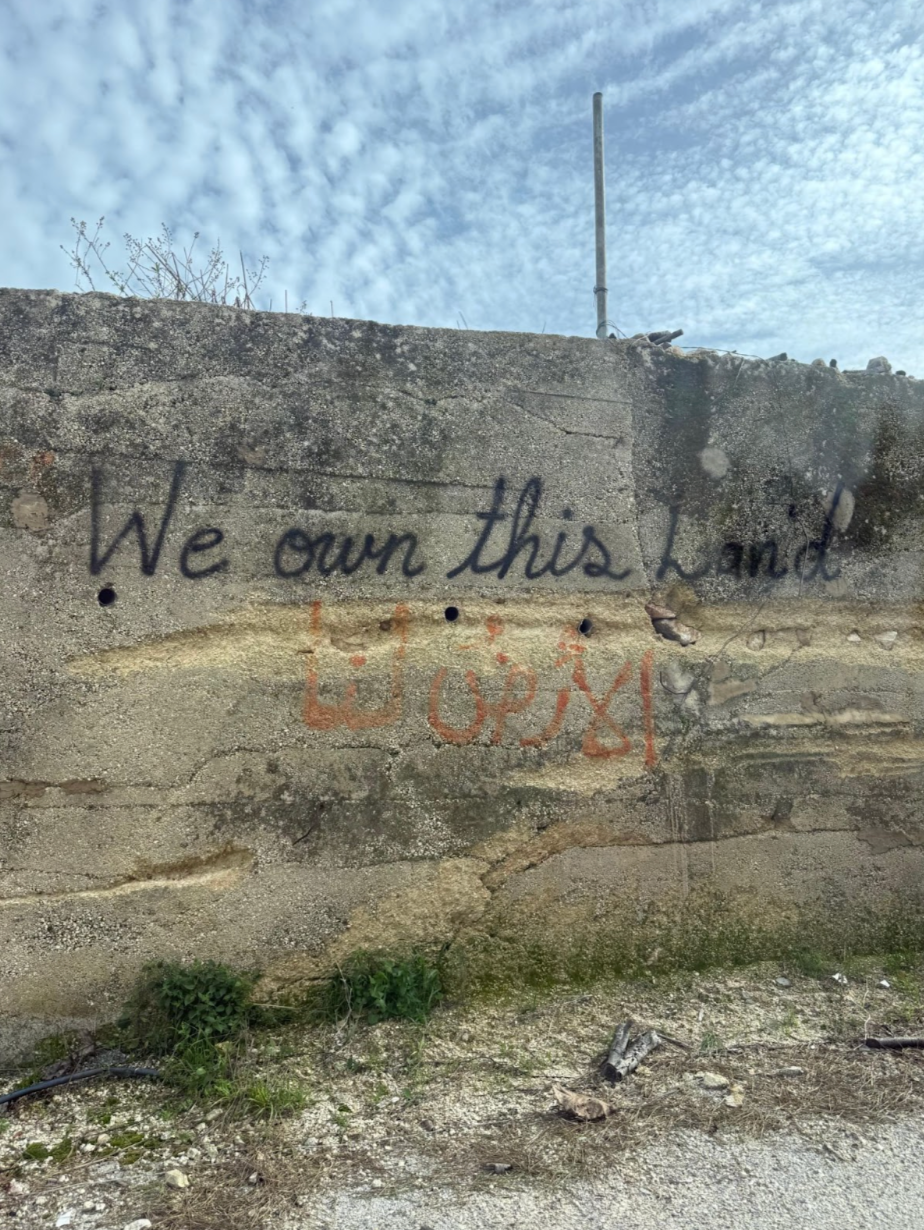
Wall Grafitti “We Own This Land,” Jnoub Lebanon
Israel and Lebanon signed a so-called ‘ceasefire’ on November 26, 2024, which ended the 13-month war between them. During this ‘ceasefire,’ the Israeli Occupational Forces (IOF) committed more than 10,000 ‘ceasefire’ violations and killed at least 330 people in Lebanon. In contrast, there was just one ceasefire violation from the Lebanese side—a flare shot into the sky that caused no damage. The 'ceasefire' period, officially broken by the Israeli-American aggression against Iran on February 28, 2026, vividly exposed Israel's true intentions in Lebanon and the political situation the Lebanese people are left to deal with.
In an article published on the 15th of December 2025, the Human Rights Watch (HRW) examined attacks on construction sites in Lebanon occurring between August and October of 2025. In the towns of Deir Seryan, Msayleh, and Ansariyeh, the IOF’s missiles struck bulldozers, excavators, and cement and asphalt equipment, destroying over 360 heavy machines. The functionality of the sites, which were tasked with rebuilding from the massive destruction brought on by Israeli-American bombs dropped over the past two years, were decimated. In the report, HRW, “did not find evidence of military targets in and around the sites,” and further stated that “the mere possibility that equipment could be used…for military purposes, does not constitute a legitimate military target.” Making it clear that Israel has been indiscriminately bombing civilians and infrastructure under the guise of ‘security,’ just as it has been doing in Gaza and the West Bank, HRW states with finality that “Individuals who order deliberate attacks on civilian objects and infrastructure are responsible for war crimes.” This is a blunt condemnation, but one that Israel is all too familiar with.
The targeting of construction sites was clearly intended to displace Lebanese residents by hindering the rebuilding of tens of thousands of homes. Since Israel claimed its target was Hezbollah equipment intended to “reestablish terrorist infrastructure,” it is important to note—despite the lack of substantiation of these claims—that Hezbollah has both a military wing, historically relied on by many Lebanese people as the unofficial defender of their homes, and a vast non-military wing, encompassing its political party, healthcare institutions, and social welfare organizations. Hezbollah, like any other Lebanese political party, consists of thousands of citizens who are not involved in “any aspect of its military operations.” This blanket designation of all Hezbollah members as ‘terrorists’ (a designation shared by the US) is a problematic mode of dehumanization, effectively classifying approximately one third of the Lebanese population as ‘terrorists.’ This allows Israel to falsely justify attacks on civilians, infrastructure, and the rebuilding of a livable Lebanon. In a statement given on January 6, 2026, the Christian-born Lebanese President, Joseph Aoun, said, “Israel’s continued attacks aim to thwart all efforts made locally, regionally and internationally to stop the ongoing Israeli escalations.” Here, even Aoun, who is no friend of Hezbollah by any stretch of the imagination, correctly analyzes the broken Israeli strategic logic, which seeks to undermine all efforts to de-escalate and reduce tensions by causing harm to the people of Lebanon who just want to live in their land in peace.
Many residents of Southern Lebanon who were displaced during the 2023 war with Israel were unable to return to their homes during the ‘ceasefire.’ They viewed the deal as a dangerous betrayal from their government, which served to dismember any force willing or capable of defending the Lebanese-Israeli border, while also allowing Israel to continue to act with impunity.
Knowing this, it should come as no surprise that during the Gaza-Israel ‘ceasefire’ deal in October 2025, Israel violated the agreement more than 1,000 times, killing more than 400 people in its first 4 months. Israel also consistently targeted journalists throughout the ‘ceasefire’ in Gaza adding to the total of at least 260 journalist lives taken by the genocidal occupation since the Al Aqsa Flood. Yet, the killing of journalists by the IOF is not unique to Gaza; the challenge of receiving news of the attacks in Lebanon grows increasingly difficult as Lebanon faces a “media blackout.” In a statement by the President of the Union of Journalists of Lebanon, Elsy Moufarrej told the IFJ that the attacks on journalists “reflect a disturbing pattern of harassment [and] intimidation […] aimed at obstructing legitimate media coverage.” From Palestine to Lebanon to Iran, the journalists tasked with reporting on the destruction caused by zionism are in more danger than journalists reporting on any other conflict in modern history.
If this is what a period of Israeli ‘diplomacy’ looked like, then what does this say about the strategic goals of the zionist entity? The desire for a so-called ‘Greater Israel’—a land extending from the Red Sea to the Jordan River—is far from a secret. Figures like Itamar Ben-Gvir (now the national ‘security’ minister) who openly tout their nationalistic lust for land are deeply embedded within the Israeli government and society. The planning of a war of conquest, spanning from Gaza, the West Bank, Lebanon, Syria, the Sinai in Egypt, to parts of Jordan is a project that is seriously discussed within the zionist entity. This ideology is not restricted to small segments of the right-wing government. It is held by large swaths of Israeli society and is deeply rooted in the zionist tradition of biblical colonization.
Israel laid the groundwork for ethnic cleansing during the so-called ‘ceasefire’ with Lebanon, and this one was done more covertly, without massive global awareness. After 15 months of bombardment, Hezbollah finally returned fire on March 2, 2026—claiming they received intelligence that Israel was planning a full-scale invasion of Lebanon, which occurred the next day. Fearful of losing ‘legitimacy’ granted by Washington and France, the Lebanese Armed Forces withdrew from Southern Lebanon. This allowed Israeli tanks and ground troops to violently enter the country, leaving Hezbollah as the only organization to defend the land.
The groundwork that was laid during the ‘ceasefire’ has moved to full-fledged ethnic cleansing in Lebanon. The invasion on March 3, 2026 led to the displacement of more than 500,000 Lebanese people in the first week. The evacuation orders given in southern Beirut alone constitute a size of midtown and downtown Manhattan. The total scope of the evacuation orders covers nearly half of the country’s land. These displacements come directly from Israeli orders imposed on the Lebanese people to evacuate from the southern borders of Lebanon to Beirut.
This war leaves the Lebanese people isolated with the threat of conquest looming over them. Just as in Palestine, the people of Lebanon have turned to international law, local and international NGOs, and humanitarian organizations to no avail. Most importantly, their own government completely abandoned their responsibility to protect them and their way of life from Israeli aggression. The peoples in direct contact with the zionist project require true sovereignty, not only from zionist aggression, but from governments that blatantly tolerate colonial occupation. The population, who, just like the people of Palestine, simply desire to live peacefully in their homeland, is in a dire situation. When colonial occupation becomes the only future offered by outside powers, the people are left with an imposing choice: submission to domination, or the uncertain struggle to defend their land, dignity, and existence.
Jordan Pacheco (GS ‘28) is a junior studying history with an interest in global power structures, neocolonialism, and anti-imperialist theory. He can be reached at jrp2231@columbia.edu.