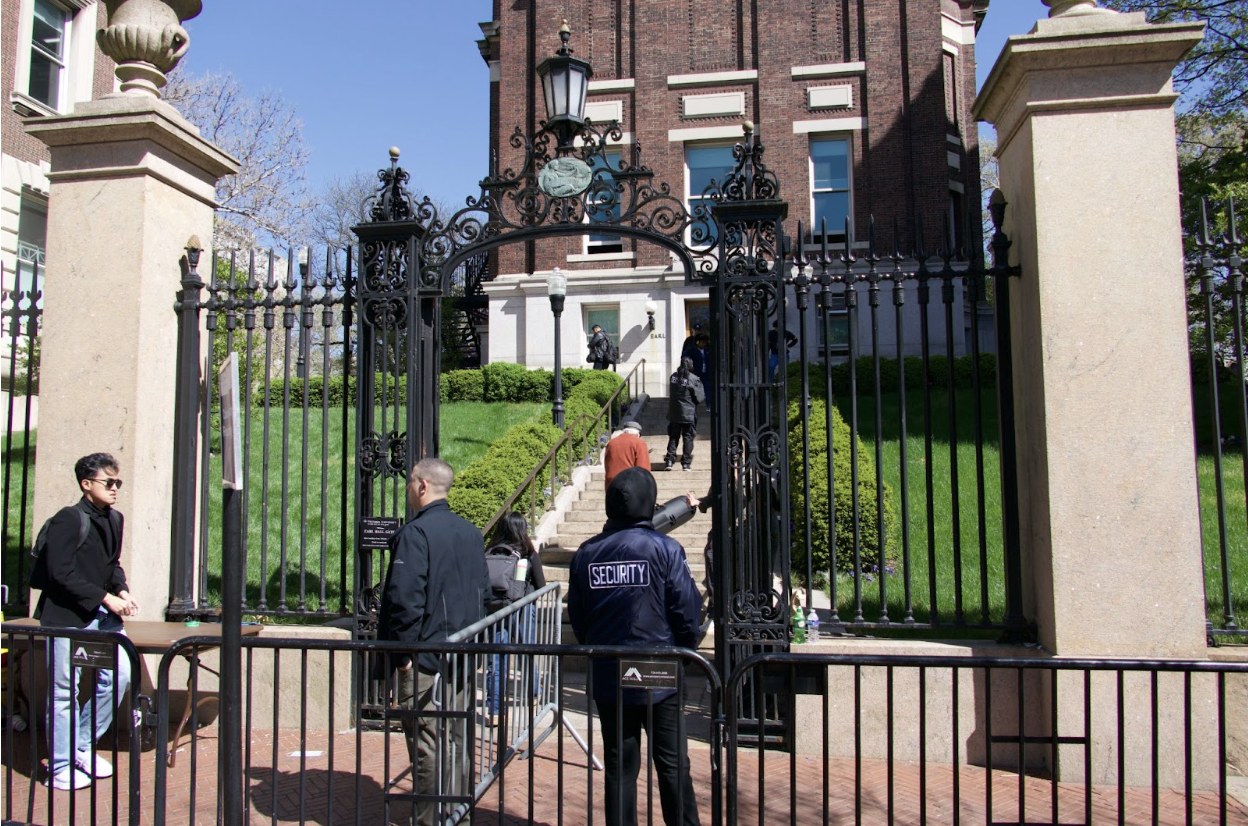
Security personnel monitor access to a side entrance of Columbia University during demonstrations on campus in April 2024. Photo Courtesy of wikimedia.

At approximately 6:30am on Thursday, February 26, Department of Homeland Security (DHS) agents entered a Columbia residential building on West 121st Street under the pretense of searching for a missing person and detained Columbia undergraduate student Elmina “Ellie” Aghayeva (GS ’26).
By mid-morning, the Columbia community received two emails. The first stated that “federal agents made misrepresentations to gain entry to the building” and instructed students and staff to ask for identification, contact Public Safety, and refuse entry to non-public spaces without a judicial warrant upon encountering law enforcement agents. At 2:42 p.m. on February 26, the Office of Public Affairs sent a second email releasing a follow-up that outlined the university’s response. Again, community members were instructed to “ask for identification,” “call Public Safety,” and were emphatically told, in bold and underlined text, “Do not allow entry.”
However, the recurring problem is not merely that DHS agents are constantly entering Columbia’s campus. Rather, it is that each time it does, the university responds in a way that shifts responsibility outward—onto federal agencies, onto legal procedure, and ultimately onto students themselves—rather than inward. Columbia’s response of announcing additional “Public Safety patrols and staffing,” protocol reminders for Residential staff, counseling resources, immigration webinars, and legal support upon Aghayeva’s detention once again reflects this pattern.
Although these measures are framed as preventative, they are largely ineffective in practice because they rely mainly on decentralized, real-time judgment by students, doormen, and Residential staff who lack both the legal authority and institutional backing to definitively deny entry to federal agents, especially when those agents act under urgent or misleading pretenses. In doing so, Columbia shifts the burden outward—not only onto students, but onto the broader campus community, from doormen to Public Safety officers, some of whom may themselves be non-citizens and therefore particularly vulnerable to the consequences of Immigration and Customs Enforcement (ICE) activity.
More fundamentally, the fear students feel in the face of ICE boils down to a larger question about whether Columbia can genuinely guarantee safety within its own residential halls and campus spaces. It is Columbia’s responsibility not only to reiterate the legal requirement that ICE present “a judicial warrant or judicial subpoena to access non-public areas,” but to implement structural safeguards that make those standards enforceable in practice.
Reports confirm that ICE has been on campus three times since March 8, 2025, and after each incident students have been directed to the same procedures that have repeatedly failed them. Although Aghayeva was released from detention, the need for direct intervention by New York City Mayor Zohran Mamdani and the President of the United States highlights the concerning absence of institutional safeguards. While some characterized this episode as puncturing “months of relative calm on Columbia’s campus,” describing it as “the first incursion by immigration police into a university building in nearly a year,” the Columbia community’s concerns have been ongoing. In the weeks preceding the detention, dozens of students and faculty protested outside of Columbia’s 116th Gates demanding “ICE off campus,” a protest that resulted in the arrest of twelve.
At the February 5 protest, demonstrators called on Columbia to “establish itself as a sanctuary campus and end its complicity with ICE.” Students have also repeatedly urged Columbia “to resist the pressure toward institutional neutrality demonstrated by the President’s advisory Committee” and to issue a public statement opposing ICE enforcement actions affecting the university’s students. In response, the university maintained that claims made during the protest were “factually incorrect” and reiterated that “no member of Columbia’s leadership or board of trustees has ever requested the presence of ICE agents on or near campus.” Mahmoud Khalil’s public allegation, following his March 8, 2025 detention, that university actions had contributed to his targeting casts doubt on Columbia’s response. More fundamentally, however, the response is reductive,narrowing the debate while simultaneously overlooking students’ substantive fears.
These fears were not limited to ICE’s presence in surrounding New York communities, but centered on the possibility that ICE’s activity could extend into Columbia’s own campus, where no clear institutional policies existed to meaningfully safeguard students. On February 25, just one day before Aghayeva’s detention, the Student Workers of Columbia held an “ICE off Campus” protest at the Sundial echoing the same fears as those on February 5th; the following morning, those fears were realized with the detention of Aghayeva––a detention that was, if not preventable, at the very least predictable had Columbia taken its students’ warnings seriously.
Ironically, while Columbia has hesitated to implement structural safeguards to prevent ICE presence in residential spaces, it has pointed to increased ICE activity as justification for broader campus security decisions. In an email at the beginning of the 2025–2026 academic year, Acting President Claire Shipman stated that “an increase in ICE activity” was a factor in the university’s decision to delay reopening Columbia’s gates until later in the year. However, this illuminates a concerning incongruity in the university’s logic: if ICE’s presence is significant enough to shape campus-wide access policies, why is it not significant enough to prompt stronger preventative protections within student housing itself?
If Columbia is serious about protecting its students, it must move beyond the abstract reallocations of responsibility that characterized its response to Aghayeva’s detention and instead centralize legal authority and institutional liability. Responsibility will always lie somewhere; the question is whether warrant review and enforcement decisions are made by students and doormen under pressure, or by designated university officials trained and authorized to assume that risk. For example, Hunter College requires that “any warrant, court order, or subpoena presented by law enforcement seeking access” to campus facilities first be reviewed by its Office of Legal Affairs before any action is taken. This policy does not, of course, guarantee that federal agents will comply with the requirement; however, it establishes a clear institutional protocol intended to ensure that legally complex determinations are made by authorized officials rather than by those at the door.
Columbia, by contrast, largely instructs students and staff to “call Public Safety,” without clearly defining who reviews warrants or who holds final authority. Given ICE’s repeated presence on campus and the university’s acknowledgment that agents “made misrepresentations to gain entry,” it’s clear procedural reminders alone are insufficient. While as of March 6, the university has announced additional training, signage, and security measures, further steps are necessary to ensure that legally complex decisions are not left to frontline staff in real time. In light of this pattern, Columbia could adopt a centralized, 24/7 law enforcement response protocol that codifies mandatory escalation, requires frontline personnel to defer immediately to a designated response team, and grants specific university officials binding authority over decisions regarding ICE encounters in residential spaces.
Furthermore, Columbia’s response need not remain purely internal. If federal agents in fact “made misrepresentations to gain entry,” as the university has stated, Columbia could pursue formal institutional and legal action. This could include filing an administrative complaint with the Department of Homeland Security’s Office for Civil Rights and Civil Liberties or its Office of Inspector General, issuing a formal request for documentation of the agents’ legal authority, or, if warranted, the university could also pursue litigation contesting unlawful entry into non-public residential space. These actions would not only shift responsibility beyond the Columbia community onto the DHS itself, but also send a clear signal that the university is willing to defend the integrity of its residential spaces through formal legal channels.
Ultimately, the issue is not that Columbia refuses to address ICE activity, but that it does so on its own convenient institutional terms and timeline. As both an academic institution and a residential community, Columbia has a responsibility to implement concrete, preventative safeguards that do not rely on students or residential staff to de-escalate situations with ICE. Its refusal to do so––despite invoking ICE activity to justify tightened campus gate security––suggests a concerning institutional willingness to impose burdens on neighboring communities while avoiding the more complex legal and operational actions required to implement preventative protection. The longer Columbia waits to meaningfully engage with students’ and faculty’s fears and demands, the more distrust will deepen between the university, its students and faculty, and the surrounding Harlem community as Columbia makes the distinctly non-neutral choice of deliberately leaving its staff, faculty, and students exposed to ongoing risk.
Jamie Kim (CC ’28) is an editor for the CPR Column, majoring in Creative Writing with minors in Political Science and Religion. She can be reached at jhk2207@columbia.edu.