If America won’t fight for Europe, who will?
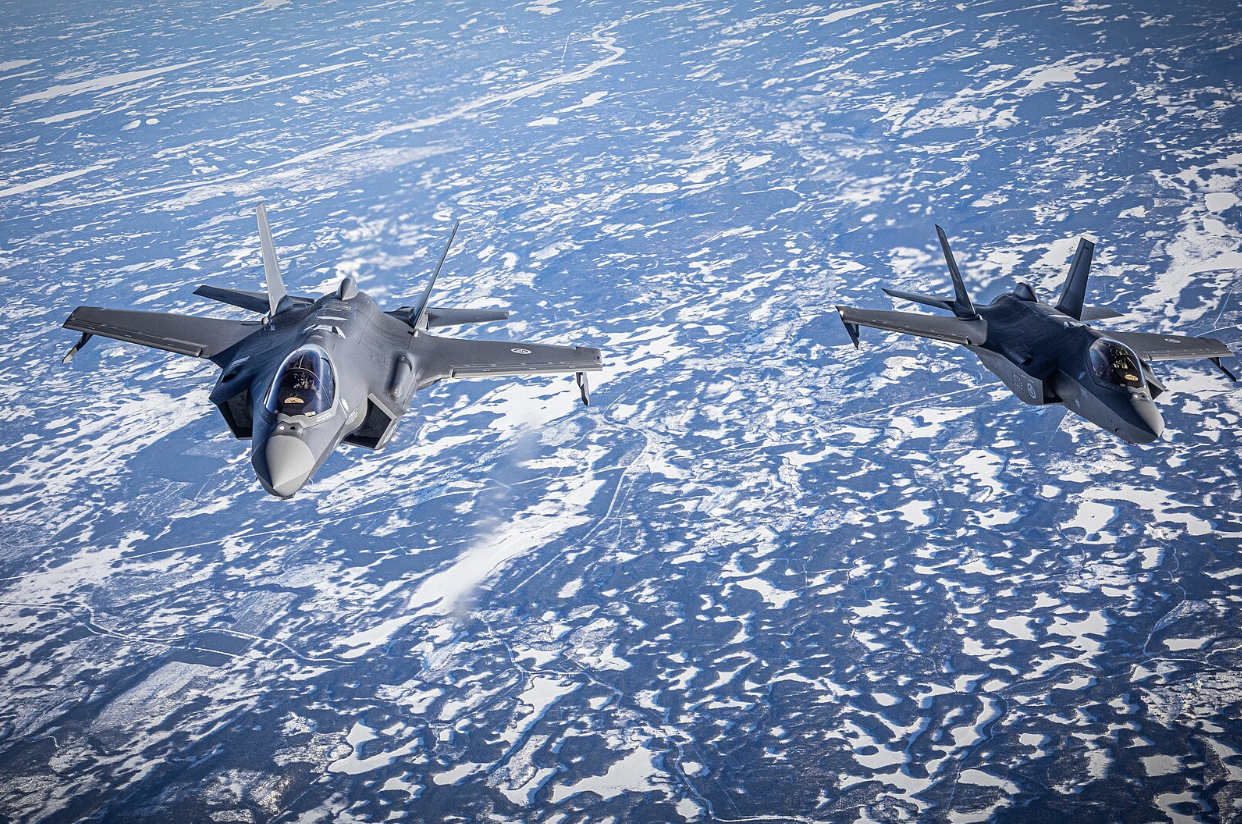
Two Norwegian F-35 jets lining up to receive fuel over Sweden as part of the Norwegian-led NATO military exercise, Nordic Response 24. Photo courtesy of Wikimedia Commons.
.jpg)
“The biggest mistake a human being can make is to think that anything can happen to anyone, except to him or her.”
This quote captured the essence of a speech given by the former Ukrainian Minister of Foreign Affairs Dmytro Kuleba, delivered while he toured the undergraduate campuses of Sciences Po Paris this past spring. As the wartime minister during the first years of the ongoing Russian Invasion, he had a dire warning to the largely European audience: if they can do it to us, they can do it to you too.
Mr. Kuleba delivered his speech in the backdrop of a radical shift in the international landscape. President Donald Trump had recently decried NATO countries who were not paying their fair share, announcing he would not uphold the collective defense ideal that binds the organization. His Vice President, JD Vance, had just taken the stage in Munich, encouraging European leaders to halt their suppression of far-right parties, an action he claimed posed a more dire threat to democracy than aggression from Russia or China. European leaders subsequently acknowledged the Munich Conference as a major turning point for U.S.-European relations due to the sharp change in foreign policy rhetoric. Despite a summit in the Hague this past June that revitalized NATO-centered talks, European countries still maintain the sentiment that U.S. warmth is largely transactional and prone to withdrawal.
Europe contributes to this shift in international power politics as well. Mr. Kuleba’s speech came after a year of far-right success in Europe, where Euroskeptic parties gained in the European parliaments, prompting questions about the idea of a unified continent. While outright anti-NATO beliefs mainly exist in fringe parties, support for current NATO policy is on weak ground. At the same Hague summit, protesters marched to show their discontent for defense practices and potential spending increases. NATO support is slipping amongst some of the strongest supporters of the alliance, such as Poland, even as they sit on the border of war in Ukraine.
If the European Union heeds Mr. Kuleba’s advice, they would understand that what has happened in Ukraine could arrive at their doorstep at any moment. The use of novel technology by Russia should be cause for concern. Artificial intelligence and autonomous weaponry has ushered in a new era of cyber-defense. Russia, unlike in the past, does not need an army to march across the Alps or Pyrenees to reach western Europe; they can wage war from afar. Moreover, Russian President Vladimir Putin’s recent hostility towards what he believes to be an aggressive and overly-militarized Europe could be a sign of what is to come.
But without a reliable US and amidst a growing imbalance of support for the organization, the European countries of NATO (NATO Europe) must take initiative and organize defensively. They must be prepared for any attack on any European country in the collective and rely solely on themselves for defense. If America won’t die for Europe, then Europe must be willing to die for itself.
NATO was born from a post-War need for strategic defense on the European continent. Like today’s Russia, the USSR proved an existential threat to democracy and peace in a war-torn central and western Europe. European defense leaders needed assistance from a strong superpower, and the US, looking to wage ideological warfare against its Soviet enemy, engaged in economic and military cooperation on the continent.
However, as Mr. Kuleba so grimly foreboded, the US has no obligation to remain in this union, or even in Europe as a whole. With its ideological enemy shifting towards China, economic warfare in the Pacific has taken precedence over waging a strategic war in Europe. There exists no binding reason for the US to defend Europe, and with a NATO-skeptic president at the UShelm, this link is at risk of failing at any point. Further, a rise in America-first ideals and a decline in support for international defense has sparked a question amongst the American public: why would they risk their lives for a continent an ocean away?
It is clear that NATO-Europe must become defense independent, but what would that look like?
Multiple strategies exist for European defense independence. The first strategy involves strengthening the leadership of the European pillar of NATO, ideally with the few nuclear-armed or high-firepower countries replacing the US as a guarantor of safety. Emerging leadership can establish itself as a distinctly European supreme commander, an analog to the Supreme Allied Commander Europe (SACEUR), which to-date, has been held solely by American military officers. Certain critics say SACEUR should remain in the hands of an American general, due to the US’s position as the world’s foremost military power. Putting a European military office in the post would place a large part of this military under non-American command for the first time in over a century. However, in a time of distance between the two continents, a European commander would allow greater centralization of NATO defense operations and chains-of-command that could work in congruence with, or in place of, disappearing American leadership.
European generals could start to take over lower-level leadership positions as well. For instance, the Trump administration proposed axing 4-star generals from the ranks of command operations of NATO as a cost-cutting measure. Europe could take advantage of this downgrade to appoint its own high-ranking generals to these positions, bolstering both the strength of the respective posts and Europe’s influence in strategic defense decisions.
Countries like the United Kingdom, France, or Germany—all of which have well-developed militaries—could take this charge. France, who has historically criticized NATO’s dependence on America, could replace the nuclear umbrella of the US with similar provisions in a concerted nuclear doctrine. Germany, usually in opposition to the French vision of European defense, now wants closer relations with both France and the UK. If the US leaves NATO, as the French have feared, a joint, European-centered defense agenda could come to fruition. French and German leadership could prove vital to ensure the nuclear defense and cooperation of Europe in the face of a mounting Russian threat.
A second strategy involves creating a European army, or at least the strengthening of joint-military operations within NATO Europe. In the case of a Russian invasion, estimated ground necessities number as many as 200,000 extra troops and a minimum procurement of over 5,000 vehicles and artillery. This would be feasible if, as currently planned by NATO, the US would be the sole contributor of these arms. But, as the US begins a drawback of American troops on the continent, the reality of a fractured and weak European military apparatus may soon appear—one that may not be able to replicate America’s firepower. Even if Europe could raise this army, US soldiers come from one centrally commanded military, not from 30 disjointed armed forces. The current sum of NATO-European troops outnumbers that of the US, standing at 1.7 million active duty soldiers; however, they are not unified under one command structure that would facilitate defense operations in the case that the collective defense of the coalition is invoked. Without a joint-command structure, theorized invasion scenarios necessitate more than 300,000 additional European troops if the US decides to fully disengage from the continent.
If Europe is not able to yield this strength, then at the very least, a centrally coordinated command of the numerous armed forces is necessary for European defense independence. While ambitious, this idea has previously been floated in talks about common European defense. The French and British coordinated Saint-Malo declaration was an early indicator of a potential European reserve force. Drafted in 1998 due to the Kosovo War, the agreement promised to create a 60,000-strong autonomous European force to respond to armed conflict. Though 300,000 is a near five-fold increase in strength, meaningful and proactive action by leaders such as France, the UK, or Germany can lay the foundation for a potential European military.
Additionally, national armies should carry out strategic coordination with their constituent militaries to maximize their joint-capability. Previous NATO-wartime operations have been criticized as uncoordinated, despite the overwhelming, on-paper strength of the organization. The Libyan Civil War is a stark example of this, where detractors claim NATO involvement ultimately cost the lives of 8,000 civilians and that operation leadership, such as France and the UK, were strategically fazed by the US’ backseat role in the campaign. The lack of military readiness was also evident in NATO operations in the American invasion of Afghanistan, with the slow application of resources, frequent command changes, and overlapping responsibilities cited by critics as examples of strategic failures during the operation.
Ultimately, continuous, regular, and joint military exercises can help reduce the incidence of strategic shortcomings and can increase the interoperability between Europe’s otherwise disjointed armed forces. Joint practice operations not only provide strategic cooperation, but can serve as methods of deterrence as well, staving off potential aggressors from attacking. It also provides comfort for the small periphery countries that make up Europe’s border with Russia. The larger, more militaristically prepared countries sit in the north and west of the continent; periphery countries with less military manpower, like those in the Balkans and on the Baltic, can benefit from increased defense expertise and joint command capacity that comes with regular and diverse military exercises.
These strategies, however, are null if NATO Europe is not able to fund them. Experts indicate that simply arming the continent to stand up to Russia will take years of increased financial contribution, with countries needing to spend at least five percent of their GDP towards their respective militaries. These strategies of defense independence, as necessary as they may be, will be costly. But in a changing geopolitical world where, as Mr. Kuleba emphasized, anything can happen to anyone, this independence is paramount. Europe must take control of its defense as a colder America distances itself. If Americans won’t fight for a future Europe, then Europeans must put their own lives on the line to fight for themselves.
Pracheth Sanka (GS ‘28) is a sophomore in the dual-degree with Sciences Po at the Menton campus, studying politics and government. He can be reached at phs2122@columbia.edu.