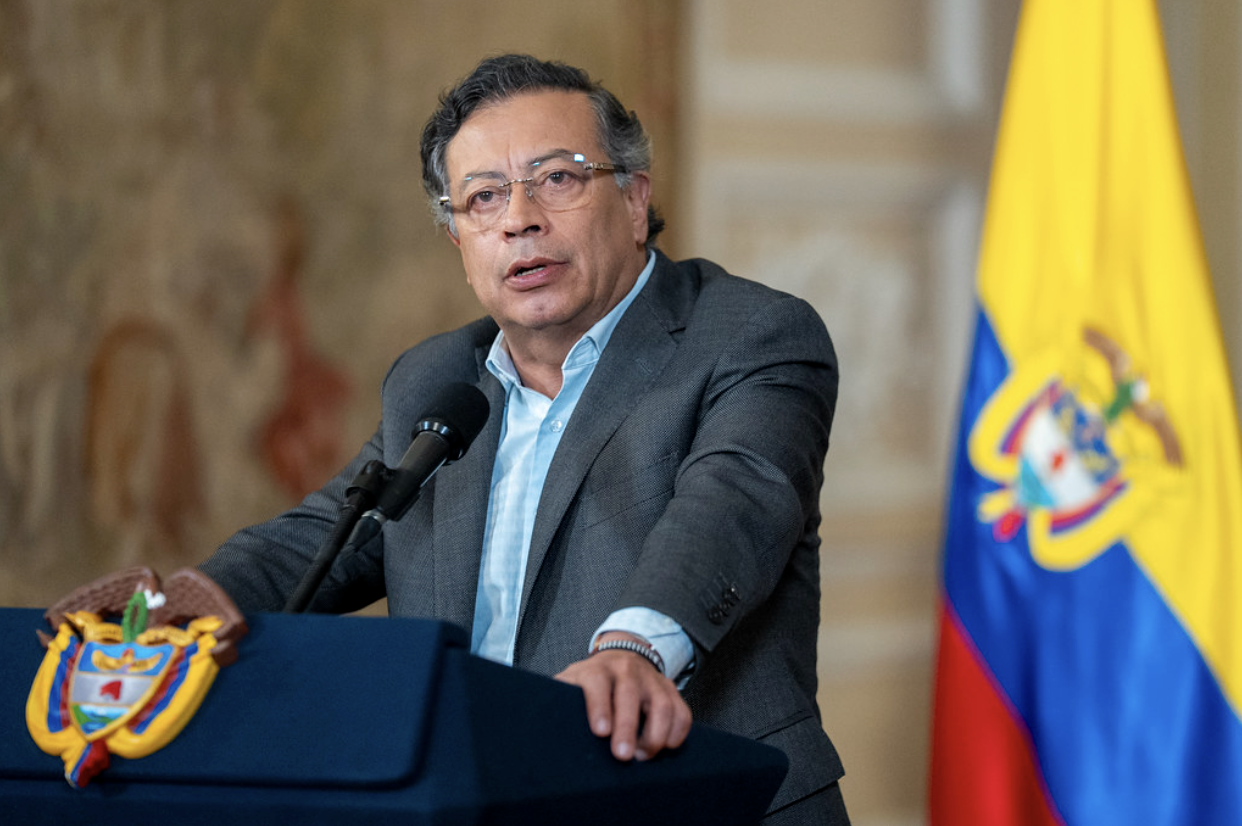
Colombian President Gustavo Petro stands at the center of a foreign-policy shift that has redefined the country’s relationship with the United States. Photo courtesy of OpenVerse.
The nation of Colombia has stood as one of the United States’ most reliable allies in Latin America for decades. The partnership, forged through counter-narcotics cooperation and cemented by a free-trade pact, once symbolized Washington’s vision of a stable, US-aligned hemisphere. However, given the recent changes in US and Colombian political priorities, that framework has begun to crack. In the span of a single year, the alliance has weathered trade disputes, clashing foreign-policy ideals, and even the revocation of Colombian President Gustavo Petro’s US visa. The United States’ recent escalation of tariffs, visa restrictions, and public rebukes against Colombia marks not an isolated diplomatic spat, but a broader unraveling of the US–Colombia alliance, driven by the collision of Washington’s coercive trade policies and Bogotá’s ideological realignment under President Gustavo Petro. Economic pressure and moral conviction are colliding across the Americas, signaling the breakdown of a longstanding partnership as the United States punishes Colombia for opposing its policies and asserting its independence.
Economic threats began early into President Trump's administration when a dispute over US flights to Colombia carrying deported individuals triggered a series of escalating trade threats. Between January and April, Washington warned it would impose tariffs up to 25 percent on Colombian imports unless Bogotá cooperated. Trade, once a tool of partnership, became an instrument of punishment. In April, the United States followed through with a 10 percent global tariff that included Colombia, a measure that cut into exports, slowed trade, and risked thousands of domestic jobs. The United States justified its actions as a defense of economic fairness and security, but for many in Bogota, it revealed a willingness to weaponize the geopolitical relationship.
What might have once been settled through diplomacy became a public show of leverage with much more significant, broader impacts on the Colombian people. Colombia’s economic reliance on US markets, long seen as a pillar of stability, had become a point of vulnerability. Ideological beliefs exacerbated these rifts in the alliance. In May 2024, President Petro severed diplomatic ties with Israel, denouncing its government as “genocidal” in response to the Gaza war. By July 2025, he was hosting a “Hague Group” summit in Bogota, urging nations to resist Israeli aggression and calling on the United Nations to assemble an “army of nations” to liberate Palestine.
Colombia’s foreign policy shift has placed the country within a rising current of left-leaning, sovereignty-focused governance across Latin America, described as a “Pink Tide 2.0.” This regional movement reflects governments seeking greater autonomy in foreign affairs, reduced dependence on Washington, and alignment with Global South causes. Yet this turn directly clashed with the Trump administration’s reassertion of US dominance under what foreign policy analysts have informally dubbed a Second Monroe Doctrine or ‘Donroe Doctrine’. This framework has shaped Washington’s increasingly coercive foreign policy in Latin America and underpinned its intolerance for ideological deviation within its own hemisphere. For decades, Bogota’s foreign policy largely aligned with US interests. Now, under Petro’s leadership, Bogotá has emerged as a central challenger to US hemispheric authority, a role that the Second Monroe Doctrine increasingly frames as subversive.
Petro’s decision resonated with students, activists, and citizens across Latin America who saw Palestine as a test of global justice. For Washington, however, Colombia’s defiance was not simply moral self-assertion, but geopolitical insubordination. The US responded swiftly and severely, signaling that it would impose economic and diplomatic consequences on countries that assert ideological independence. This pattern echoed the Trump administration’s broader posture toward the region, evident in its rollback of ties with Cuba and its intensified sanctions on Venezuela, showing how left-leaning governments often face US pressure for ideological reasons.
In September 2025, after President Petro spoke at a pro-Palestine rally outside the United Nations headquarters in New York, urging US soldiers to “defy orders” supporting Israel, President Trump revoked Petro's visa. The move was largely symbolic as sitting heads of state rarely need standard visas, but its implications were profound. By targeting Petro personally, Washington signaled that disagreement would be met not with dialogue but with exclusion.
Petro criticized the decision on social media as a violation of international norms, and Trump responded, asserting US dominance and defending his actions. By escalating into a public, personal clash on social media, the feud marked the moment the long-standing US–Colombia alliance openly fractured. Colombia soon recalled its ambassador from Washington, signaling the lowest point in bilateral relations in decades. In October 2025, President Trump announced that the United States would halt all foreign assistance to Colombia. Prior to this incident, the country had received an estimated $230 million USD in the last fiscal year and over $700 million USD in 2023.
The rupture carries implications well beyond Bogotá and Washington. For Latin America, Colombia’s defiance represents a test case for how far smaller nations can assert autonomy in a system still dominated by US power, especially given Washington’s increased enforcement of ideological rigidity. For the United States, these events reflect a new approach to dissenting allies, relying on tariffs and diplomatic isolation rather than cooperation and persuasion.
For Colombia itself, the dilemma is deeply existential. Petro’s government must now balance moral conviction with material necessity. Its solidarity with Palestine affirms Colombia’s values on the world stage, yet its economy remains tethered to US trade. Millions of Colombians depend on remittances and migration channels linked to the US economy. Washington’s means of coercion still carry weight, even as political authority diminishes. Every act of resistance risks economic repercussions, a vulnerability the US has increasingly leveraged as a form of coercive soft power. At the same time, Colombia has begun expanding trade ties with China, a shift visible across Latin America. But whether this gradual reorientation can provide enough economic stability to offset potential US retaliation remains uncertain. Petro’s challenge is thus not only political but philosophical: can a nation stay true to its principles without sacrificing prosperity? While Petro should maintain his ideological stance as a demonstration of national autonomy and the right of each state to form its own convictions, doing so challenges the US expectation that its economic power can set the boundaries of Colombia’s sovereignty.
The rupture between the United States and Colombia represents more than a temporary diplomatic dispute: it reveals a deeper realignment in the Americas. Morally, it is troubling for a larger power to wield economic support as a means of coercing ideological conformity. Such actions perpetuate hierarchies that threaten the authenticity of national identity and the freedom of global political expression. Colombia’s resistance exposes a broader decline in US influence across Latin America. Once the uncontested leader of the hemisphere, the United States now confronts a region more ideologically pluralistic and less compliant. As the US punishes dissent, reviving a Monroe Doctrine approach, it hastens the erosion of the very influence it seeks to preserve. Nations across the region now exercise greater autonomy in trade and ideology, limiting Washington’s ability to shape outcomes. Ultimately, the US–Colombia rupture illustrates a shifting world order, one in which coercion can no longer disguise insecurity, and where US power will continue to erode if it cannot adapt to a hemisphere increasingly unwilling to sacrifice autonomy for alignment.
Sharanya Maulik (BC ’28) is a staff writer for the Columbia Political Review studying political science and economics, with a focus on voting behavior and macroeconomic policy. She’s also unusually good at planning her next hypothetical vacation with budget flights. She can be reached at sm5797@barnard.edu