Selective Abortion and Pro Choice’s Selective Advocacy
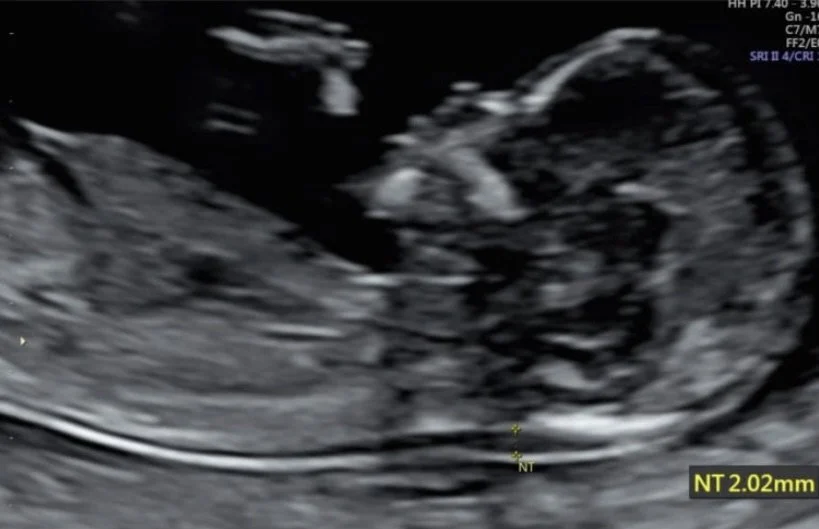
An ultrasound scan measuring nuchal translucency measurement and presence of the baby’s nasal bone to determine Down Syndrome at 11-13 weeks. Photo courtesy of Western Imaging For Women.
In 2008, Sarah Palin gave birth to her son Trig, who has Down syndrome. From that point on, her prevalence in the right-to-life debate was intensified. In a 2015 interview with CNN, Palin recounted her own “kind of devastating” experience receiving Trig’s prenatal diagnosis, but urged mothers, as she did, to overcome fear and embrace the beauty that comes from “a child being a little different.” In the interview, Palin voiced her support for Ohio House Bill 214, a policy that would ban all abortions in cases where the fetus has Down syndrome. She added that her experience with Trig only “solidified [her] family’s support for the sanctity of life,” and that high rates of Down syndrome abortion–estimated at 67% in the US–are emblematic of a culture that views life as something “to be just thrown away.”
Palin is just one of many pro-life Republicans to express outrage over ability-selective abortion. Mike Pence, then governor of Indiana, signed into law in 2016 a bill prohibiting abortions based on a Down syndrome diagnosis, referring to it as a “comprehensive pro-life measure.” And in 2021, North Carolina Republicans proposed legislation that would require physicians to attest that abortion was not sought due to the likelihood of Down syndrome–immediately prompting widespread resistance from Democratic lawmakers, the ACLU, and Planned Parenthood on the basis of protecting a right to abortion.
Spurned by progressive, pro-choice spheres, opposition to neoeugenic technologies–modern technologies allowing for greater parental choice, including prenatal screening, prenatal diagnosis, and preimplantation genetic diagnosis–is adopted by the anti-choice right. In its satisfaction of liberal values, scientific progress, and individual choice, neoeugenics has evaded much-needed critique for its discrimination against the disabled–reform and critique that pro-choice voices must mobilize.
Due to advancements in prenatal technology, neoeugenics indirectly encourages selective gestation through abortion of disabled fetuses, from cystic fibrosis to spina bifida to–as this article will address–Down syndrome.
Since its post-WWII birth, neoeugenics has existed in the liberal political climate of personal choice and scientific progress, making it fundamentally distinct from early 20th-century classical eugenics, its pseudo-scientific, authoritarian parent. Classical eugenics infamously utilized race-based categorizations to execute campaigns of mass sterilization that aimed at an “ideal human race,” but neoeugenics–medically tested, safe, and with no element of state coercion or mandate–ostensibly poses no such threat of infringement. Bioethicist Nicholas Agar–who coined the term “liberal eugenics” in his 2004 book Liberal Eugenics: In Defence of Human Enhancement–argues that neoeugenics is morally distinct from authoritarian eugenics because it is a “radical extension” of “procreative freedom.”
Prenatal diagnosis, in essence, simply provides parents with health information about their child, as is surely their right. But pro-choice advocates, wholly satisfied with neoeugenic’s progressive presumptions, too easily discount the negative impacts of these technologies.These drawbacks lie not in the technologies themselves but the cultural environment in which they operate–one which fails to address systemic obstacles to bringing a disabled child into the world. It is this environment of liberal conviction that has enabled neoeugenics to exclude Down syndrome from future generations while continuing to operate under bioethical standards.
In a 2018 lawsuit against Ohio House Bill 214, the ACLU rightfully denounced the law’s failure to provide resources for parents of children with Down syndrome, insisting, “We will never address discrimination and the needs of people with disabilities by stigmatizing people who have abortions.” But discussion among Democrats on how to address discrimination in prenatal care is, in fact, nowhere to be seen. The reality is that people with Down Syndrome in the United States are presently being eliminated–the time for Democrats to directly address the discrimination that works through gestational care has, more than, arrived.
But addressing this issue will be impossible as long as American liberal politics remains tied to an all-encompassing doctrine of personal choice. This commitment has undeniably been instrumental to feminist successes in reproductive autonomy, but when applied to new technologies without regard for societal reverberations, it appears less progressive. What can we do when protecting the choice to have a child or not implies choosing against a certain type of child?
Much of the failure to address this question can be traced back to liberal interpretations of and commitment to the right to privacy. Although both cases are now overturned, the majority decision in Planned Parenthood v. Casey, in upholding Roe v. Wade, defended the right to abortion as an extension of the right to privacy, providing that any infringement of the government upon personal reproductive choice is unconstitutional. This right to privacy traces back to the 1965 Griswold v. Connecticut decision on contraceptive use, which drew from the personal liberties given through the First, Third, Fourth, Fifth, and Ninth Amendments–and was later extended to protection under the Fourteenth Amendment, as argued in Roe and Casey. In fact, in the 2018 case against Ohio House Bill 214, the ACLU argued that legislation preventing selective abortion violates “the very heart of the Fourteenth Amendment right to privacy and autonomy.” In the Casey decision, Justices Souter, Kennedy, and O'Connor evoked the sentiments of modern reproductive liberalism, saying “[A]t the heart of liberty is the right to define one's own existence, of meaning, of the universe, and of the mystery of human life.”
But there are communal repercussions to giving a blank check for everyone to “[define]... the mystery of human life” on their own terms. The protection of the right to privacy has partially constructed a “thin conception of autonomy and decisional privacy” that disregards the social and institutional ableism that impacts personal reproductive choices. In the words of Rhonda Shaw, researcher of ethics and medicine, prenatal diagnostic technologies “have less to do with expanding freedom of choice than with regulating the sorts of reproductive bodies and offspring allowed in liberal societies.” Through the total liberation of certain bodies, we limit others–namely, current and future generations of people with Down syndrome, who will see these new genetic standards for a “worthy member” of the new generation as an existential blow to their own personal worth.
The ableism in reproductive justice can be further contextualized through a much earlier case, one directly oppositional to the ideals of the Casey decision: Buck v. Bell. In this 1927 case, the majority opinion concluded that forced sterilization of disabled (“feeble-minded”) women did not violate the Due Process Clause. Despite the progress in protecting reproductive autonomy in the late twentieth century under the 14th Amendment, Buck v. Bell was never fully repealed. Forced sterilization of young mentally disabled women, though it appears an ancient policy of classical eugenics, can still be legally executed in thirty-one US states. This failure of modern progress exposes a break in the continuity of personal reproductive autonomy–disabled people, both as mothers and as children, are treated differently under current reproductive policy.
This failure to counteract ableism in gestational care is evident in the practices of the medical institutions. Prenatal choice is made possible through “informed, sympathetic counseling,” supposedly not meant to encourage, but rather to inform parents of their options for a pregnancy with a disabled child. Despite this standard, after the diagnosis of a fetus with Down syndrome, positive information about having a disabled child is rarely included, only drawbacks. And while 86% of genetic counselors mentioned termination after diagnosis, only 37% mentioned continuing the pregnancy. These facts undeniably constitute a claim of ableism against neoeugenic prenatal care, which Democratic policymakers and liberal nonprofits continually neglect.
But there is certainly a place for critique of neoeugenics within pro-choice arguments. Just as we would resist genetic selection on the basis of race or sex, we must resist selection on the basis of ability. Above all, it must be emphasized that access to prenatal technology and protection of a right to abortion for women carrying disabled children should be protected, just as with any other pregnancy. To achieve the ideal of “seizing the means of reproduction” without empowering established systems of discrimination, the goals of reproductive control and social equity must be pursued cooperatively.
To formulate a better future of reproductive choice, we must examine the situations that lead women to choose to terminate fetuses with Down syndrome. Many mothers are concerned with a high risk in those with Down syndrome of heart defects, leukaemia, early dementia, and potential inability to be independent in adulthood, leading them to terminate, in many cases, wanted pregnancies. Healthcare costs exacerbate the issue–families of children with Down syndrome amass incremental out-of-pocket medical costs of $18,248 between birth and age 18 years. This financial obstacle is insurmountable for many families, not to mention the financial burden that arises if a parent must stay home to care for their child. These reservations derive predominantly from a lack of societal support for children with Down syndrome and their parents, both when it comes to non-preventable medical risks (heart defects, leukaemia, dementia) and somewhat malleable social factors (social exclusion, discrimination, difficulty of independence).
Greater Medicaid support and broader subsidies for parental care of disabled children in the home are necessary to address these concerns. At the policy level, Democrats must argue more broadly for policy that creates spaces for those with Down syndrome. As widely advocated for by the National Down Syndrome Society (NDSS), funding must be increased for special education services, professional development programs, and community-based services. Initiatives such as tutoring, career training, and youth social programs, while currently supported by a number of nonprofits like the NDSS and Gigi’s Playhouse, must be more widely accessible for those with Down syndrome and their families.
Neoeugenics can be contested without demeaning the right to abortion–we need only to make our country a better place for disabled children and adults. In our highly developed society, resources and advancements have made it possible for us to work towards a more accessible future for disabled people–it is regressive to allow, unchecked, the possibility that they may be removed altogether. For the future of disabled Americans, it is imperative that pro-choice voices confront this tension and work towards a more equitable future.
Abra Cotner (CC ‘29) is a staff writer from Danville, Pennsylvania. She studies political science and history and can be reached at alc2336@columbia.edu.