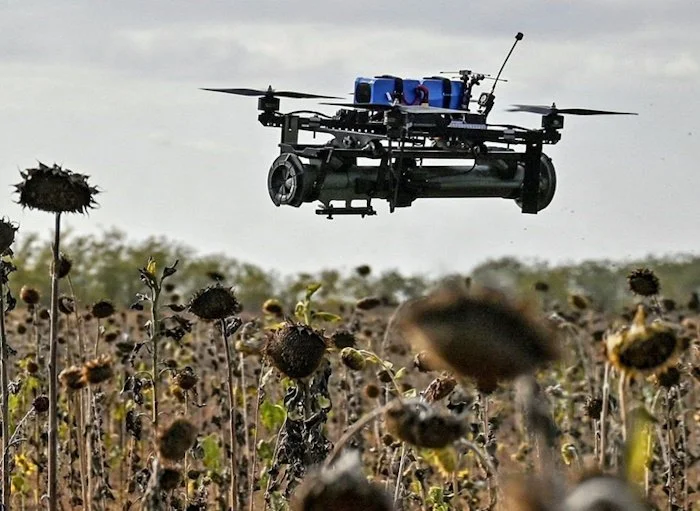
FPV drone hovering above Ukrainian sunflower field, symbolizing the use of new technology in the Russo-Ukrainian war. Photo courtesy of the Centre Culturel Cao Dai.
On May 25, 2026, Pope Leo XIV released his first encyclical, the Magnifica humanitas in which he dismissed just war theory as “outdated,” sparking conversation around the theory’s value in religious, academic, and political realms. Regardless of whether one follows Catholic tradition, the letter questions the ideological foundation of international humanitarian law, making analysis of just war theory’s relevance to contemporary conflict indispensable. Just war theory is divided into two pillars: jus ad bellum and jus in bello, respectively referring to the “right towards war” and just conduct during war, regardless of whether it was just to wage that particular war. Jus ad bellum lies on the foundation of a just cause, the declaration of war by legitimate authorities, equality of capacity between the actors, and a high probability of victory as well as right intentions; jus in bello, in turn, gives noncombatants immunity and prohibits excessive violence.
The undeniable influence of the theory is most prominently demonstrated through its influence on the Geneva Conventions, which shape humanitarian legislation worldwide. The Geneva Conventions, signed in 1949 by 196 states, are among the most widely accepted treaties and are recognized by the UN under Article 102 of the UN Charter. Therefore, prominent frameworks for the protection of peace in the post–WWII world order have ideological origins in just war theory, making it vital in understanding modern debates and legislation on conflicts like the Russo-Ukrainian war. However, cyberwarfare and the movement of war into the public sphere, has created a disparity between the reality of modern conflict and the response that 20th century mechanisms, based on just war theory, generate. The public sphere, as defined by Habermas, refers to “the domain of our social life in which such a thing as public opinion can be formed.” What has changed today is that social media allows for public opinion not only to be formed, but to exert influence on international response to war.
Reading the Russo-Ukrainian war against just war theory reveals its shortcomings in setting an effective framework for response to modern conflict. This is because of the seemingly conventional nature of combat in this particular war, that being between national militaries and often using familiar military tactics; however, even in a war that doesn’t seem to violate previous understanding of conflict as per the just war theory, the latter falters in its analysis due to emerging norms and technologies.
For example, military experts, like the former Commander-in-Chief of the Armed Forces of Ukraine Valerii Zhaluzhny, have emphasized the extent to which the Russo-Ukrainian war marks the beginning of a new kind of warfare, calling it a “a war of attrition fought with drones, algorithms, and high-precision systems.” He criticizes Western governments and NATO for failing to adapt and urges them to abandon their “strategic paradigm shaped by the Second World War.” A failure to adapt to such changes in the nature of conflict results in unsustainable aid and response: despite a military contribution of over $197 billion to Ukraine from bilateral donors like the EU, G7, and other countries, military experts emphasize that aid should focus on integrating new systems, rather than simply supplying arms. For example, Zhaluzhny urges NATO to reconsider its economic model focusing on arm contributions, saying “while [Ukraine] looked for more drones, [Russia] redefined the battlefield.” This is reinforced by NATO deputy supreme allied commander Europe Air Chief Marshall Johnny Stringer who said Ukraine’s rapid production of drones should serve as a “wake up call” for the alliance as other military operations (namely the US campaign in Iran) have exposed the danger of failing to integrate a diversity of autonomous systems. Therefore, it is evident that, on a military level, there is a discrepancy between the way in which modern warfare is evolving alongside new defense technologies and international response to it.
This disparity is also attributed to developments in cyberspace that cause ambiguities surrounding the application of just war theory. Namely, a lack of clarity in the distinction between combatant and noncombatant, peace and war, and defense and attack make narratives of conflict more malleable, and therefore less universal.
Between sovereign states with international legitimacy, the Russo-Ukrainian war appears to be a more rigidly defined conflict than most in the present; nevertheless, in this war, the uncertain boundary between combatant and noncombatant diminishes the effectiveness of just war theory. If noncombatants are protected, an actor is at a disadvantage since each civilian has now gained the capacity to exert influence on an international platform, steering the focus of the debate surrounding conflict. For example, civilian representatives of the Russian state are present on an international platform, such as in the reintroduction of the Russian Pavilion at the Vienna Biennale. Shlava Nikvashvili told Politico that “the fact that institutions are once again debating how Russia should participate, instead of whether accountability has happened, already shifts the narrative in Russia’s favor”; furthermore, Russia has recently charged the founder of the social media app Telegram with aiding terrorism, showing the extent to which the regime perceives noncombatants as a threat because of the power the public sphere holds over political legitimacy.
In his encyclical, Pope Leo emphasized the dangers of using just war theory, stating that “communication networks, fragmented information environments and algorithms that reward conflict can magnify polarization and resentment, increase propaganda and make shared discernment more difficult”; however, while the Pope highlights the dangerous consequences of using the theory, he fails to note that these negative effects are not inherent to the theory itself, but are rather the repercussions of its incompatibility with modern warfare in that the former necessitates rigid boundaries and the latter requires a granular understanding of civilian participation. Today, unlike in the 20th century when the theory gained prominence in international frameworks, approximately 5.79 billion people on Earth have access to social media. Each individual social media account is able to reach a multitude of others from all over the world. This is especially relevant because anthropologists like Dudier Fassin posit that modern wars focus on hearts and minds as humanitarian ideals drive policy and legitimize actions. This phenomenon combines with the capacity of each individual to exert influence to create an information environment that, according to Jen Easterly, “is so fragmented that it doesn’t necessarily matter whether something is true. It matters whether it goes viral.” Thus it is in this way that noncombatants become both a threat and an asset to a state's agenda, undermining just war theory in its need for a rigid understanding of participation to analyse conflict.
Furthermore, increased capacity to carry out cyber attacks undermining critical infrastructure has also contributed to an uncertain distinction between peace and war, fracturing analysis of both the declaration and conduct of war. For example, Russia conducted a full scale invasion of Ukraine on the 24th of February 2022, suggesting that the application of jus in bello is to begin at that point; however, even before the 2014 annexation of Crimea, scholars have pointed to Russia’s strategy known as new-generation warfare, which forwards the argument that the boundary of peace and war cannot be defined using solely the presence or absence of state-sanctioned physical invasion.
Under this approach, the targeted battlespace is the mind, making it incredibly difficult to identify when one party is conducting an attack. According to Olexandr Hryb, it is in fact “impossible to identify whether a society is under information warfare attack because incoming flow of information is constant so can only be detected from post event results of destruction.” When a point of attack, and therefore the beginning of a sort of war, cannot be identified, how can either of the pillars of just war theory be applied?
As covert attacks become more prominent, the definition of an action as defensive increasingly loses weight, further diminishing the extent to which just war theory is useful in analysing and responding to conflict. According to the theory, violence has to be defensive. But in a world where perception is moulded by the media, the validity of a so-called defensive action is increasingly difficult to establish. In 2022, Russia’s invasion of Ukraine was deemed an act of aggression by many international actors like Amnesty International, who called it a “crime of aggression.” But while the international community largely considered the act an aggressive violation of sovereignty, the Russian narrative centered around the idea of defense from the Western ploy to enable regime change in Russia post-Cold War.
Nonetheless, the Pope is right to point out the consequences he does: as the technological landscape evolves, actors with sufficient structural and soft power can exploit their ability to shape perceptions, knowing that as long as they can rationalize their actions fitting into “just” categories, they cannot face a detrimentally concrete response. For example, Russia has consistently portrayed Ukraine as a fascist and corrupt state to demobilize international support, which has proven to be successful among American citizens with over one fourth of those taking part in studies believing that “up to half the U.S. aid money given to Ukraine was stolen by Ukrainian officials for personal use”. Therefore, the danger of using just war theory, which has become increasingly more prone to manipulation, is that there is truly no framework that can be consistently interpreted and applied in response to aggression, reducing the capacity of international law to uphold standards of respect for human rights and safety.
It is therefore unrealistic, and in fact destructive, for actors like the UN and state governments to continue relying on just war theory in an age where the definitions it necessitates are increasingly more inconsistent. Dominant political actors must adapt their understanding of modern-day war, continuously revising frameworks to the facts available rather than grasping onto models that have now become tools for aggression and manipulation as opposed to protection. Just war theory has been challenged on military, religious and ethical grounds—is it time to reconsider its foundational role in international human rights law.
Oleksandra Gordiyenko (GS '30) is a student in the Dual BA with Sciences Po at the Menton Campus. She can be reached at og2359@columbia.edu