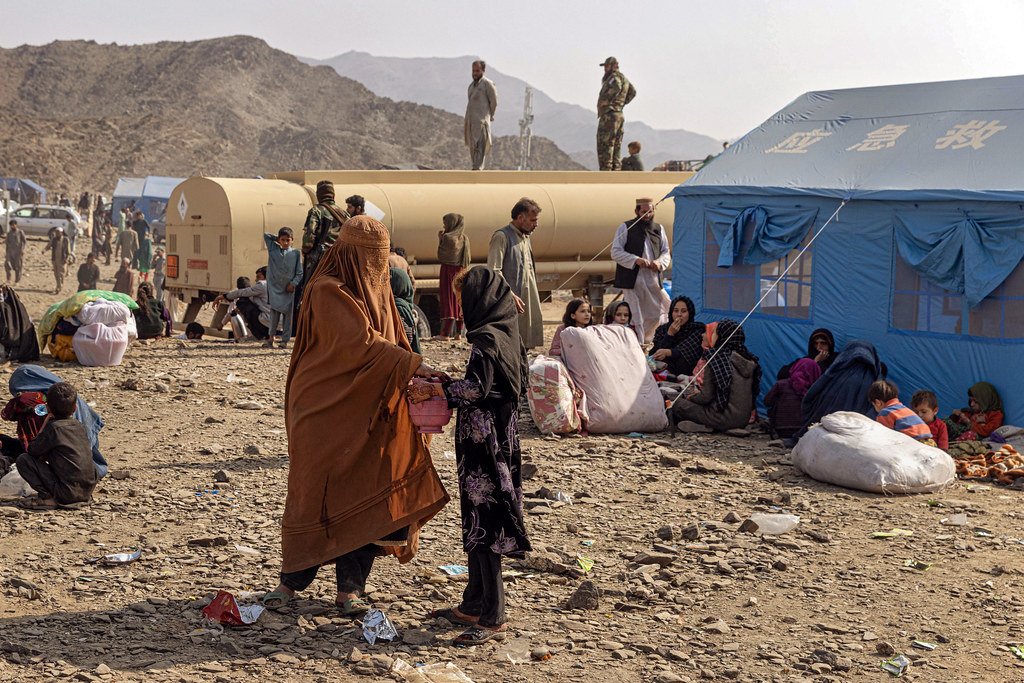
Afghan families cross into Afghanistan at the Torkham border crossing after being expelled from Pakistan, part of a mass deportation campaign that has intensified alongside the broader conflict between the two countries. Photo courtesy of UN Women/Sayed Habib Bidell
In June 2026, Pakistan launched an air strike along its border with Afghanistan that the government says killed 26 militants. Afghanistan’s Taliban government tells a different story: 13 dead, including 11 children, whom they classified as non-combatant civilians, and 14 others wounded in a residential area. Such a discrepancy in casualty counts has almost become routine, with each country narrating the same strikes as either counterterrorism or civilian slaughter. The strikes themselves have also become routine. This recent air strike is just the latest in a war that has been building for over a year between two governments, which, five years ago, were allies.
This reversal is stranger than it may first appear. For most of the two decades-long US occupation of Afghanistan, Pakistan was widely understood to be the Afghan Taliban’s chief patron. Pakistan provided a safe haven for its leadership, intelligence support, and diplomatic cover largely as a hedge against Indian influence in Kabul, a strategy Pakistani officials have long called “strategic depth.” The idea emerged from Pakistan’s narrow geographic layout and a desire to avoid military encirclement. When the Taliban reclaimed power in August 2021, it was reasonable to assume their relationship with Pakistan would deepen, but instead, that assumption has proven wrong, escalating into the most serious military confrontation between the two countries in decades, raising the question of whether “strategic depth” ever functioned as intended. While it may have served Pakistan’s interests in the short term, it failed in the long term as the Afghan Taliban gained autonomy and turned inward to spawn domestic militancy inside Pakistan.
After the Taliban’s return, however, the relationship quickly soured over the Tehreek-e-Taliban (TTP), an independent militant group that shares ideological ties with the Afghan Taliban. TTP attacks inside Pakistan increased as militants operated from safe havens in Afghanistan, while Kabul resisted Islamabad’s demands to take decisive action against the group. Pakistan responded with growing diplomatic pressure, cross-border strikes, and increasingly aggressive policies toward Afghan refugees. By late 2023, Pakistan had begun mass deportations of undocumented Afghans, further straining relations between the two governments and deepening resentment in Kabul. Islamabad assumed that the Taliban’s comeback into power would become strategic leverage in the region, but instead it led to a recurring security liability as the Taliban government was unwilling to subordinate its own political authority and security priorities. Pakistan increasingly viewed Afghanistan as a security threat, and by 2025 the relationship had moved into direct military confrontation.
The pattern of escalation
On October 9, 2025, the rupture became undeniable when the TTP attacked Pakistani soldiers in the province of Khyber Pakhtunkhwa. Pakistan responded with an airstrike in Kabul targeting TTP leader Noor Wali Mehsud, killing nine Afghan soldiers, but not their primary target. Days of ground fighting followed the airstrike before international mediation from Qatar and Turkey produced a ceasefire.
Four months later, on February 26, 2026, Afghan forces launched a cross-border offensive. Pakistan answered the next day with coordinated air and ground strikes on military installations in Kabul and along the border. As the fighting continued, both sides exchanged accusations over civilian casualties and the targets of Pakistani strikes. Two days later, Qatar, Saudi Arabia, and Turkey brokered a temporary pause timed to Eid. That pause held only long enough for the June strikes to begin the cycle again. Neither country is actually resolving the underlying issue, and temporary pauses before the fighting reignites won’t do much for the region’s long-term stability. With the third such collapse happening in just under a year, the ceasefires are clearly only temporary.
Why does this keep happening?
The conventional reading of this conflict treats the TTP as a betrayal. Pakistan built the Taliban, and the Taliban won’t discipline the group attacking its patron. However, that framing assumes that Pakistan ever had the leverage to make Kabul comply, and it didn’t, for a structural reason: the Afghan Taliban’s legitimacy inside Afghanistan depends on not looking like a Pakistani client. Any overt submission to Pakistani demands instantly strips the regime of its nationalist credibility among the Afghan population. A government that spent years fighting to expel foreign-backed authority cannot now be seen taking orders from Islamabad, even if Pakistan is the patron that helped return its power.
The tension between Kabul and Islamabad exists because legitimacy in Afghanistan is historically tied to resisting foreign control, and the Afghan public is highly aware of and sensitive to Pakistani influence. The Taliban’s primary political narrative is that they are independent Islamic nationalists who freed the country from foreign invaders. The TTP grew out of the same Pashtun Deobandi militant tradition as the Afghan Taliban, which makes any leniency toward it look like capitulation. Pakistan wants the Afghan Taliban to suppress an organization that is ideologically adjacent to it and whose members are connected across arbitrary borders. The Pashtun identity is critical because it creates a transnational ethnic bond that supersedes the official border, making any Taliban crackdown on the TTP look like a betrayal of their own people to appease a hostile Pakistani state.
The Durand Line, which separates Pakistan and Afghanistan, directly cuts through the Pashtun homeland. No Afghan government has ever recognized this line, viewing Pashtuns on both sides as one nation, and Pashtun nationalism makes it difficult to recognize the border’s legitimacy. Pakistan’s aggressive policies toward Afghan refugees have deeply intensified this ethnic friction. Pakistan’s campaigns to deport over a million undocumented Afghan refugees directly target a population that is predominantly Pashtun. Again, for the Afghan Taliban, arresting TTP fighters at the behest of a Pakistani state that is expelling and mistreating their Afghan brothers would be viewed domestically as the ultimate capitulation.
This is what makes the current war different from a normal border dispute. Ceasefires keep failing because Qatar, Saudi Arabia, and Turkey can broker pauses, but none of them has the leverage over either government’s core security calculus, which is exactly why each pause has held only until the next incident. Islamabad sees TTP sanctuaries in Afghanistan as an existential security problem, while Kabul sees Islamabad’s demands to eliminate those sanctuaries as an infringement on Afghan security. Pakistan cannot accept a government that tolerates threats to its territory, while the Taliban cannot accept demands that make it appear subordinate to Islamabad.
Who pays for that failure?
Strategic depth was designed decades ago to give Pakistan security. Instead, the independence that made the Afghan Taliban’s 2021 return possible has resulted in a war between the two governments. Pakistan is in active conflict with the regime it once called a strategic asset, and Afghan civilians face violence from both directions at once–Pakistani airstrikes on one side and a Taliban government whose own uncompromising rule has locked a generation of girls out of classrooms. Simultaneously, hundreds of thousands of refugees are being pushed back into a country now under bombardment. As fighting escalated after October 2025, aid organizations operating in border camps scaled back services amid funding shortages, leaving refugees and transiting families with few resources at a moment they needed them most. Between January and March 2026, the United Nations Assistance Mission in Afghanistan had documented at least 750 civilian deaths and injuries inside Afghanistan, driven primarily by airstrikes. Meanwhile, Pakistan has continued mass deportations of Afghan refugees throughout the conflict, more than 146,000 in 2026 alone, on top of over one million forcibly returned in 2025.
Many of the refugees that were deported had lived in Pakistan for decades, and human rights monitors have warned that returning to Afghanistan, where dissidents, journalists, and women who defy Taliban restrictions face arbitrary arrest and worse, may violate the international legal principle of non-refoulement, which prohibits returning people to places where their lives or freedom would be threatened.
Decades of policymaking and attempts to build security have been reduced to a policy measured in deportations and bombs. While Pakistan sought to enhance security, it instead got a war. Pakistan miscalculated the Taliban’s loyalty, but its bigger mistake was assuming that dependence could be converted into control. Once the Taliban had to govern Afghanistan rather than fight to retake it, it did not necessarily need Pakistani direction to retain that power.
Anaya Qayyum (BC ’28) studies Anthropology and Human Rights, with an academic focus on international law, politics, and foreign relations between the United States, South Asia, and West Asia. She can be reached at aq2251@barnard.edu.