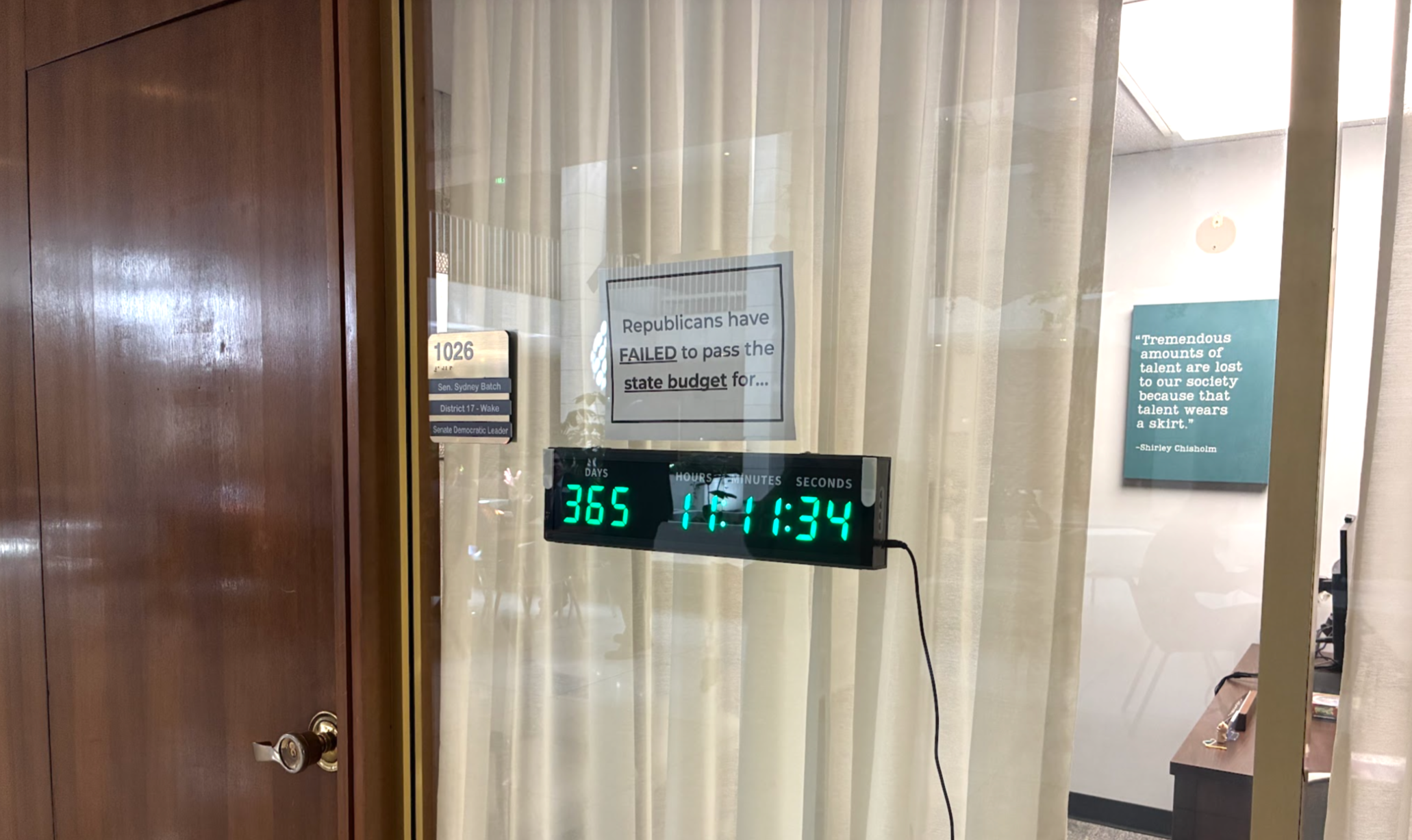
The clock outside Senate Minority Leader Sydney Batch’s office counting the days North Carolina operated without an appropriations bill. June 30, 2026. Photo Courtesy of Pracheth Sanka.
June 30th, 2026. The clock outside Senate Minority Leader Sydney Batch’s office continued counting onward. The bright green digits showed 365, marking the calendar year that had passed since the State of North Carolina failed to enact a budget. It had been over 1,000 days since the State last had a comprehensive budget signed into law, dating back to 2023. Rumors spread that a bill would be passed before the July 4th holiday, but legislative employees still joked that they might only receive a budget as a Christmas present. Yet, despite a gridlocked legislature, everything still operated as normal. The state parks remained open, state agencies worked as usual, and no state employees were furloughed. Crucially, the government did not shut down.
Government shutdowns are the partial or total cessation of non-essential government activities due to lapses or deficiencies in funding and spending. This occurs when the legislature cannot agree upon budget appropriations for state agencies, which, under the Antideficiency Act of 1884, are prohibited from spending or obligating money without approval from Congress. Many states have similar antideficiency and balanced budget laws, though state shutdowns are fairly rare. Federal shutdowns have become increasingly frequent, especially as a favored tool of the Trump administration, under which five partial or full shutdowns have occurred over his two presidential terms.
Unlike the federal government and many other states in the union, North Carolina has specific laws in place to prevent any shutdown of the state government. Instead, the state operates on continuing resolutions, funding provisions of the most recently enacted budget that automatically renew every year. This continues until a new state budget is agreed upon. Effectively, spending remains the same, new funding initiatives freeze, and wages stagnate. However, state employees still work, and North Carolinians have access to state infrastructure and resources.
The benefits of this system are clear. Full shutdowns, as the October-November 2025 federal shutdown had shown, can bring statewide and national economic impacts. Leading to furloughed employees, canceled flights, and delayed government contracts, the Congressional Budget Office predicted that the shutdown led to over $16 billion in lost wages, 162,000 government employees being laid off, and $11 billion permanently lost from the economy. While this figure only represents about 0.05% of the country’s $27 trillion in gross domestic product, a reduction of this size led to decreased spending and dampened consumer confidence in the American economy. And though these macroeconomic effects might seem minimal, the individual consequences to certain American consumers were immense. Over 630,000 people were furloughed, and 730,000 laborers worked without paychecks. SNAP, the American food-purchase assistance program, was completely paused beginning in November. The pause of SNAP, which provides food benefit debit cards to low-income families to buy groceries and nutritious food, left 42 million in-need Americans receiving less than half of their typical allotment. This outsized effect on federal employees and low-income Americans is avoided in a system of continuing resolutions, where government employees and state-run programs and projects, such as SNAP, would operate as normal.
But this federal shutdown, the longest ever, lasted 43 days, much shorter than the 367 days lost in North Carolina. Lawmakers in Washington were pressured, in just under a month and a half, to find willing yes votes to avert further economic and political disaster. Lawmakers in Raleigh, however, did not face the same impending crises as their fellow politicians in DC. The state Republicans, who hold a supermajority in the Senate and a majority in the House, faced infighting between their respective leaders over tax cuts and state employee raises. As talks began in June 2025, these fiscal disputes pushed back budget proposals by over a year.
This meant a full year of wage stagnation for state employees, as inflation crept up to 3.5%. This meant a full year of reduced investment in statewide projects because of last-minute stopgap spending measures. This meant that western North Carolina, still reeling from Hurricane Helene, failed to receive adequate funding for a full year, complicating disaster recovery.
These pitfalls don’t only affect large state projects and state employees; they affect regular North Carolinians too. After the budget was passed on July 2, the clock outside Leader Batch’s office froze at day 367. Next to the figure were 367 grievances, a four-page-long list her office attributed to the Republicans’ delay in the process. This list included, among other things, nursing shortages, tuition increases and scholarship cuts in the University of North Carolina system, and frozen funding support for local fire and emergency departments. This meant blowback in key sectors that directly serve the state’s citizens, issues that took over a year to be remedied.
Still, despite the year-long wait, legislators in both houses believe this system is superior to a full shutdown. I spoke with House Minority Leader Robert Reives, a Democrat who represents the more rural fringes of Raleigh’s metropolitan area in Chatham and Randolph Counties, who strongly disapproves of a shutdown budget system: “I don’t like the idea of shutdown because nowadays the shutdown has been used as a political tool.” He fears the current use of this legislative process has strayed too far from its original purpose as a hard-stop deadline that politicians had to meet. He believes that the increased usage in recent years is seen as a “fun thing,” a whimsical event that ultimately hurts the lives of Americans. While he recognizes specific issues with continuing resolutions, he does like the system North Carolina has in place.
Still, while politicians may understand, and even vouch for, continuing resolutions, Leader Reives explains that they should help their constituents understand how the system works, especially its faults. He says that “ the hardest part about the continuing resolution is that it is a bare-bones [continuing resolution],” wanting voters to know that it does not adjust for inflation or change over time, and, vitally, it is not a new budget. This misunderstanding of the budget process may be why Republican leadership did not feel pressure to quickly enact an appropriations bill; when a voter base does not feel it has a stake in the budget process, it will not generate the pressure necessary to force a budget through.
However, Leader Reives illustrates that he still faces political pressure from his own constituents and advocacy groups. Representing a politically active and engaged district, Reives says he receives many emails, calls, and meeting requests about the budget and new funding. A few moments before we spoke, he had a brief conversation with a farming lobbyist who was asking for more money for his district, an occurrence that is not uncommon for Leader Reives’s office: “They don’t even know if they’re getting the money; it’s not one of those things where they are waiting to get the money [they] know they’re getting… so every year, all these groups have to come and fight for money again.”
Across the political aisle, the Republicans faced similar pressure, especially when the budget stalemate was a direct result of infighting between the party’s House and Senate leaders. Speaking with freshman Republican State Representative Mike Schietzelt, he emphasized that the party’s inability to agree on and pass an appropriations bill made it an easy scapegoat for both the political opposition and state media. As a target of constituent complaints and budgetary concerns, his office was no stranger to calls or emails from frustrated teachers and state employees wondering when they would receive their promised bonuses and benefits.
Representative Schietzelt also underscored the role of interpersonal and factional divides in the Republican Party that created internal pressure. With relative newcomer Speaker of the House Destin Hall, whose budget policy goals clashed with the longtime State Senator and current Senate President Pro Tempore Phil Berger, appropriations negotiations became difficult to navigate amongst the different factions and coalitions in both chambers. Things became especially tricky when Senator Berger lost his primary, signaling the end of his 25-year stint in the State Senate. With no need to worry about long-term relationships within the House or Senate, Senator Berger doubled down on specific budget provisions, most importantly pushing to maintain a cap on the state income tax. This steadfast approach by the now-exiting Berger contrasted with Speaker Hall’s wish to maintain loyalty and cohesiveness in his first term at the House dais. Representative Schietzelt likened the budget stalemate in the Party to Homeric mythology; the test of leadership comes from how well you can maintain the ship as the Budget Scylla tries to pull your party apart. Unlike in a shutdown, which would force quicker negotiations, elongated negotiations resulting from continuing resolutions allow this in-party tension and pressure to bubble up. This system not only allows pressure to come from constituents, but it can even force it through interparty dynamics.
Still, this pressure may result from their offices’ specific role in House leadership and their district’s unique demographic composition. After spending the summer with a relatively quieter district, where constituent issues tend to gravitate toward the city and federal levels, I saw that this pressure was not evenly distributed. Specific districts, especially those in leadership positions, certainly faced constituent pressure regarding state appropriations. But most districts, especially those representing rural and conservative North Carolinians, did not have to engage with activist voters and groups seeking to move forward with a budget. I believe this is because many of the state’s citizens do not feel the effects of a budget stalemate firsthand. For most non-governmental workers, it is business as usual. Although they may face some delays or inefficiencies, as long as North Carolinians can continue to utilize state resources, they won’t add to the tension of the appropriations budget for most districts and politicians.
Nevertheless, one could argue that the stress of budgetary pressures is placed on the very politicians who are vital to the process, those like Leader Reives who hold leadership positions in either chamber, who drive and decide what belongs in each appropriations bill. While continuing resolutions do not put the full weight that a shutdown would place on legislators, the system does allow for pressure to be applied at the correct level of government. And even if certain sectors, projects, or groups receive funding from a continuing resolution, future budgetary and funding pressure on their behalf leads to political pressure on legislators. Though not facing the direct and imminent economic consequences of a shutdown, continuing resolutions do still give constituents an opportunity to force their hand, showing that a system without shutdowns is not a system without political coercion.
Other politicians whom I spoke to, who held a more pessimistic view of the current system, proposed a graduated shutdown mechanism. If the budget is not passed by predetermined dates, an increasing amount of government functions would be reduced or eliminated until a budget could be agreed upon. For example, if the legislature does not have an appropriations bill ready by June 30, a segment of less-vital state agencies would receive less funding, and state legislators would have their pay cut by a certain percent. If another month (or any other predetermined time period) passes, more state agencies would cease to function or be funded, and by the ultimate deadline, a full government shutdown would occur, and legislators would receive no pay.
This itself, however, has its own host of potential issues and would undeniably spark debate and broader policy questions. Which government agencies would shut down first? What constitutes a vital agency? By how much would legislators’ salaries be reduced? This hybrid system, while alleviating certain flaws in shutdown systems and continuing resolutions, would also create its own faults and would require negotiation and consensus among policymakers to ensure the system is fair and protects the rights, interests, and privileges of state citizens.
Ultimately, North Carolina’s current budget system does have its upsides. Even though continuing resolutions led to a year-long struggle for an appropriations bill, this scenario was a historic outlier, driven mainly by political infighting within the majority. While we can’t say this will be a unique event, and the risk for future appropriations stalemates increases with factionalism within both parties, this outcome is certainly less damaging than a full shutdown. With specific issues and funding gaps, agencies still operate, and most North Carolinians can carry on as normal. And while, at face value, it seems as though state legislators were sitting idly and were slow to respond to the situation, many politicians, especially those in prominent districts or in party leadership, faced mounting pressure from constituents or from other members of their party, and still had to navigate tough conversations to push forward a steady budget, one that was not the product of quick conversation, but instead long, thought-out deliberation and compromise.
While hybrid solutions could be the forward pathway that avoids a damaging shutdown or a year-long budget stall, North Carolina’s continuing resolutions certainly are the better option of the two. The 367-day hiatus was an anomaly, and continuing resolutions saved the state’s citizens from the fallout a shutdown would undeniably have wrought.
With the digits 367 still frozen outside of Leader Batch’s office, the clock serves a dual purpose. The first, a warning of complacency, a mark of the infighting and antagonism that led to this year-long struggle. The second, a battle scar, a show that North Carolina still thrived throughout the ordeal. While the road was tumultuous, those frozen numbers are proof that North Carolina not only survived, but endured because of continuing resolutions.
Pracheth Sanka (GS ‘28) is a junior in the dual degree program with Sciences Po Paris. He is studying political science, economics, and mathematics.