How US Policy is Helping China Win the Tech Race
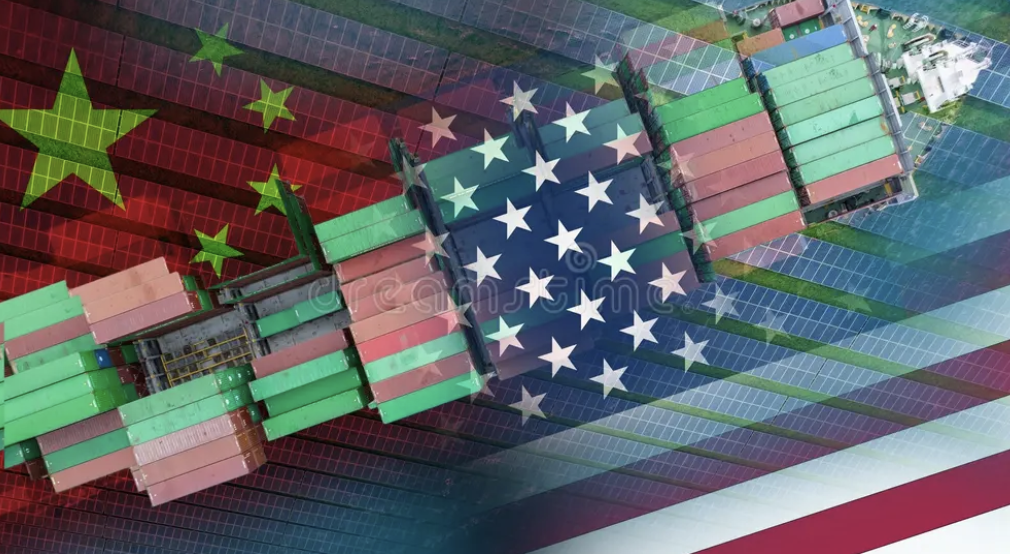
The overlapping US and China flags and shipping containers visually represent the global competition for economic, technological, and scientific influence discussed in the article. Photo courtesy of Dreamstime.
For much of the postwar era, American scientific dominance has rested not only on funding and institutional prestige, but on its ability to attract global talent. The United States built a thriving research ecosystem, anchored in elite universities and sustained by seemingly endless federal investment, that drew ambitious scholars from around the world, including a substantial number from China.
By the late 2010s, scientists of Chinese descent made up a significant share of the US research workforce, accounting for roughly 16 percent of all science and engineering researchers and an even larger proportion in key fields such as engineering and computer science. For decades, many of China’s brightest minds chose to stay and work in the United States instead of returning to China where research funding was less abundant and academic freedom was not guaranteed under the watchful gaze of the Chinese government. What China experienced as a perpetual loss of intellectual capital, the United States enjoyed as a permanent strategic advantage.
However, this inflow of Chinese academic talent depended on the assumption that the United States would remain the most attractive and secure destination for ambitious researchers, both in terms of financial compensation and academic freedom. Today, that arrangement no longer holds as firmly as it once did. The once largely one-directional movement of Chinese scientists into American institutions has slowed and, in some critical fields, even reversed. The number of Chinese researchers leaving their US posts, or refusing to pursue them altogether, has risen, with researchers often citing professional uncertainty, funding constraints, and political scrutiny as reasons for their departures.
To understand how this shift emerged, it is necessary to examine the recent changes in the relationship between the federal government and American universities, particularly with regard to research funding and political oversight.
Predictable federal investment has always been a pillar of America’s research dominance. Consistent funding allows laboratories to work on multi-year projects and doctoral students to commit several years of their lives to research. Without that continuity, research projects stall, scholars cannot commit to projects, and the entire ecosystem falls apart.
Under President Trump, budget proposals have repeatedly targeted reductions to key agencies such as the National Institute of Health (NIH) and the National Science Foundation (NSF), which fund most American civilian research. For example, recent budget plans have called for a 37 percent cut to NIH research funding and a 50 percent cut to NSF grant programs. Although Congress often moderates the steepest cuts, this pattern of proposing dramatic reduction sends the signal that federal research is politically contingent.
Columbia was one of the first universities to experience a more direct use of funding as leverage. After having 400 million dollars worth of research grants pulled due to allegations that the university had failed to adequately address antisemitism on campus, Columbia chose to initiate a series of reforms and negotiate with the Trump administration in order to get funding back. While efforts to address antisemitism at Columbia are both necessary and appropriate, this sent an unsettling message to the broader American research community: that research funding was becoming dependent on political alignment.
University research funding has historically been a non-partisan guarantee from the federal government. For example, when universities such as Columbia were centers of protests against US government policy during the Vietnam War, federal research funding not only continued, but it expanded through agencies like the NIH and NSF. Even amid widespread campus unrest, the federal government maintained its financial commitment to university research, upholding the notion that scientific funding should remain insulated from political disagreement. The recent use of funding by the Trump administration as leverage in a broader political dispute undermines the institutional norms of the long-standing partnership between universities and the government, eroding the institutional confidence of the American research system.
To fully understand the broader climate affecting Chinese researchers, however, considering unpredictable funding alone is insufficient; it is also necessary to examine earlier policy developments that shaped perceptions of risk and belonging within the academic community. In particular, the origins of this climate can be traced to policies introduced during the first Trump administration.
In 2018, the administration launched the China Initiative through the Department of Justice (DOJ), which promised to combat economic espionage and protect sensitive technologies from reaching the hands of the Chinese government. Though safeguarding intellectual property is a legitimate concern, the policy unfairly targeted professors with no ties to Chinese intelligence networks, resulting in the alienation of the Chinese-American research community.
Take the case of scientist Anming Hu, an associate professor of mechanical and aerospace engineering at the University of Tennessee, Knoxville. Hu was the first academic charged under the China Initiative. After nearly two years of FBI surveillance failed to uncover any evidence of espionage, prosecutors chose to instead try charging him with fraud and making false statements related to minor details of a disclosure form on a NASA grant.
At trial, the government’s case fell apart. Court proceedings revealed that the FBI had knowingly built its prosecution on flawed and misleading evidence. The lead agent even admitted he did not believe Hu had ties to the Chinese military, yet presented materials to university administrators in order to convince them that Hu was a spy. In 2021, after a mistrial and subsequent retrial, a federal judge finally acquitted Hu, ruling that no rational jury could rule that he intended to defraud NASA. By then, however, Hu’s reputation was already ruined. He had been fired, publicly branded as a security threat, and endured years of professional and personal damage.
Hu’s case illustrates the problem with the China Initiative. Out of dozens of prosecutions, only a small fraction actually involved allegations of espionage, and even fewer resulted in convictions. Many cases instead revolved around disclosure paperwork, administrative oversights that were reframed as national security threats. A statement released by former US Attorney Carol Lam explains how the China initiative generated “perverse” incentives to unfairly prosecute Chinese researchers. By giving more funding to cases of Chinese economic espionage, FBI agents were systematically encouraged to pursue Chinese scientists and then scramble to assemble suspicious evidence, instead of building a real case first.
Though the China Initiative was shut down in 2022, the psychological toll has continued to linger. A 2024 study by sociologist Yu Xie surveyed 1304 U.S-based scientists of Chinese descent and found that 35 percent reported feeling unwelcome in the United States; seventy-two percent do not feel safe as academic researchers; 42 percent express fear about conducting research; 86 percent believe it has become harder to recruit international students to be laboratory assistants’ and 65 percent worry about collaborating with colleagues in China.
In allegedly attempting to defend American research from foreign threats, the China Initiative instead undermined one of America’s core strengths: its ability to attract and retain global talent. As a result of this atmosphere of uncertainty, China has capitalized on this golden opportunity to poach Chinese researchers.
China is well prepared to receive these Chinese researchers working here. In response to the funding uncertainty and political scrutiny researchers face in the United States, Beijing has begun ramping up programs aimed at targeting expatriate scientists. In addition to the allure of being in a more linguistically and culturally familiar environment, Beijing has been offering generous start-up funding, prestigious titles at Chinese universities, dedicated laboratory space, and greater research autonomy in order to lure their brightest minds back home. These programs were explicitly designed to reverse decades of outward migration and they have already worked to strengthen China’s position as a new research superpower.
The effects have been concrete. According to the 2025 Nature index, China, not the United States, now ranks first globally in high-quality scientific research output, having overtaken the United States’ lead in 2022. Eight of the world’s ten fastest-rising research universities are Chinese institutions. Last year alone, several of America’s best STEM researchers in fields such as mathematics, oncology, chemistry, chip architecture, and AI researchers have decided to leave their American institutions and work at Chinese universities like Tsinghua and Westlake University.
As the US and China race for technology supremacy, this exodus of Chinese scientists from the United States threatens to unravel decades of American technological supremacy while bolstering China’s rise as the new scientific superpower. US research dominance has long rested on predictable funding, institutional trust, and a steady supply of the world’s best intellectual talent. By destabilizing funding structures and fostering an atmosphere of scrutiny through policies like the China Initiative, the United States risks reversing the Chinese brain drain that once strengthened it. If confidence in the American research system continues to decline while China actively courts dissatisfied scientists, the United States may find that it has eroded its own foundation of scientific leadership faster than any foreign rival could have.
Maximilian Peh (CC’28) is a staff writer majoring in Political Science and Middle Eastern Studies. He is interested in international relations and the new roles China and the Middle East will occupy in the next international order. He is currently working on becoming fluent in Arabic.