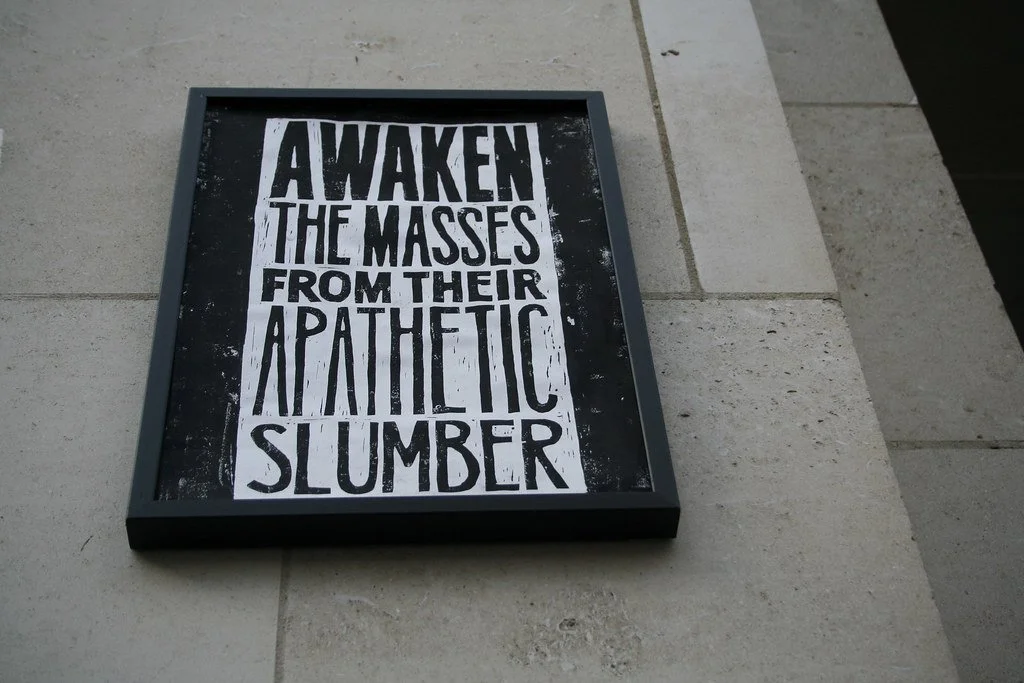
An unidentified location, featuring a poster encouraging activism. Photo courtesy of Openverse.
My generation has never experienced politics untouched by algorithms. Every election I have been old enough to follow has unfolded, at least in part, on social media. From Obama’s historic victory in 2008 to Trump’s unconventional win for a second term in 2024, these campaigns showed how political campaigns compete not only for votes but also for attention, likes, and shares.
Very few people today question whether artificial intelligence will affect elections. The debate has shifted from “if” to “how.” The more urgent question is how artificial intelligence will shape voters’ political habits, particularly through the spread of disingenuous disinformation and the rise of political apathy. If AI erodes public trust in the democratic system and convinces citizens that their participation no longer matters, it threatens election outcomes and the legitimacy of our democracy as a whole.
The root of a healthy democracy is shared ideals that allow disagreement to occur without undermining the system itself. Melissa De Witte, Deputy Director of Social Science Communications at Stanford, gathers perspectives from experts and conveys in her article how healthy democracies need discourse and disagreement. She speaks with Debra Satz, Dean of the Stanford University School of Humanities and Sciences, and Paul Brest, Director of the Law & Policy Lab at Stanford Law School. Satz shares, “Disagreement can be a space that allows sharply different voices to be heard, but only when there are established processes and procedures in place to handle conflict when it arises and norms of openness, humility, and mutual respect.” Mutual trust bridges access and participation, and it is fundamental to democracy because, as defined by the Youth Democracy Cohort, our “democracy depends on participation,” and if trust deteriorates, cynicism increases while promoting political apathy. When people no longer trust or support these systems, where do they turn?
The most dangerous consequence of the rise of AI is that it may convince people that there is no point in making their own decisions in the first place. Artificial intelligence has created a world where information can be broadly distributed, but it can also be manipulated for political persuasion. Now, speeches can be written in seconds, and political conversations can be generated to mimic the voices of political figures, without direct human participation. Its rapid advancements have created an environment in which citizens question the authenticity of information, leading to disengagement across the nation. Yet, when 81% of Americans feel that crucial election content will be rife with misinformation because of artificial intelligence, it becomes increasingly hard to trust the integrity of democracy.
For years, Generation Z has been labeled politically apathetic, a label that is clearly far-fetched, as shown by the major role youth play in enforcing civic action, now more than ever. At age five, when I visited Washington, DC, for President Obama’s second inauguration and saw protest groups like CodePink advocating for change in foreign policy, I began to understand the importance of civic participation. This generation cares deeply about the issues shaping tomorrow. Youth turnout has consistently increased, peaking at 47% in the 2024 presidential election. Beyond the polls, young organizers have become leading voices on prominent issues of gun violence and safety impacting their communities. However, while civic engagement is at a new high, indifference is also growing. This dubiety continues the lingering question “Is what I’m consuming even real?” The increased uncertainty of reality introduced by AI doesn’t just distort people’s beliefs in the political system; it erodes the essential confidence voters need to participate in democracy in the first place.
Youth are asking about the validity of politicians’ words and stances, whether a news article was published by a journalist or generated by artificial intelligence, or if the image posted to X by the President of the United States of a gold eagle attached to the White House is authentic. The challenge is no longer the accessibility of information; it’s whether or not people can trust what they see. If the next generation of changemakers cannot find reliability and comfort in the published media, participation cannot be sustained. Paradoxically, artificial intelligence holds incredible potential to strengthen the fight for a better, more civically engaged country. A Harvard Kennedy School study finds that “AI can provide us with a more efficient way of delivering a fair number of constituent services,” including monitoring budgets, AI chatbots for quick results, and offering a variety of language services. When used responsibly, AI could contribute far more benefits than barriers.
The answer isn’t to reject the presence or impact of artificial intelligence. America is a global force because of its willingness to invest in innovation, and AI will continue to shape its future. The key is ensuring our democratic systems evolve alongside these technological developments. This means demanding political campaign transparency and investing in technological literacy for accuracy across major social media platforms. By doing so, companies can be held accountable for addressing AI-generated content. The Artificial Intelligence Use Policy implemented in Lewis County, WA, is an example of the needed increase in intentional measures that will preserve the trust on which democratic participation depends.
As a nation, if we begin addressing this issue, starting at the local level, we can create significant change. As AI continues to evolve, so must this generation. There is a responsibility to preserve the core of democracy, our commitment to truth, and civics. A true democracy is only as strong as its well-informed citizens, and it will be only worth as much as people value and search for it.
Preston Lee (CC ‘29) is studying Political Science and Art History at Columbia College. He can be reached at ptl2115@columbia.edu.