Why Poets Can Tell You More About Politics Than Politicians
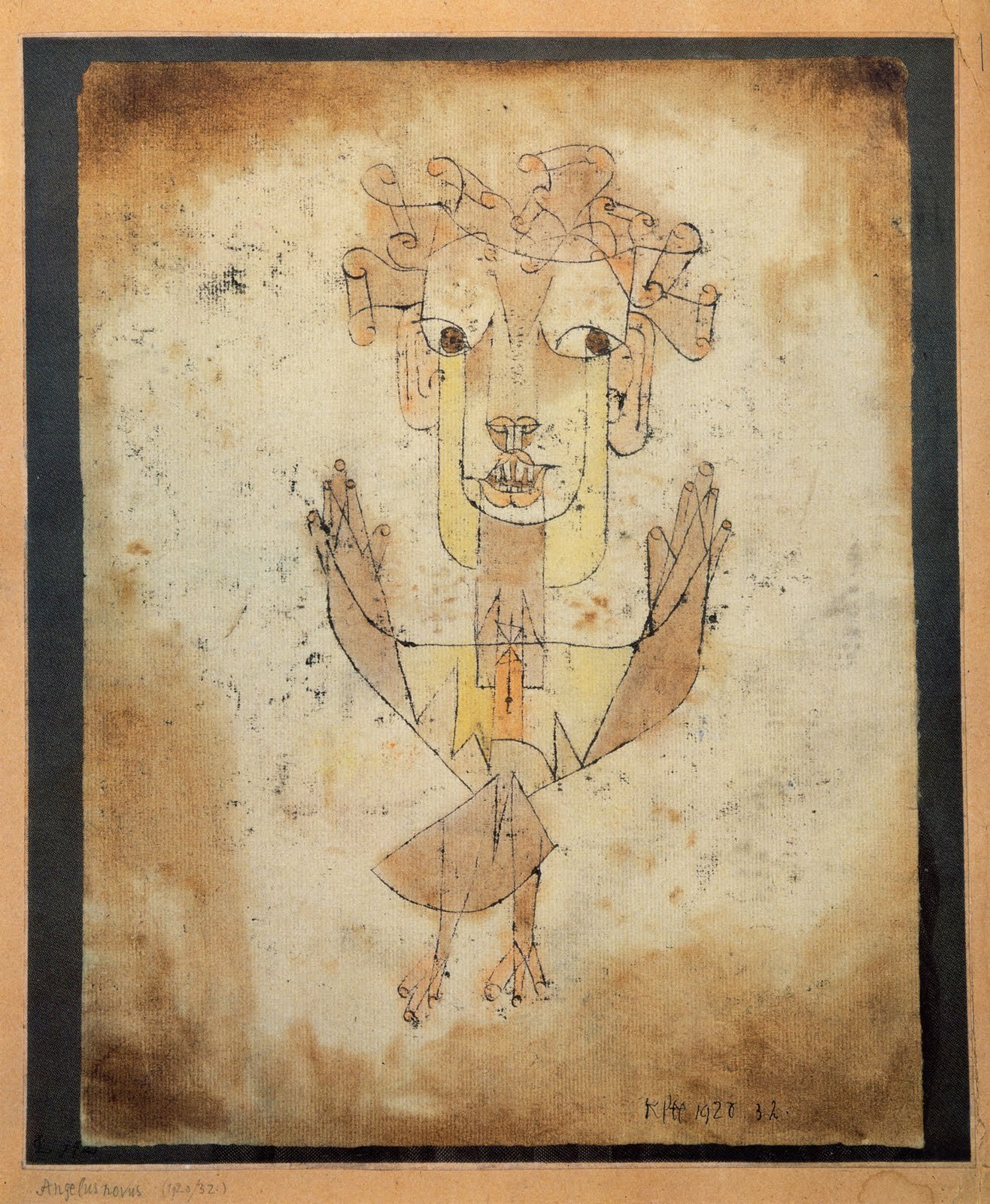
Monoprint of the Angelus Novus, or New Angel, by Paul Klee.

I.
Walter Benjamin wrote and published most of his works in the two decades that are mythologized in our present historical imagination as the height of political horror, excitement, and confusion: the 1920s and 1930s—the rise of Fascism in and outside Continental Europe, Stalinist Terror to the East, the Great Depression, Art Deco, and war. Across those two decades, politics and society appeared to undergo transformations so profound that many historians have come to describe the period as one that both resists easy categorization and paradoxically serves as a template for categorizing other eras. And as one might imagine, there was just so much to write about.
Yet Benjamin often guided his essays toward images and metaphors that seemed, at once, oblivious to, and transcendent of, the politics of his time. In Theses on the Philosophy of History, he opened with an image of an automaton playing chess, whose hidden operator symbolized historical materialism. In The Task of the Translator, Benjamin led his essay toward its metaphorical climax: the translator as one who pieces together the remnants of a broken vessel, forging a language that redeems meaning. And, in the essay Unpacking My Library, he presented the collectors of objects as curators of memory, and thus, as historians who conjure fragments of time and build a constellation of thought.
Walter Benjamin was a Marxist political author. Although he was, in many senses of the word, a poet, none of the works I’ve mentioned could be extracted from their political meaning and read merely as literary experiments. They were serious attempts at understanding and transforming the world. Why, then, given that he was surrounded by intense political reckonings, did he choose as his objects of political critique seemingly apolitical phenomena? Why did the fascists and the Stalinists come as afterthoughts in his essays?
The answer will not be surprising to people who find the banality of modern politics draining. Think of all the topics that have occupied our feeds in the past months. I cannot deny the victims of suffering their due dignity; however, it is fascinating how just a few months ago, the entire political moment was subsumed by the urgency of a scandal: catching some pedophiles in the government. It seems as though the Democrats, lost in their euphoric intensity over the fact that some voters may turn against Trump if his affiliation with Epstein’s crimes were to be proven, were not going to let go of the issue. And when they were finally ready to let go of the issue, due to the increasing density of their portfolio of priorities with the government shutdown, the media picked it up, coining the issue as a bastion of their demand for true politics. Who would have guessed that after the shutdown came to an end, Democrats were to revive their scandal-politik, all so passionately.
But I won’t pity us anymore, because there is no doubt that someone else in history echoed our exhaustion with the tedium of political theater. Benjamin saw, in the rising fascism of his time, a trend that we are too familiar with today: stagnation. Politics became a matter of the preservation of the system as is, even as it took on brand new aesthetic forms. In other words, nothing meaningful ever changed, other than mere symbols, caricatures, and phantoms, all of which mimicked that world-historical force which once promised humanity its freedom.
II.
Indeed, in Theses on the Philosophy of History, Benjamin addressed the problem of meaningless and meaningful politics by examining each through their respective understandings of history. The relationship between politics and history was crucial to Benjamin, precisely because it explained how politics could break free from the wheel of its moment, which seemed to revolve eternally without ever moving. For Benjamin, there were two answers to the question: the “historicist” and the “historical materialist.” The former imagined this relationship as one-dimensional, with politics serving history. The latter, by contrast, understood the relationship as dialectical, unfolding within a continuously transformative field, insisting that history could, under the right circumstances, just as effectively serve politics.
Historicism, Benjamin argued, justified the present world and its institutions through the eyes of history, and it justified history through the eyes of the present world. Ideas emerged, regimes were toppled, and people were destroyed; all change took place through the same, ever so calm momentum, without a single force exerted against it. At its core, historicism rested on a fundamental geometric assumption: that history has always been, and could only ever be, an upward-sloping curve toward the sky. That is why it treated the relationship between politics and history as a completely passive one. History itself was already doing all the work of transformation, independent of our conscious efforts. Thus, politics—the conscious efforts of our humanity as a collective—might as well confine itself to the administrative field, applying, on occasions, the demands of the historical present, rather than attempting to transform it. An image appears of a contemporary politician: a person whose primary goal is to attain and maintain political office, and precisely, nothing beyond that.
Although historicism offered a form of seductive reassurance, Benjamin contended that its textbook is selective in its contents. Every historical moment, he argued, had a claim on history: a claim to be recorded in history books as a necessary fact. Yet historicists, committed to narrating their fantasy, only collected events that fit that idea of progress and erased those that did not. In other words, historical moments that justify, in syllogistic form, the current state of affairs are preserved as markers of historical progress, whereas those that resist the prevailing order are forgotten. The selective memory of historicism deeply unsettled Benjamin, who insisted that nothing that has happened should be regarded as lost to history. He expressed this conviction by guiding the reader into one of the most beautiful images ever reproduced in the history of literature:
An angel is depicted there who looks as though he were about to distance himself from something which he is staring at. His eyes are opened wide, his mouth stands open and his wings are outstretched. The Angel of History must look just so. His face is turned towards the past. Where we see the appearance of a chain of events, he sees one single catastrophe, which unceasingly piles rubble on top of rubble and hurls it before his feet. He would like to pause for a moment so fair, to awaken the dead and to piece together what has been smashed. But a storm is blowing from Paradise, it has caught itself up in his wings and is so strong that the Angel can no longer close them. The storm drives him irresistibly into the future, to which his back is turned, while the rubble-heap before him grows sky-high. That which we call progress, is this storm.
Not only does the Angel of History see the forgotten past and its demand for redemption, but he sees complete and catastrophic destruction in what we see as progress. A celestial, spherical biomass, a complete phonebook of history’s comparative politicians, each swallowed, one after another, into its unending mass.
The essay defines historical materialism generally, in opposition to historicism, as an understanding of history precisely not as a series of inevitable events. Benjamin probably thought that this task was best done by Marx before him. He does, however, mention one important task of the historical materialist, to “seize hold of a memory as it flashes up in a moment of danger,” redeeming the forgotten struggles of the past through the present. It is to understand that moments in history exist that defy the historical present. Therefore, historical materialism, which is a form of logic, has a transformative aspect built into itself. It is critical and intrusive by necessity. And its critical practice allowed Benjamin to hold history to be a servant of politics.
III.
“In the struggle against that state of affairs, criticism is no passion of the head, it is the head of passion.” —Karl Marx, in “A Contribution to the Critique of Hegel’s Philosophy of Right”
It is then necessary to talk of historical materialism as a form of critique. However, it is a question in and of itself whether the art of honest critique, in the form that Benjamin engaged in, has survived up until this day. We have an entire field of contemporary “critical theory,” but that theory is “critical” insofar as it allows us to reaffirm the facts that are already known to us: that oppression is wrong, and racism is bad. So it is really a dishonest form of critique.
But why is it that one honestly critiques something? To critique something is to try to understand something in its purest honesty. Then, to hold something as an object of critique is to hold it in the highest esteem. We do not critique things we know to be completely meaningless and without any potential. We critique precisely the things that we understand to have the capacity to transcend beyond themselves.
This was the critique of capital for Marx. Marx did not hate capital, nor did he hate capitalism. They were both mere historical facts to him. What he found particularly interesting in both of them was the fact that, in his view, they contained the seeds of a revolution within them. This is why he took on the work to identify every single contradiction within the system, to argue that based on the premises (organization) of the system, it was impossible to realize the conclusions (ends) of the system, and that we needed a different system to reach the former’s conclusions.
In another sense, to take something up as an object of critique is to reflect your thoughts upon that object. It is to paint that object with yourself, to re-symbolise it through yourself in a way that unravels the meaning within the object, which was placed in it perhaps intentionally or unintentionally by someone else. Thus, at the heart of it, a critique is a highly intimate task.
This is all to say that we typically do not, and we should not, critique things that are unworthy of our critique. If the substance of our critique is just to tell people that they are wrong and that we are right, maybe it is not the most worthwhile investment. It is in this notion of honest critique, informed by Benjamin’s Philosophy of History, that we find the answer to why his essays tackled metaphors and images rather than the immediate political reality around him.
IV.
Benjamin knew that mere existence in the historical present did not immediately make something an object worthy of his critique. He was not a historicist. He knew that all moments had equal claims over the historical past and the historical present. Through his philosophy of history, then, he was emancipated from the necessity of engaging in constant service to the historical present, and this emancipation allowed him to reach beyond that historical present.
Moreover, Benjamin simply did not see the transformative potential of reflecting on his present moment: the fascism of his time. There was little emancipatory politics that was to come out of a critique of fascism. Thus, he did not think that fascism was worthy of his image. Instead, he formulated his emancipatory politics through images and metaphors, some created in his vivid imagination, others already present in the world around him, just outside momentary politics. This was his way of falling beneath the wheel of momentary politics, that perpetually spinning arrow on the pivot pinned against the wall of history. This was his way of trying to set the wheel free, so that it may make a meaningful distance by its own force.
At the end of the day, our immediate experiences are what shapes our life. No matter how desperately we may want to, we cannot completely abstract ourselves from our present reality. Nonetheless, as things still stand, we have the freedom to engage in criticism with the choice of our own. Perhaps this freedom will never be entirely taken from us. It is nonetheless contested by the historicists of our time: those who tell us that the present political discourse, by virtue of it being a historical present, in its place on that very eternal wheel, is the most relevant and most important fact worthy of our political attention. Hence, our imagination cannot even picture “journalism” outside contemporary political discourse. To read the news today is to know Trump’s second-to-last meal of the day.
Perhaps, at times when everything seems like it is captured by a perpetual repetition of itself, and when that unfreedom we feel at every moment crushes us and fills us with resentment, it may be best to try to look down, look outside, or look inward: to look anywhere else but that wheel. Perhaps, at such times, we are to trust poets rather than politicians to inform our sense of politics, precisely because they are often the ones who know where else to look.
Yunus Akdal (GS ’26) is a political science major and critical theory enthusiast. Contact Yunus if you disagree at ya2545@columbia.edu.