Rethinking South Korea’s Military Keynesianism
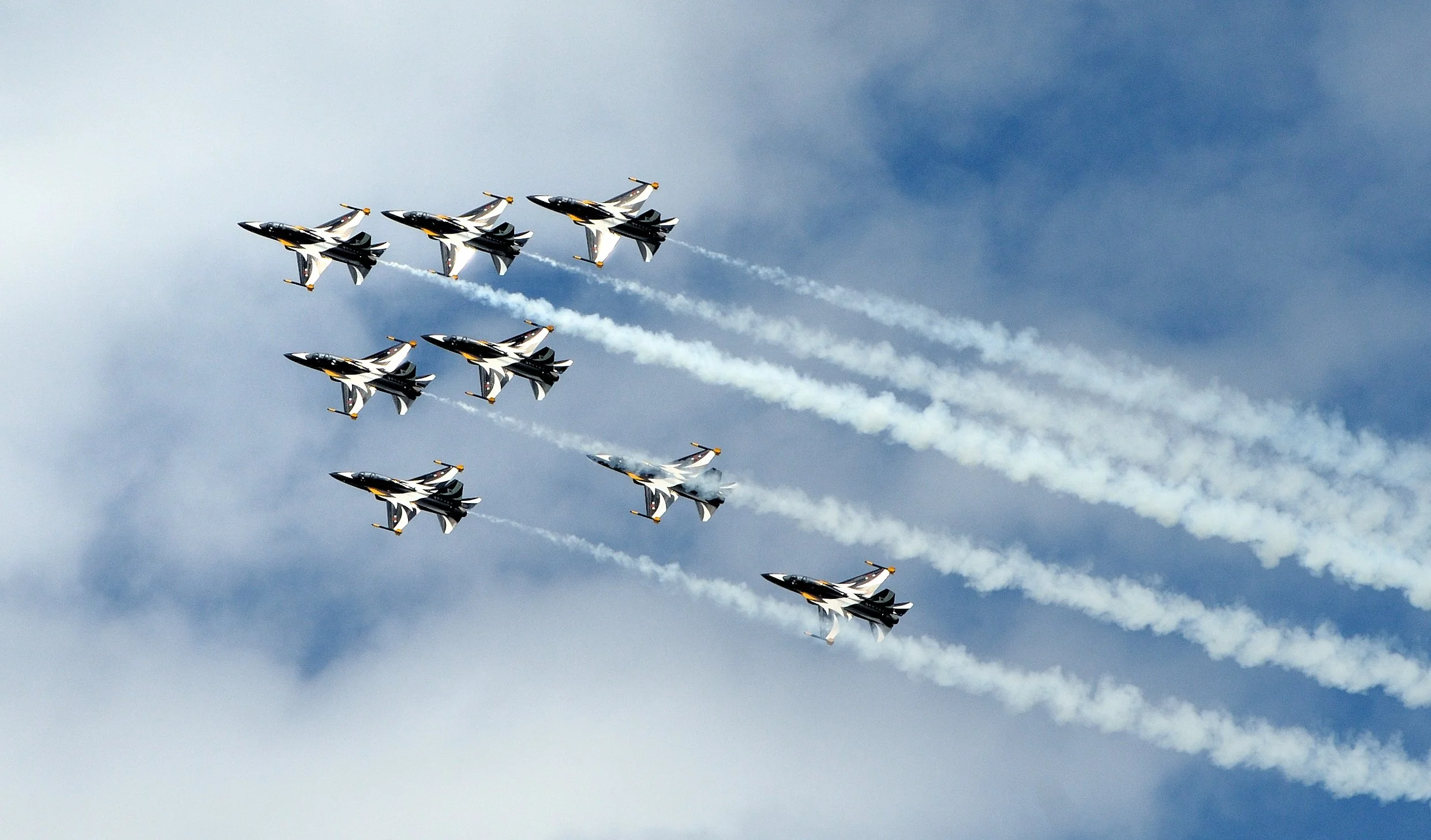
Republic of Korea Air Force 53rd Air Demonstration Group. Photo courtesy of the Republic of Korea Armed Forces.

When President Trump began his second term, he demanded that South Korea sharply increase its budget for stationing U.S. troops and its overall defense budget. Recently, South Korean President Lee Jae Myung announced an 8.2 percent increase in military spending for the 2026 fiscal year, with plans to reach 3.5 percent of GDP by 2035. While this surge appears to be a response to growing U.S. pressure and Washington’s reshaping of its Indo-Pacific security priorities, it also gestures toward something more; it is not only a move towards long-term military independence and strategic agency, but also a broader neo-Keynesian economic experiment to drag the nation out of its developmental plateau. However, military spending alone cannot secure sustainable growth. Defense-led stimulus offers only short-term gains, and South Korea’s distinct geopolitical realities demand a more balanced and long-term economic strategy beyond military Keynesianism.
Historically, the phrase “military Keynesianism” described the mid-twentieth century strategy of offsetting economic downturns through increased military spending. While heavy government spending is a feature of traditional Keynesian economics, it departs from John Maynard Keynes’s original call for socially beneficial investments in public goods, such as infrastructure, and focuses on providing fiscal firepower to the defense and arms industries. This model creates a form of welfare-warfare state, where military spending stimulates aggregate demand directly through government spending and indirectly through multiplier effects on private consumption and reinvestment.
The fiscal model was first developed during the Second World War and institutionalized in the postwar era through taxpayer-funded arms contracts that channeled subsidies into private industry. During Russia’s war on Ukraine, this pattern has reemerged: Western powers are again boosting defense budgets after decades of austerity, turning military expenditure into a means of both security and economic stimulus. Under the banner of combining “military independence with commercial revival,” Europe’s defense buildup marks a new experiment in state-led growth—one that South Korea has now adopted on the other side of the world.
Since the Korean War, South Korea has continuously been among those who led the world in per capita GDP military spending. While the percentage expenditure has declined over the years from its record high of 7.2 percent of GDP in 1960, South Korea still remains one of the top ten military spenders in the world. This constant buildup, a result of an unending Cold War in the peninsula, has positioned South Korea to be one of the world’s strongest military powers. South Korea has also engaged actively in arms sales, making recent overseas deals with countries such as Saudi Arabia and Poland. In particular, Korea has capitalized on European countries that do not currently possess the capacity to ramp up production through arms deals.
In recent years, South Korea’s economy has shown signs of a “peak out,” a pattern that mirrors Europe’s experience of slowing growth, austerity measures, and an aging population. Facing comparable pressures, South Korea appears to be turning toward a form of military Keynesianism similar to Europe’s post-Ukraine strategy of using defense spending to revive economic momentum. In a country where increases in defense spending face minimal societal resistance due to a persistent threat from the North, subsidizing the arms industry also provides a politically viable path to industrial growth. Additionally, modern capitalist economies like South Korea depend on exports to absorb surplus production, which means that South Korea may promote arms exports abroad via externalized military Keynesianism to sustain growth through foreign demand. Together, these factors suggest that military Keynesianism has reemerged as South Korea’s most accessible and politically palatable form of industrial policy.
However, focusing on military spending to boost long-term economic growth has clear limitations, both practical and theoretical. First, modern weapons production depends on highly automated manufacturing that uses little labor, giving it a much lower economic multiplier than traditional Keynesian investments in infrastructure, welfare or education. While military Keynesianism may prove effective in wartime economies where countries are operating at total war capacity, it is unlikely to add much to long-term peacetime economic growth. This is especially true for South Korea, which has refrained from engaging in foreign wars since its deployment of troops to Iraq in 2004. Should South Korea decide to use military spending as its main source of growth, it faces the risk of overstretching its fiscal capacity in a peacetime economy where expensive military investments will render obsolete long-term economic growth. On this note, economic historian Mark Harrison points out that historical examples from the interwar period provide no clear theoretical support that the multiplier effects of peacetime fiscal spending on the military had a correlation to economic recovery from stagnation.
If Korea is serious about adopting an economic policy oriented towards long-term growth from an economy already suspected to be at its peak, it must invest more in traditionally Keynesian sectors such as government-sponsored welfare and infrastructure instead of assuming them to be hollow. In 2022, South Korea only spent 9.02 percent of its GDP on welfare spending, compared to other Organisation for Economic Co-operation and Development (OECD) countries like France (40.84%), Germany (40.79%), and Japan (39.35%), while it has seen notable decreases in education and infrastructure expenditures.
The most effective economic strategy for long-term growth must also take into account the unique geopolitical context of South Korea; simply tracing Europe’s moves will not suffice. Its military buildup must instead develop military independence following signals of increasing American strategic ambiguity under the Trump administration’s new Indo-Pacific defense strategy. In a political climate that brims with isolationism, the buildup should be a way to bring wartime operational control (OPCON) back into Korean hands. Recently, President Lee’s statement—that it is a “submissive mindset” to think that self-defense would be impossible without foreign control over the Korean military—has stirred controversial reactions among the Korean public. Considering the current strength of the South Korean military, however, it must be prepared to embrace its long-anticipated military autonomy on the peninsula, regardless of controversies.
The constraints of using military buildup as a purely economic force should also be weighed alongside the cultural significance of the military. For decades, the Korean armed forces have often been viewed as insular and hierarchical, a perception reinforced by the previous administration’s declaration of a failed martial law. Recently, Chairman of the Joint Chiefs of Staff Jin Young-seung emphasized in his inaugural address that the military must “unite as one to overcome the December 3 martial law crisis and be reborn as the citizens’ army.” His remarks, in tandem with Korea’s projected increases in military spending, signal a push for domestic reform: to move beyond its authoritarian legacy and redefine the military’s role as a purely protective force serving the national interest. Noam Chomsky writes that military Keynesianism benefits the state by allowing it to stimulate the economy without provoking public scrutiny or participation, unlike social spending, which invites democratic engagement; thus, bringing military Keynesianism into full effect before fully isolating military power from politics is not the right move. Strengthening the military as an independent force, rather than complicating its relations with domestic economics, should remain Korea’s priority.
Furthermore, a purely pacific attitude to treat the military as an economic engine first and a protective force second will not befit the Korean context. The extreme divergence in wealth and diplomatic power between South Korea and North Korea has blurred the idea of war, but the threat lives on. Increased military expenditure would put South Korea in an even more superior military standing against the North, whilst retaining strategic independence from America in the Indo-Pacific region. Pumping money into the military, hawkish as it may sound, is an effective way to relieve the country from continued geopolitical vulnerability and offer certainty amidst long-standing strategic ambiguity. If Korea moves onto treating its military as an economic tool before addressing the security dilemma itself, hopes for peace will founder no matter how much short-term economic success is achieved.
The Korean government’s long-term vision with regards to their military expenditure is unclear, and stances tend to change over administrations. However, South Korea has already entered a decade-long bet—a bet that will determine whether funnelling public money into the neo-Keynesian military-industrial complex could bring both military strength and long-term economic growth.
But it seems clear that South Korea can hardly afford to achieve both objectives at the same time. South Korea’s military buildup should, therefore, be accompanied by traditional Keynesian means of economic growth, emphasizing the need for social welfare and infrastructure to invest in long-run multiplier effects. It must also take into consideration the unique strategic and cultural conditions that make the Korean military what it is. Holding onto both objectives at once, and merely benchmarking recent European trends, will result in a meager outcome where neither valuable long-term economic output nor a focused defense strategy will be achieved.
Yongjae Kim (CC ’27) is a columnist at CPR and a junior studying philosophy.