The Making of a Martyr: How Charlie Kirk’s Assassination Exposes America’s Double Standard on Political Violence
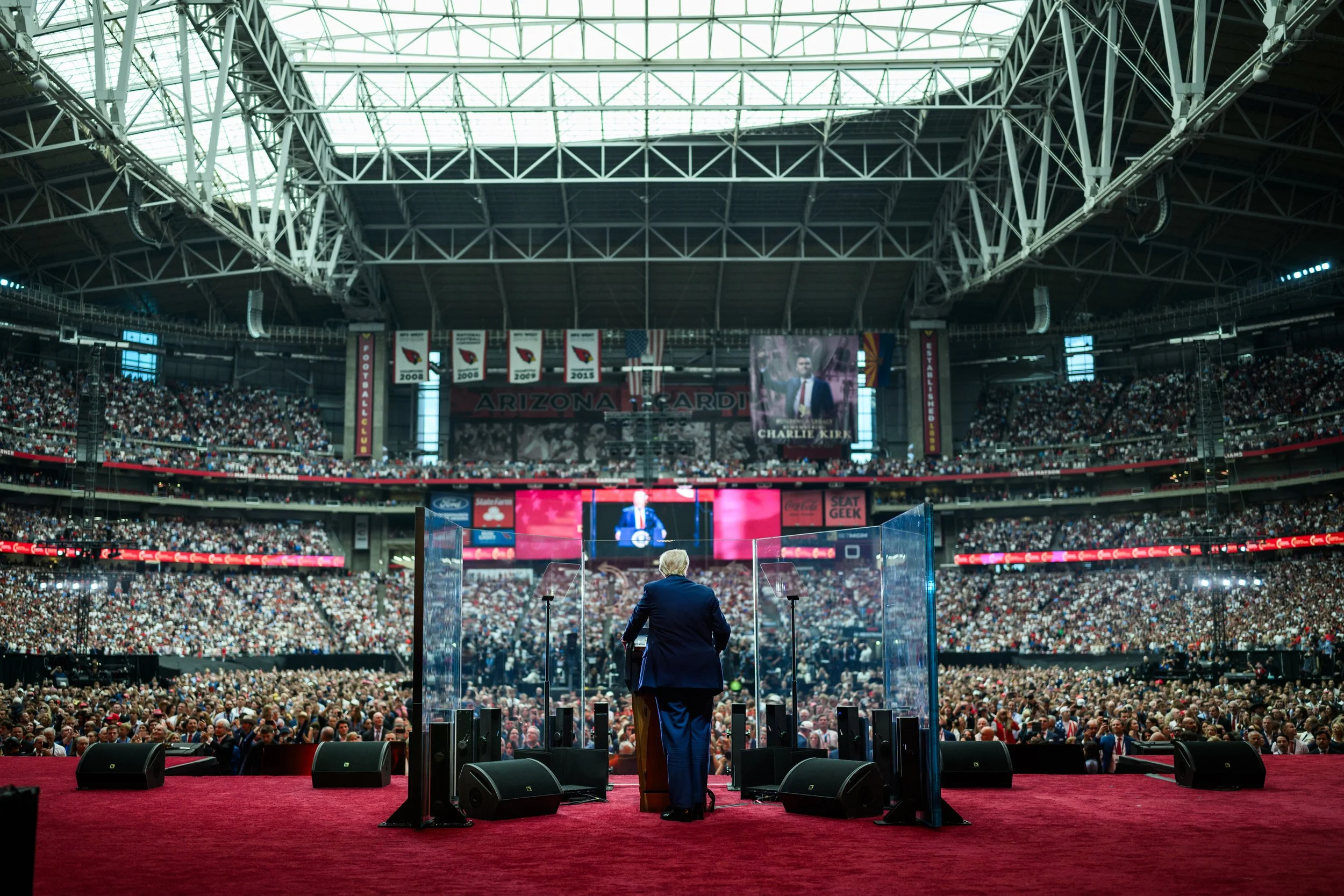
Donald Trump attends Charlie Kirk’s memorial service on September 21, 2025, at State Farm Stadium in Glendale, AZ. Photo courtesy of The White House.
Charlie Kirk was not a politician. And that’s exactly what made him so dangerous.
Kirk, the founder and face of Turning Point USA, a conservative youth organization that existed under the misconstrued banner of “activism,” was a coercive extremist who faced little to no legal repercussions for his actions. He gained fame on social media platforms where he shared videos of what he disguised as “democratic debates” with college students, which in reality were confrontations carefully curated to go viral and provoke Kirk’s viewers.
On September 10, 2025, Kirk was shot and killed by an audience member after being asked a question about mass shootings at an event for his “American Comeback Tour” at Utah Valley University. His death comes in the wake of a growing trend of political violence in America, marked by the assassinations of United Healthcare CEO Brian Thompson and two Minnesota state lawmakers in the past year.
Since his assassination, Kirk has been mourned with memorials all around the world. People attended vigils in London, Washington D.C., Utah, Australia, and Berlin, to name a few. A group of South Korean conservatives vowed to protect his legacy, holding memorials and protests in which they chanted, “We are Charlie Kirk.”
But why has Kirk’s death received so much recognition and led to even further acclaim?
Kirk was the perfect political actor who used his seemingly democratic debates as a facade, masking male rage. His assassination only elevated his political status, allowing him to emerge as a political martyr and symbol of influence across the world. Kirk’s emergence as a martyr marks a dangerous shift in American politics, one where outrage and violence are deemed as legitimate means of persuasion and political gain.
Kirk’s entire brand relied on performance—one that mainly spoke to men. He was masterfully able to disguise confrontations, typically with college students, as conversations. He only uploaded content where the debates with these students went his way, creating the reputation of being a master debater among his audience. His most viral videos on Turning Point USA’s social media are titled with attention-grabbing headings that emphasize Kirk’s rhetorical dominance, such as “Charlie Kirk SHUTS DOWN Student Insulting His Intelligence” or “Charlie Kirk's Most SAVAGE Campus Moments.” These videos follow a clear and divisive pattern, beginning with a student simply disagreeing with Kirk’s extremist beliefs. After stating an opinion or posing a question that contrasts with Kirk’s political tenets, he interrupts, aggressively responding and preventing the student from speaking again. This misguiding tactic frames these argumentative interactions as intellectual debates, with Kirk, unsurprisingly, painted as the winner.
Following his assassination, these videos continue to circulate on social media. And Kirk’s threatening work, promoting belligerent, aggressive political debate, has been carried on by individuals who resemble him–white men who attempt to inject conservative thought into universities. For example, on November 10th, the University of California, Berkeley, held a Turning Point USA event with over 900 attendees to close out the American Comeback Tour.
Despite his constant silencing of others, Kirk is seen by his followers as a man silenced for speaking his truth. President Donald Trump endorsed this idea, stating shortly after the assassination that Kirk “was violently killed because he spoke for freedom and justice.” Oklahoma is currently considering a bill that would require all state colleges to build a statue memorializing Kirk and the legacy of supposed free speech he promoted. Stephen Miller, White House deputy chief of staff, vows that the White House is at war with the left, which they are invoking in Kirk’s name. Predictably, Kirk’s death has morphed into a political tool that Trump and Miller can use to promote their right-wing agendas in the name of free speech, which they blame the “radical left” for attacking.
In the wake of his death, Kirk’s legacy has only grown louder and more influential. His assassination has elevated him from being merely a prominent political debater to being seen as a political martyr. Beyond retroactively rewriting Kirk’s legacy, deeming him a martyr dilutes the meaning of the word and is offensive to actual martyrs, such as civil rights leader Martin Luther King Jr., journalist Jamal Khasshogi, and others who spent their lives advocating for human rights and the betterment of the world. And now, Kirk is equated to them in his martyrdom status. His entire career rested upon his silencing of others, especially people from the left who believed in basic moral principles—whether they be diversity, equity, and inclusion, LGBTQ+ rights, or bodily autonomy. Yet now, ironically, he is a man who was silenced for his views.
Take the example of Melissa Hortman, the speaker emerita of the Minnesota House of Representatives, who advocated for universal free school meals, voting rights expansion, and codifying access to abortion. She was killed in June 2025. Her assassination was a form of political violence, with the shooter allegedly carrying a target list of dozens of Minnesota Democrats. Hortman had a memorial at the Minnesota Capitol, but her death did not receive anywhere near the national or international recognition that Kirk’s did. Her legacy of advocacy and policy work was quietly mourned, while Kirk’s aggression was glorified not only in the United States but across the world.
This growing narrative of Kirk as a martyr is dangerous, and it reveals a political climate that rewards anger and provocative language. Charlie Kirk was unapologetically himself, showing no remorse for his behavior and comments—unabashed and afraid. His actions encouraged entitlement amongst young boys, as they fed into his narrative of confidence and unashamed commentary in a world ridden with “cancel culture.” For them, Kirk represented a man who upheld the ideals of traditional masculinity and stopped at nothing to provoke others and share his opinions.
Kirk offered his audience permission–a permission no woman has ever fathomed having in American society. A permission to be angry and refuse to listen to others or reflect, which has now been misappropriated to be seen as bravery.
The “angry man” has become the hero of American politics in 2025, the symbol of power and the “real oppressed person.” The right in America and other right-wing regimes throughout the world are capitalizing on this trend to attack liberal institutions and spread hateful rhetoric. Anger is now the symbol of martyrdom, rewarded with protests, slogans, and monuments.
People are increasingly choosing to celebrate outrage, fear-mongering, and silencing others in politics. The meaning of martyrdom has morphed to describe figureheads who advocate for a facade of freedom rather than actual liberty, through intimidation and hateful rhetoric. Our democracy is fragile and risks collapse with the glorification of extremists like Kirk.
Jemma Granite (CC ’29) is a staff writer for CPR from London, United Kingdom, studying human rights and Latin American and Caribbean studies. She can be reached at jhg2167@columbia.edu.