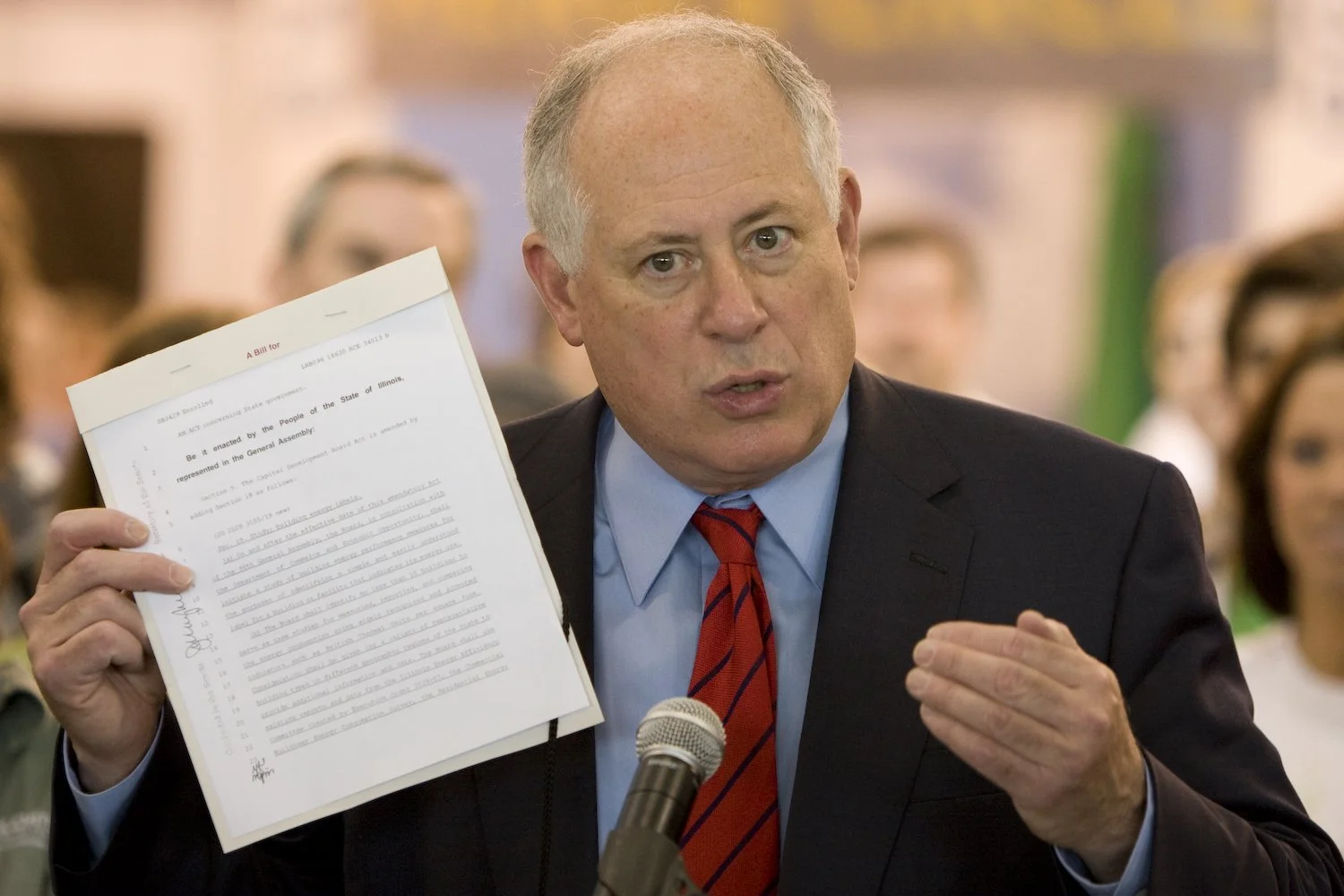
Photo courtesy of Chris Eaves.

Few public figures embody the struggle to restore faith in government as clearly as former Illinois Governor Pat Quinn. Quinn became Illinois’s 41st governor from 2009 to 2015, assuming office after a corruption scandal that led to the impeachment of his predecessor, Rod Blagojevich. During his tenure, Quinn faced the arduous tasks of rebuilding trust in the government, a massive budget deficit, and unemployment stemming from the Great Recession. In this interview, which took place on December 8, 2024, Governor Quinn offers poignant lessons for today’s troubling societal and economic landscape.
Jacob Drews (JD): I would like to start off at the beginning of your tenure as governor. After stepping into the office following former Governor Blagojevich's impeachment on corruption allegations, you inherited a state shaken by corruption scandals. How did you approach rebuilding trust in the state government during this time of crisis?
Pat Quinn (PQ): Not only was Blagojevich impeached, but he was also convicted by the Illinois Senate by a vote of 59 to nothing. Impeachment was done by the House, but later there had to be an impeachment trial in the Senate, and that occurred on the 29th of January of 2009. Blagojevich himself came and defended himself, and then the vote was taken – 59 to nothing! – to convict him. At that moment, he was no longer governor. Actually, he was flying back to Chicago in a state plane when the moment of conviction occurred. I was in my office as lieutenant governor, and shortly thereafter, the justice of the Illinois Supreme Court came over and swore me in as governor. They didn't want any kind of gap. Probably about an hour later, we had a ceremonial swearing-in with the same Chief Justice of the Supreme Court in the Illinois House of Representatives. My oldest son was there; he held the Bible. My other son, David, had been with us during the official swearing-in in my office but had to go back to Chicago.
Right after being sworn in, I went over to the governor's mansion. I got a call from Chrysler, which had a huge auto plant in Belvidere, Illinois. Their representative told me that within a couple of weeks, they were going to shut down entirely. That was my first call as governor. The next morning, I went over to the state capitol and announced the creation of the Illinois Reform Commission. I appointed about a dozen people, none of them legislators, headed by a former U.S. Assistant Attorney named Patrick Collins, and their job was to recommend ethics reforms for Illinois’ government in the next 100 days. We needed to implement those reforms in the aftermath of not only Rod Blagojevich, who was impeached and later convicted in federal court, but also his predecessor, George Ryan, who was convicted in federal court. For a time, we had two former Illinois governors, George Ryan and Rod Blagojevich, in federal prison for wrongdoing.
I said when I became governor that we needed to have a recall amendment for the office of governor. It required amending the Constitution, but it was designed to acknowledge that the people of Illinois were entitled to honest government and should have the opportunity, by means of petition and a recall referendum, to remove a governor if he or she was violating that oath. I convinced the House and Senate in Illinois to put that constitutional amendment on the November 2010 ballot, and the people, by a two-to-one margin, voted for it. That was part of cleaning things up. The Reform Commission recommended a robust series of reforms. I'd say about 60%, maybe two-thirds, were enacted into law. Campaign finance reform was one, purchasing reform, Freedom of Information Act reform, and a variety of others. We could have gone further. Part of going further was having an ethics initiative that would empower voters to propose reforms for Illinois’ government by initiative petition and binding referendum. We needed a constitutional amendment for that. Several times, I proposed it when I was governor, but the House and Senate leaders were not interested, so there's still a lot of work to be done.
JD: Besides that initiative process for ethics in Illinois, what other steps would you advocate for tackling corruption in Illinois today, if you had the chance?
PQ: To me, the central issue is empowering voters at the ballot box to go around the legislature, which has been historically resistant to reform, whether it's controlled by Democrats or Republicans. There's a machine political tradition that goes back a century or more in Illinois, in both parties. The resistance to having voters enact conflict-of-interest statutes is a big problem. In Illinois, legislators can vote on bills where they have a personal financial conflict of interest. There's no law against that. Right now, the former Speaker of the House, whom I had to deal with for six years, is on trial in federal court. The allegation by the federal government is that he was running a racketeering operation from 2011 to 2019. One accusation is that he had a property tax appeal law practice and used his influence to obtain clients. Whether that's a crime will be decided by a jury, but the bottom line is that members of the legislature should not have these kinds of conflicts of interest. Most states have enacted statutes against that. In Illinois, it’s advised not to vote on bills where you have a financial interest, but it's not mandatory. The legislative Inspector General, Tom Homer, pleaded with the legislature to pass such a prohibition, but they ignored it.
That underlines why you need the initiative process, where the people can set the rules for their government. The government belongs to the people of Illinois, not the insiders. This corruption is really a corruption tax on everyday people. Commonwealth Edison, our largest utility, pleaded guilty to bribery in a deferred prosecution agreement and was fined 200 million for their activities from 2011 to 2019, by their own admission, bribing the legislature. That's why I'm a big believer in initiative and recall. At the local level, the same concept should apply. In the city of Chicago, numerous aldermen have been convicted of felonies. States like Wisconsin, Michigan, and Ohio have local initiative processes available. Illinois does not. It's a battle for direct democracy. We also need recall at the local level for mayors. Only three cities have it. I’d like to see it in every town, so incumbents stay on the right course.
JD: When you were governor, Illinois also faced a 13 billion budget deficit and an underfunded pension system. How were you prioritizing those issues, and what were the challenges in implementing solutions?
PQ: The day I got sworn in, the national economy was crashing. President Barack Obama had been sworn in nine days earlier. He was from Illinois and was a personal friend of mine. He invited me to the Oval Office, and he told me how bad things were. We had three crises: an ethics crisis, a job crisis, and a budget crisis, all at once. We had to work very hard on jobs. Early on, we passed the ‘Illinois Jobs Now’ capital bill—over 30 billion dollars to build roads, bridges, housing, broadband, high-speed rail, and more. We passed that in my first few months to help people get back to work. We also had the ‘Put Illinois to Work’ program. If an employer agreed to pay someone 10 an hour, we, the state, paid that 10 an hour for six months to get people off unemployment and give them hope and a résumé. We were second only to California in that effort, and tens of thousands of people got jobs.
That approach, along with helping big employers like Ford and Chrysler stay in Illinois, was part of our effort to get the economy going again, because people who work pay taxes, and that helps the budget. Still, revenues dried up for a while, so in 2010, during a Tea Party year, I proposed raising the income tax from 3%. I ran on that and won. In January 2011, we passed the increase to start paying down bills. Sometimes you have to do hard things in politics.
JD: What lessons can other states or even the federal government learn from that time of fiscal struggle and your approach?
PQ: At that time, I said the number one civil right was a right to a job. When people don't have a job, they lose hope. We needed to prime the pump, like the government did in the 1930s. We helped Ford in Chicago expand from one shift to three. We helped Chrysler in Belvidere go from 200 employees to 4,500. That’s what the government must do when there’s an unemployment crisis. It also helps the budget. There’s still more work to do, but that’s the key lesson.
JD: Now, looking at our current political climate, are there any parallels between today's challenges and those you faced?
PQ: I don’t think we have the unemployment crisis we had in 2009 and 2010, though there's still work to do to get everyone a good job. We also need to address the cost of living for people living paycheck to paycheck. When I first got involved in politics, utility rates were a huge issue. The utilities would get rubber-stamped rate increases. Through petitions, we created the Citizen Utility Board, which is now 40 years old. It fights unfair rate increases. I believe we should have a consumer insurance board in Illinois to protect people from high car and home insurance rates. Without an initiative process, it can be tough to enact these reforms, but it's important. I signed consumer bills, but it’s never finished. You always have to be on your toes.
JD: How would you address the hyper-partisanship we see today?
PQ: I’m a Democrat. I did not support the person who was elected president. I don’t agree with many of his policies, and I think we must resist them. That’s what an opposition party does. But I’m not a doomsayer. If something doesn’t go your way in politics, you pick yourself up and organize. Early to bed, early to rise, work like hell, and organize. It’s important at the state and local level to find reforms we can enact, with petition and referendum if necessary. When I was governor, I signed the bill for the Affordable Care Act to apply in Illinois. The legislature wasn’t moving it, but we had a Democratic majority, and it passed. I signed it, and about a million people got health insurance. The people need to step in when something goes off track, marching, petitioning, and electing legislators who share a better vision. Democracy is not a spectator sport.
JD: What advice would you give to young individuals aspiring to enter public service on how to handle a crisis?
PQ: Volunteer. The heart of America, the heart of Illinois, is the heart of a volunteer. Find causes and groups you believe in. Young people have tremendous energy and idealism. When I first got started in politics, I was good at passing petitions for candidates and later for issues. One of our first petition drives was to stop legislators from collecting their entire salary on the first day of office, before working. We collected 635,138 signatures—an all-time record in Illinois at that point. Another petition reduced the size of the Illinois House from 177 to 118 after legislators raised their pay by 40%. People called us a ragtag band of volunteers, but that’s how America began: we said to King George we didn't like his government. We’re coming up on the 250th anniversary of the Declaration of Independence, so let’s be a ragtag band of volunteers for reforms we believe in.
Governor Quinn’s words resonate not just as reflections on the past but as an urgent call to action for today. His unwavering belief in the power of ordinary citizens to effect change is refreshing as faith in institutions falters and cynicism crowds out civic engagement. While seemingly irreconcilable visions for the future clash in Washington and statehouses, Quinn’s brand of people-centered leadership offers a model for other leaders today, a model that is rooted in the conviction that reform is best started from the bottom up.
Jacob Drews (CC ‘27) is a staff correspondent at CPR, majoring in political science.