A Letter to Sundial: Columbia Doesn’t Need Your Moderation
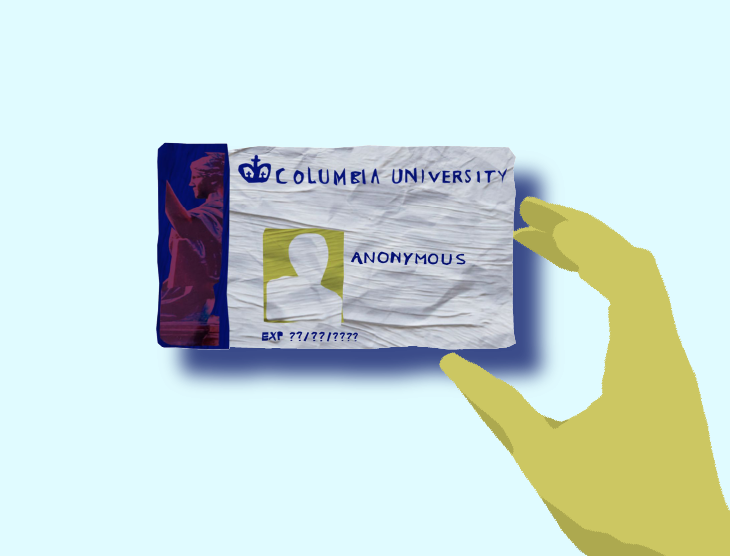
Original design by Anya Herzberg.
This letter is a response to an editorial that was featured in the November-December print issue of Sundial, titled “Why Sundial Rejects Anonymous Pieces.”
Dear Reader,
This spring, I received word from one of our staff writers that the Trump administration’s targeting of Columbia’s research funding had made continuing their studies in Morningside Heights impossible. In their final correspondence with our team, they wrote the following:
What is most disheartening is not simply the systemic nature of these failures but the lack of institutional responsiveness when students are faced with life-altering consequences. This is not merely a bureaucratic lapse—it is a moral failing.
I was saddened to see that writer go, as I was to hear from several other members of our staff that the risks their speech posed to their visas, employment, and even physical safety had dissuaded them from continuing to write. Because of conversations like these, our team created a new process to accept anonymous submissions from every part of the Columbia community. The reasons for that decision were many, but they all rested on one basic principle: that requiring someone to risk everything in order to write about the world’s problems is destructive to any speech environment seriously concerned with solving those problems.
You can imagine my surprise as I flipped through the latest print issue of Sundial and read on the very first page that Editor-in-Chief Alex Nagin and Deputy Editor Imaan Chaudhry insist as a matter of policy that accepting anonymous submissions “sets a regressive precedent which hinders the open exchange of ideas.” They argue that to offer anonymity is to allow writers to remain “half-committed, [presenting] ideas but not [taking] ownership of the full weight of them.” In doing so, the editors of Sundial have chosen to embrace an all-too-common conflation of the chilled speech that results from violations of political rights with duplicity or some sort of “failure of will” on the part of the speakers.
If the writers mean to say that defending the “open exchange of ideas” requires excluding anonymity as a legitimate vessel for political thought, then we at the Columbia Political Review couldn’t imagine anything more regressive for a campus as frigid as our own.
We shouldn’t have to remind anyone that our two most famous alumni, Alexander Hamilton and John Jay, concealed their identities under the Roman-inspired pseudonym Publius as they wrote the Federalist Papers. Hamilton and Jay chose anonymity because it allowed their arguments for the nascent Constitution to be evaluated on their own merits, removed from any distortions their public profiles might provoke in the reader’s mind. Even earlier, Thomas Paine published Common Sense anonymously in order to protect himself from retaliation by the British Empire. And that doesn’t even begin to cover the many artists, dissidents, and polemicists throughout history who dared to think that their ideas were worth more than their identities.
Bearing this history in mind, anonymous submissions hardly amount to “self-isolated ideas bumping into other self-isolated ideas.” (I can’t think of a single “isolated” idea, much less one that “isolates” itself.) Anonymity clearly affirms a tradition of political dissent and artistic production that spans centuries of repression and resistance. Seeing as we find ourselves in a moment when websites are colluding with the state to ruin the lives of students and professors for speaking out about Palestine; when research funding is made contingent on scholars’ orientation along the fronts of the culture war; and when international students are quite literally abducted in the street for writing op-eds, I see no reason to abandon the practices used by our own alumni to construct the very system of rights we all agree is in crisis.
Accepting anonymous submissions is the obvious thing to do amid political reprisals that have all but thrown vulnerable students under the bus. Far from “the reduction of people into ideas without ownership,” our policy recognizes that our writers are people first and foremost, with stories and stakes that are often invisible to those evaluating their work. And while forgoing names obviously adds a layer of protection for the vulnerable contributor, it also dampens the chilling effect that would otherwise keep essential perspectives from ever entering our collective conversation.
Sundial’s insistence that anonymity belies a lack of courage only makes sense if your opinions don’t meaningfully challenge the status quo. Anyone can claim the “courage” of “taking ownership” of their thoughts when they have nothing to lose by putting those thoughts to paper. Embracing anonymity can give writers the freedom to express even their most personal views, those that we all have but might never dare to express if compelled to attach our name to them. That is where the “full weight” of an argument lies, not in the author’s byline.
Assuming that anonymity will prompt writers to “slip into ideological entrenchment” betrays a severe lack of faith in the critical thinking skills of the average Columbia writer, and, for that matter, the average reader. It takes for granted that once a name is removed, both the writer and the editor will abandon any semblance of nuance, rigor, or responsibility in their work. But anonymity doesn’t erase the norms of good argumentation, nor does it release the editor from the job of editing; it simply protects the futures of the people making the arguments and preserves the diverse range of opinions we must encounter in a healthy speech environment.
Let’s assume for a moment that Alex and Imaan are right—that namelessness gives special cover to reductive, bigoted, or bad-faith arguments. Even if that were true, reading critically and in good faith is equally essential. Is the Federalist’s headline lampooning the conservative reputation of Sundial a dangerous attack on good faith or, you know, a joke in a humor magazine? Serious critique and light-hearted jabs are admittedly easy to confuse in the political charge of the times, but the fact that Sundial devotes an entire paragraph of its editorial to defending itself against a punchline tells us enough about why satire sometimes requires anonymity.
We also believe that it is the job of editors to get their facts straight. As evidence of anonymity’s dangers, Alex and Imaan cite a piece from the Harvard Salient that echoed the “blood and soil” rhetoric of Nazi Germany. But this piece was not anonymous at all—it was publicly authored by David F.X. Army, as nearly every news report on this incident acknowledges.
They cite yet another Salient article, this time written under the pseudonym “Cornelia,” that lazily argues for a return to gender-segregated education in terms of the distinct “natures” of men and women. Putting aside the obvious flaws in Cornelia’s logic, you would be hard-pressed to find an orthodox religious sermon in this country that doesn’t argue along similar lines. Why, then, should this be used as evidence that anonymous articles produce intolerable ideas? Readers, regardless of their gender, do not need to be shielded from worldviews that were matters of policy at Columbia until 1983. In fact, their recent and persistent institutional dominance is exactly why engagement, not avoidance, is necessary for all of us.
We do agree with Alex and Imaan that “anonymity breeds radicalism.” The Communist Manifesto was first published anonymously, after all. But we, as a multi-partisan publication, reject the notion that editors should strain out the honest thoughts of radical writers simply because their arguments by definition challenge our most basic assumptions. Calling a view “radical” should not disqualify it from contributing to our discussion of the world’s problems and how we can fix them. To be sure, there are limits to what “free speech” actually means to our respective “free speech publications [sic],” but it is literally the editor’s job to make sure that an idea not worthy of publication is not published. That alone is a moderating force, and to make the threshold for rejection any closer is a partisan choice masquerading as principle.
We understand that, as a campus-oriented publication, Sundial’s editorial concerns almost always fall somewhere between Broadway and Amsterdam. But I plead with you to look at the bigger picture: students everywhere are facing targeted consequences for speaking their minds, and our response has to be more than “FAFO.” As our former staff member so eloquently put it, institutional responsiveness to life-changing consequences is the essence of what our university failed to accomplish when push came to shove with the federal government. That responsibility now falls to us, and to refuse the task would itself be a moral failing.
Alex states in a different editorial that “free speech is the issue of our generation.” I agree. But this generation has lost its appetite for the kind of weak-willed commitments to moderation that brought us to this moment of crisis in the first place. Any true commitment to free speech demands that we reckon with radical ideas, regardless of who they come from. And while I appreciate the provocative argument that he and Imaan offer in this piece, I’d also like to hear provocative arguments from the hundreds of other students who, for one reason or another, don’t have the liberty of speaking so publicly.
Anonymity is not cowardice. Sometimes, it’s the only way that the truth can reach the page. Sundial can stick with the comfort of moderation for now, but we’ll choose to give a voice to those courageous writers who have been silenced by circumstance. And if protecting our writers’ ability to speak honestly is “radical,” then radical is exactly what this campus needs.
For the staff,
Adam Kinder
Editor-in-Chief, Columbia Political Review
Adam Kinder (CC ‘26) is a senior at Columbia College studying political science and anthropology. He can be reached at ask2297@columbia.edu. If you would like to submit an article to the Columbia Political Review, anonymously or not, he urges you to do so on CPR’s Submit a Pitch page.