One City, Two Outlooks: How Two New Yorkers Are Responding to Zohran Mamdani’s Election
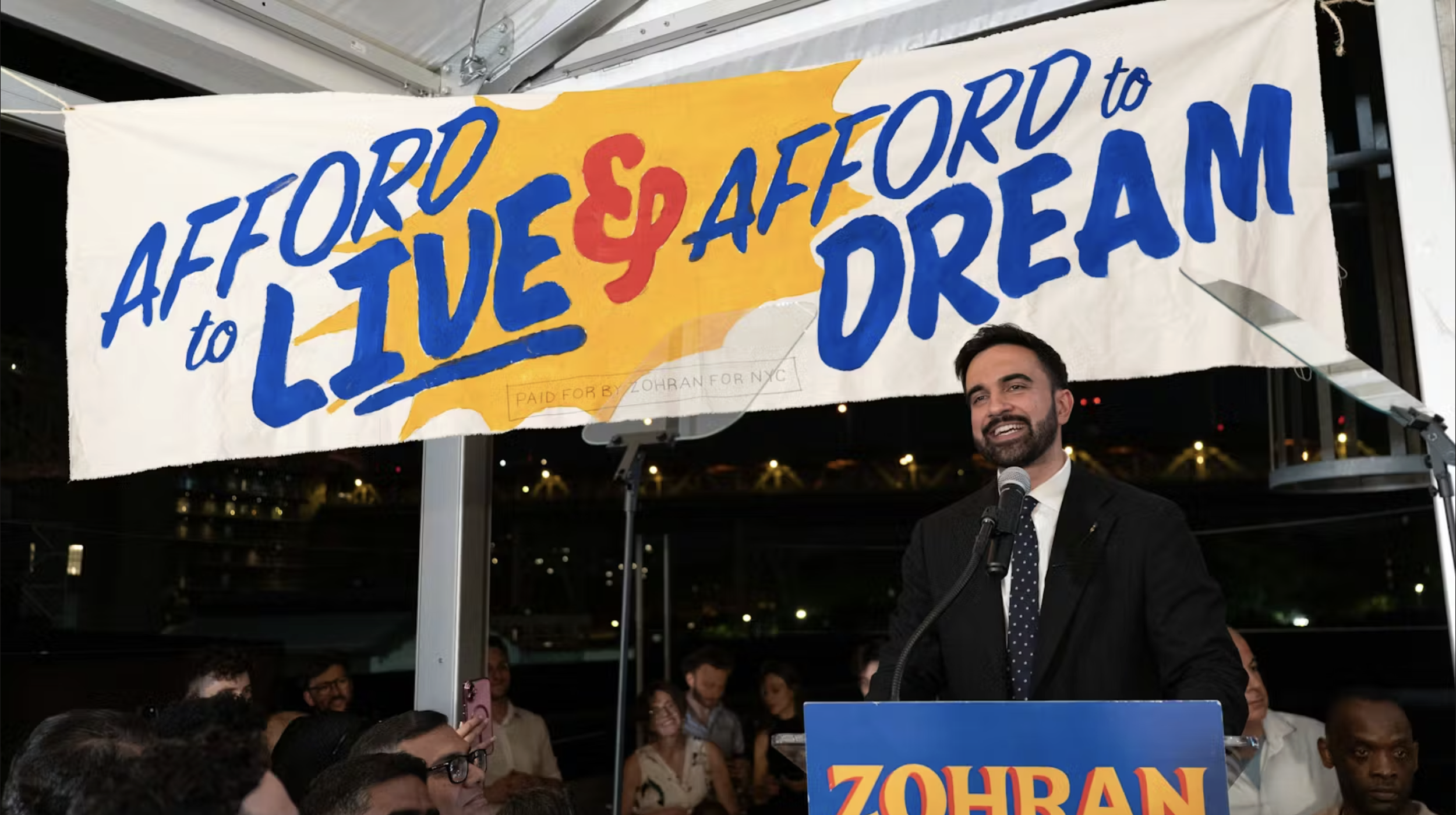
Photo courtesy of IMAGO/SOPA Images.
On November 4th, 34-year-old Zohran Mamdani completed one of the biggest political feats of recent memory: he won election as New York's next mayor. There has been extensive analysis on how the Democratic Socialist, currently the Assemblyman for New York State’s 36th district, attained control of the nation’s largest city. As we assess this choice, what really matters is the response of everyday New Yorkers who are essential to this city’s success.
Staff correspondent Rohan Sarma spoke to two individuals with every right to call themselves a New York success story: Marquis Harrison, a teacher in Central Harlem, and Dr. Smith*, a physician in lower Manhattan, are unsung heroes whose work often goes unappreciated. They are the everyday New Yorkers whose open and honest thoughts offer an insight into the city’s politics that neither data nor analysis can provide.
When it comes to New York’s most recent election, however, their common ground as servants of the city hasn’t led to shared political views. Keep reading to learn more about how these two New Yorkers are responding to Mr. Mamdani’s victory, and what it means for their professions.
*To prevent the politicization of their practice, the interviewee referred to as ‘Dr. Smith’ has asked to be anonymized.‘Dr. Smith’ is a pseudonym.
Rohan Sarma (RS): I'm hoping you can start by telling us a bit more about yourself; to do that, I'm going to ask you to try and encapsulate what it means to you to be a New Yorker.
Marquis Harrison (MH): I grew up in New York City. I was born and raised in the Bronx, and I went to school in Harlem. So, New York has been a part of my life, and I’ve always been here; the only time I didn't live in New York is when I went away for college, where I went to the University of Rochester.
At the end of my academic career there, I applied for Teach for America, which is a two-year dedication to teach in an urban area. I thought I would do that for two years and go to law school. I was placed in New York, at home. I didn't expect that—actually, I was trying to go somewhere else, LA or Washington, D.C.—but I got placed here in New York, where I was very familiar. I then had a desire to make sure that I was teaching in Harlem, as I saw that the community had been changing and as I saw that people were being forced out because of the lack of affordable living and things like that. I went to high school in Harlem, and I thought it was important that I serve the students who are part of my community and a historic community that means so much to so many people.
And so I was placed at the Frederick Douglass Academy, and what I thought was going to be two years ended up being 16 years of teaching there. I ended up not going to law school because of my involvement in education, the love that I have in helping students go to college and then just being a part of that community. I also currently serve as the community board chair of Community Board 10 in Central Harlem. So that's a part of my life.
Dr. Smith (Dr. S): I moved to New York about 20 years ago, and have never wanted to leave. For me, it’s funny that, when you're a young child, you play the game MASH. You're going to live in a mansion, an apartment, a shack, or a house. And you give four cities and four professions. My top city was always New York because I visited it a great deal. And my top profession was always a doctor. So in terms of the MASH game of life, this was always where I wanted to be and always what I wanted to do.
And, once I moved to New York City, I very much felt at home. Even though it was hard to pass a co-op board, get my kids into school, and even get into a book group initially, it was all well worth it. And it really has become home much more so than any other place that I've lived. We love being a part of the fabric of the city and enjoying every facet of the city.
RS: It sounds like New York and its multifaceted nature is definitely a big part of your lives. But, regardless of our attachment to the city, a lot of our focus has recently been on Zohran Mamdani's election as the new Mayor. As long-time New Yorkers, I'm hoping you can tell us a bit more about your thoughts on his victory.
MH: First of all, let me just state that I personally am extremely excited about what I think the possibilities are for the next four years. And I say “possibilities” because I do believe that Zohran provided a sense of hope. [He provided] hope that the city could be affordable and could be feasible for working people.
I will say that I recognize campaigning is different from governing. And so that's why I continue to remain hopeful that he will not only be able to put some of the plans and policies he has in place to make the city more affordable, but that he will also be pragmatic in doing so and that he will work with other people who have different opinions and ideas.
But I will say that even his recent appointments of his deputy mayors and his transition team continues to build my hope because he has put in people who have great experience and who are also research oriented. I think that it’s really important that there are people who have skills, who are willing to learn, and who have experience.
And so I am very hopeful for what these next four years could be. I'm also recognizing that I think he will have to build partnerships with the state government, because some of the things that he has in mind aren’t controlled by the mayor or the city council. And so, as a teacher who taught government, I am someone who's very much hoping that he will be able to build a very positive working relationship with Albany and our Governor so that some of those changes can come into effect.
Dr. S: It's very troubling to me on several levels. Number one, our family is Jewish, and I do not think he is a friend to Jewish people. Even though he sort of tokenizes certain Jewish communities or causes, overall, he is, I think, a threat to the safety of our community and a community that has built New York City and is very much a part of New York City. So much of what people think of as New York is actually Jewish coded, and so I find that extremely troubling.
I find it troubling as somebody who knows that the city is the center of finance and his policies, both in terms of his approach to companies from Israel but also companies in general, I feel are antithetical to the founding of New York even before we as a nation were the engine of commerce and capitalism. So I find that extremely troubling.
And thirdly, and this probably should have gone first, I am troubled by his inexperience. He is not somebody that I would hire, given how flimsy his resume is, to work for me in my office, let alone somebody who should be running a city that has the budget of a small country. So those are my three pillars of trouble.
RS: Mr. Harrison, I'm grateful to you for touching on experience in that response, because that has been a common criticism of Mr. Mamdani, that he doesn't have the experience to run the biggest city in the country. It sounds like you think he surrounded himself with the right people to address that. Is that correct?
MH: Absolutely. I'm not that young, I’m about to turn 40, but as someone who grew up in the city and who some people still consider young—he's younger than me. When I hear people talk about a lack of experience, it was something that I was always told when I applied for different things. It's something that younger folks always deal with.
And to me, his campaign showed how he thinks. It's not always about the experience you've had, but who you put around you, who you surround yourself with, and who you put in places of leadership. That, to me, is what leadership is about too. And I think he's proven himself. He took on the entire establishment. Everyone just assumed Andrew Cuomo was going to be the mayor when he first got into that primary. And look at what he did, he created a campaign that changed New York forever.
And so, when people talk about their concerns about his experience, I'm like, did you not see this campaign that just took place? Because that showed me that he has enough experience to make the right decisions and he's willing to also learn.
I've always been against the idea that you have to have certain experiences to do certain things. Because, to me, that's not necessarily what effective leadership is.
RS: Dr. Smith, is there something he could do to alleviate your worries and make you feel more positive?
Dr. S: I think that his orientation and emphasis on boycott, divest and sanction is threatening to Jews, to non Jewish Zionists and to capitalists. So if he decided to jettison BDS (boycott, divest and sanction) and realize how much Israel and the Jewish community actually provide to both the safety and the economy of the city, that would be wonderful. But I feel like that's not what he's about. So he would need to not be what he has claimed as the animus of his politics.
RS: Your respective sentiments are shared and voiced by many New Yorkers, but not all of us have your specific lenses in education and in medicine, respectively. I'm hoping you can give us a sense of what Mr. Mamdani’s election means to you not as a New Yorker but as a professional and, even more specifically, how this will interact with the actions of the Trump administration.
MH: As an educator, there are a few reasons why I'm extremely excited, hopeful, and feel that this is a great thing. First is the fact that I teach at a school where about 60% of the students are Muslim. For those students to now see that New York City has elected its first Muslim mayor is more than overwhelming.
I'll tell you a quick story: I was in charge of the graduation for high school seniors and, for many years, the school had engaged in having an opening prayer at the beginning of the ceremony. I followed along with the practice, and I said we need to integrate and have students of different faiths pray. I remember when we first had a Muslim student give the prayer. This was many years ago, and some of the administrators and colleagues were concerned, [saying] “I don't know if this is going to be a good idea.” And when they saw the reactions of the parents and how proud they were at their child’s graduation to have a student come and deliver an invocation in their faith, it was so powerful that those teachers all came to me after and some of them were crying because they saw [those parents’] pride. So I think that same pride is going to reign amongst the students to know that, yes, you can lead the largest city in America. So that's one aspect of this.
I think that Zohran, again, is inspiring. I’ve seen young people, my former students, who had said that they wouldn't vote, working on his campaign canvassing. So that's one thing.
On the policy level, we have been dramatically impacted, obviously, by the cuts to the Department of Education, around Title I schools and around special education. The federal government is doing a hit job and gutting public education. This mayor is going to have to fight, because even though we have mayoral control of the schools, the state government has a huge part of this too in funding our schools. And so it's going to require both the mayor and governor to have an excellent working relationship. Next year we're also going into state elections, and so the governor's going to be up for reelection. I think it would be really promising for her that she works well with this incoming mayor.
I think he has a mandate. I don't care what anyone says. He had over 50% of the vote. But I will say that this is a mandate in the sense that he built a new coalition of voters, a new mandate of working people. And so it's going to take him fighting.
I am concerned too, about what the president or the federal government may do. I think about this all the time because of this bravado around Donald Trump, and if he’s going to show New York City that, now, “I'm going to control [you].” And so I do think we’re going to see an increased presence of ICE raids. I think we may become ground zero where Chicago and LA were maybe just test cases; that could be coming to New York. I think it's got to call upon us as educators and teachers. We have to build systems into our schools to protect our students, who may not be documented. We are working on that. We are very much aware of that—building policies and practices and even drills— and unfortunately, that might be the climate that we have to endure for a little while now as we prepare for a new mayor, with what's possibly going to be happening under this federal government.
Dr. S: I think that the ethos of New York has protected any concerns that I have vis-a-vis the Trump administration in terms of access to all aspects of women's health care and reproductive freedoms. And so I have felt troubled and worried, but it hasn't made much change in my day to day, which is reassuring.
This is larger than being a physician, but outside the walls of my examining room: what I do worry about with Zohran Mandami is safety in our city, and the question of will there be an increase in crime with his negative orientation towards more traditional policing. And if there's more crime in my city, then there is going to be more anxiety and a lack of safety. As a physician, those are my worries. I worry when politics of any stripe has an impact on my patients. So, more widely, if I lived in a state where I wouldn't be able to protect women the way that I can [here], that would cause me a great deal of anxiety. And so, living in a city where there may be specific communities that are more impacted by elevated crime than others, it doesn't matter if that's only 10% of my practice; that causes me 100% more distress when I know that patients of mine are feeling unsafe or threatened in any way.
I think that medicine has always been, so the joke is, about states’ rights. Well, I've always enjoyed states’ rights [in New York] as it speaks to medicine, because I have worries about the vaccine orientation, et cetera, but thus far have been unaffected. And a positive thing that just came out of this administration as a women's health provider is actually a more positive focus towards hormone replacement. So I take the wins when I can, I try not to borrow trouble, and I will see what comes in terms of the day-to-day practice and the impact on my patients.
These discussions show us that there’s no one way to feel about Mayor-elect Mamdani’s victory. Mr. Harrison and Dr. Smith are both leaders in their industries, and their hope and concern, respectively, is rooted in and justified by their experience. It’s clear from the election that these sentiments are shared by many New Yorkers—50.4% of the city voted for Zohran Mamdani, which means that 49.6% did not. There were both proponents and opponents of his election, and these conversations reveal just that.
Navigating this division will be a major challenge for Mayor-elect Mamdani. He has the unenviable task of maintaining his commitments to his loyal fanbase while, as he’s promised, being the Mayor for all New Yorkers—Mr. Harrison and Dr. Smith included. Zohran Mamdani will likely stand for reelection in four years; while much will be written on his performance between now and then, the definitive test of his success will be how individuals like Mr. Harrison and Dr. Smith vote in 2029. Will supporters, like Mr. Harrison, feel let down, or will Mamdani live up to their expectations? Will skeptics, like Dr. Smith, have their worries allayed, or will they maintain their opposition at the ballot box next time? Yes, it’s cliché, but there’s really no more fitting conclusion than ‘time will tell’.
Rohan Sarma (CC ‘29) is a staff correspondent in the Columbia Political Review’s Interviews cohort. You can email him at rohan.sarma@columbia.edu.