From Ras Laffan to Algiers: Helium, Conflict, and Opportunity
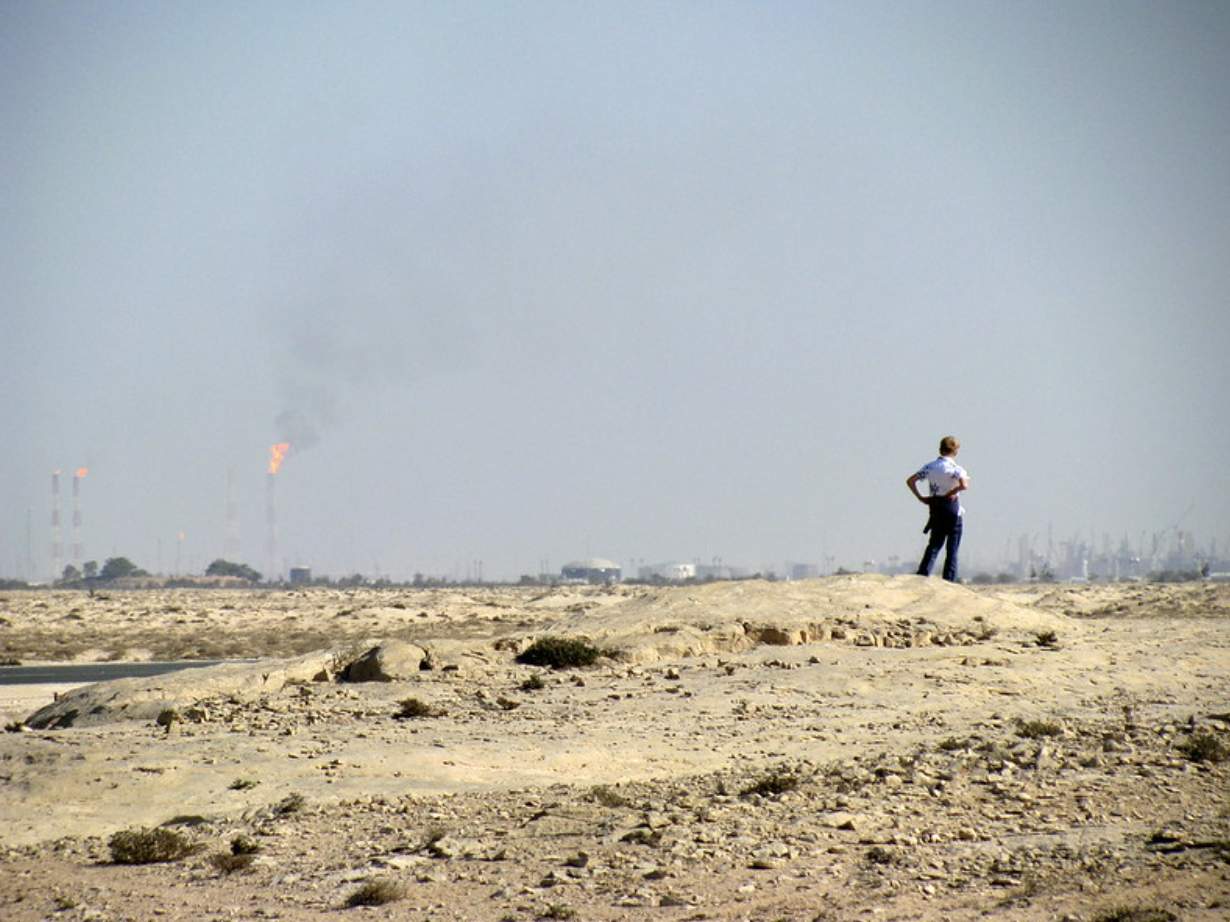
A worker surveys an industrial horizon as gas flares burn against the desert sky, emblematic of the billions of cubic meters Algeria wastes through flaring each year instead of capturing helium. Photo courtesy of Flickr.
In the dead of night, the sky glowed orange over the industrial skyline of Ras Laffan, Qatar. Within hours, smoke was rising above the seemingly endless natural gas liquefaction plants that power Qatar’s energy empire. Pipelines, processing units, and storage tanks have become targets in war. Iran’s attacks have knocked out 17% of Qatar’s liquefied natural gas export capacity, costing about 20 billion USD worth of damage. However, there was a deeper shock: helium.
Qatar produces roughly one-third of the world's helium. Every advanced chip in the data center that trained the artificial intelligence (AI) program you used this morning was made possible by helium. So was every MRI scan ordered this week. So was every satellite launched this year. The reason is helium's physical properties: no other element can stay liquid below 269 degrees Celsius while refusing to react with anything it touches. Industries built on these properties cannot redesign around a different gas.
This attack on Ras Laffan has cracked open an opportunity for other suppliers. For Algeria, the world’s fourth biggest producer with the world’s third-largest helium reserves, this is a golden opportunity if they choose to take it.
Commercially, helium is not a traditional energy commodity because it is captured as a byproduct of natural gas processing: producers cannot ramp up helium output when supply runs low because it is tethered to natural gas economics. The market is also highly concentrated, with four countries accounting for essentially all commercial production: the United States, Russia, Qatar, and Algeria. The structure of the helium market is opaque and rigid, vulnerable to quick changes in supply. State producers, like QatarEnergy and Algeria's Sonatrach, sell to a small group of industrial gas firms, like Air Products, under long-term contracts that lock in volumes for years. These firms then refine transport and resell the helium to end users under separate multi-year contracts. Helium buyers are locked into existing contracts and cannot redirect supply, while a few alternative producers can scale to fill the gap.
The end users of helium are the most vulnerable to these attacks, like the European Union (EU). The continent is 85% import-dependent, with half of that coming from Qatar in 2024. The EU acknowledges the importance of helium to its economy, having added it to its critical raw materials list in 2023. They did so after the Russo-Ukrainian War, in which sanctions on Russia, among other factors, cut the EU helium supply by 15% and forced hospitals to postpone non-emergency MRI scans and semiconductor fabs to ration production. Potential disruption resulting from the conflict in the Middle East could prove much worse than the 2022 shortages. QatarEnergy has declared force majeure on all of its long-term contracts with Italy and Belgium, suspending its commitments without a defined recovery date. The uncertainty surrounding the conflict is ever more concerning for an EU helium importer. Iran has repeatedly demonstrated that it can close the strait at will using drones, speedboats, and mines, making any serious convoy attempts impossible without a high cost of lives and capital. Even an eventual peace deal or ceasefire would not erase Iran’s success in weaponizing the strait and its resilience to US attacks, making Qatari helium more risky to buy for the EU.
Europe is pouring billions into the exact industries that cannot survive without the helium it just lost access to. The most fitting example is the EU Chips Act, explicitly designed to expand Europe’s semiconductor ecosystem and reduce dependence on outside suppliers. In 2025, the EU Commission formally granted CHIPS Act status to four semiconductor projects. In February 2026, the EU opened NanoIC in Leuven, its largest Chips Act pilot line, backed by 2.5 billion euros and explicitly aimed at next-generation chips for AI, healthcare, and 6G. By 2025, the EU had also expanded its network to 19 AI factories across 16 member states, with more than 2.6 billion euros committed. In January 2026, it broadened the EuroHPC framework to support AI gigafactories for training and deploying large AI models. The EU’s clear shift in policy to support AI efforts makes helium a vulnerability in its supply chains, which will be felt after helium stocks run out.
As a possible replacement for Qatar’s role in helium production, Russia is not an option. First, the EU’s 14th sanctions package, following the Russian invasion of Ukraine in force since September 2024, formally banned Russian helium imports. Moscow has already repositioned itself to Asian markets. In 2025, Russian state-owned energy firm Gazprom was supplying half of China’s helium imports, with volumes up 60 percent year-on-year. Russian Prime Minister Mikhail Mishustin declared the disruption had “opened up new trade opportunities for Russia,” a signal of intent for the Asian market since it cannot access the EU market.
The United States is also not a viable replacement. Although it is the largest helium producer in the world, producing 81 million cubic meters of helium in 2024. But 56 million were consumed domestically, and that figure is set to grow larger due to large investments in AI. The four largest hyperscalers of AI, Amazon, Google, Microsoft, and Meta, are projected to spend close to 600 billion on AI infrastructure capex in 2026 alone, making every dollar dependent on chip production and every chip dependent on helium. The supply of helium is already a concern; American semiconductor manufacturers have signaled they will not meet their 2030 production goals because there is no way to boost supply fast enough. Airgas, one of America’s largest helium distributors, has already declared force majeure and cut domestic customer shipments by half. The US cannot fully serve its own market; how can it expect to serve Europe's?
Algeria is Europe’s only potential supplier capable of mitigating the loss from Qatar. The EU and Algeria already have strong ties, especially in energy, with a strategic energy partnership established in 2013 and reaffirmed in February 2026. Geographic proximity is also another strong advantage for Algerian helium. Helium is a cryogenic product, which means it must be kept at near absolute zero. Specialized transport containers hold it for 35 to 40 days before pressure builds to unsafe levels, causing the product to be lost. Algeria sits 415 nautical miles from Marseille, only a two to three-day trip by tanker. Algeria’s production capacity is 50 million cubic meters annually, much higher than its current output of 11 million. The infrastructure exists. The relationship exists. The gap between what Algeria produces today and what it could produce is a decision waiting to be made.
Algeria already has four LNG liquefaction plants, three at Arzew and one at Skida, built to process 25 million tons of gas per year. The country also has the recovery infrastructure in place at both sites. When liquefaction runs more gas, the helium plants connected to them, HELIOS at Arzew and HELISON at SKIKDA, produce more helium at marginal cost. The 2018 agreement connecting two additional Arzew units to HELIOS is a good example of more gas through existing equipment, more helium out, and no new construction.
However, in 2025, the two plants processed less than 10 million tons, less than 40% of capacity. The other 45% of the helium is being vented and burned off in flare stacks, alongside the 8.6 billion cubic meters of gas Algeria wasted through flaring in 2022, more than half of Algeria’s entire annual LNG export volume. There are two primary drivers for this low capacity utilization. First, Skikda has suffered repeated equipment failures, including a turbine breakdown in 2021 that took 45 days to fix. Secondly, Algeria suspended the pipeline carrying gas westward through Morocco in 2021 over a diplomatic dispute with Morocco, stranding 12 billion cubic meters of annual export capacity.
The path forward requires directing existing resources towards a market Algeria has been ignoring.
First, Algeria must prioritize Skikda, its northeast liquefaction facility. Sonatrach has already committed 1 billion USD to energy transition projects in its 2023-2027 investment plan, explicitly including flare gas recovery at Skikda and Arzew. The helium plant there, HELISON, is not broken; it is underused. Only one of its processing units is running when three should be. Getting Skikda to full capacity automatically restores HELISON’s output.
Algeria must also expand its northwest liquefaction facility, Arzew. The 2018 agreement demonstrated that connecting additional processing units to the HELIOS recovery plant increases helium output with no new construction at the plant. The units not yet connected represent the same opportunity.
Thirdly and most importantly, the country must redirect flared gas. A 2023 agreement redirected gas from flaring to processing infrastructure at Sonatrach-operated fields, cutting flaring by 30% in one year. Scaling this model across all active flare sites will convert waste into additional LNG feedstock, which will increase LNG revenue, lower carbon emissions, and produce more helium as a byproduct.
Finally, Algeria should sign offtake contracts now. At this crucial moment, European buyers have no alternatives and no leverage. Algeria should be locking in long-term supply agreements with French distributors before its production increases.
Algeria is missing the foresight and will to treat helium for what it is: a strategic export in a supply-constrained market where it holds every structural advantage.
The Ras Laffan attack revealed the fragility behind Europe’s industrial future. Algeria is the only producer with the reserves, infrastructure, and proximity that can possibly fill Qatar’s role. Algeria’s entry point is France, because it is the European helium hub; it imports helium and redistributes it to other EU countries. A direct Sonatrach-Air Liquide supply agreement plugs Algeria into the network that redistributes helium across half the continent. The real question is whether Algeria will keep treating helium as a by-product to be flared or will it recognize its value.
Elias Merad Taouli is a third-year student at Columbia University with an interdisciplinary major between political science and statistics and a minor in sustainable development. He can be reached at et2762@columbia.edu.