Alliance without Reliance: Australia Must Rethink AUKUS
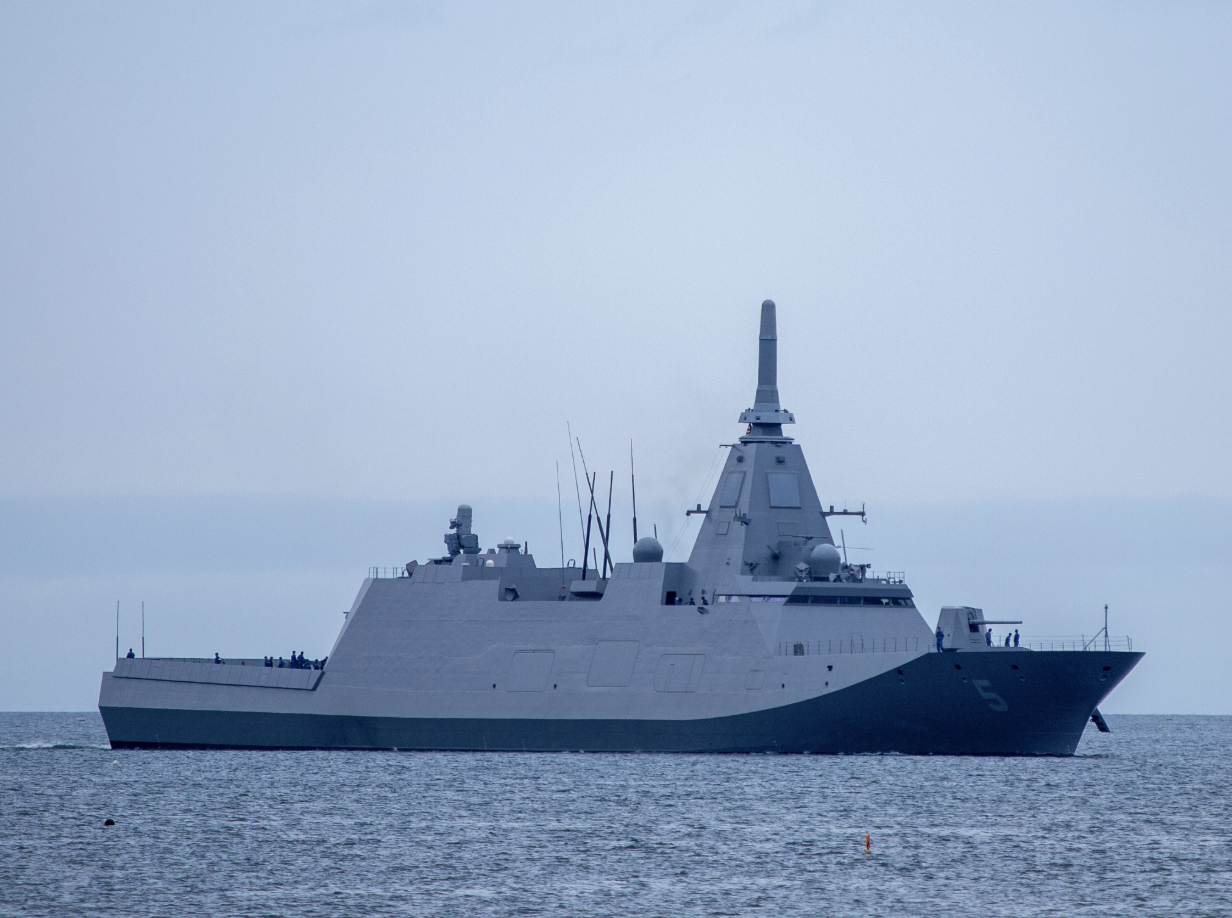
Australia has signed a contract for the purchase of three Mogami-class frigates from Japanese manufacturer Mitsubishi Heavy Industries. (Photo Courtesy of Creative Commons)
It is clearly in Australia’s national interest to deter the Chinese Communist Party (CCP) from projecting political and military power in the Indo-Pacific. Beijing’s increasing military assertiveness is disrupting the regional balance of power to Australia’s detriment. The CCP continues to make aggressive maritime claims in the South China Sea unsupported by international law. In 2022, the PRC negotiated a security partnership with the Solomon Islands that could allow Chinese navy ships to dock within 1000 miles of the Australian coast, signaling an intention to increasingly project both soft and hard power. In 2025, the People’s Liberation Army Navy conducted unannounced live fire exercises off of Australia’s coast for the first time, sending a clear signal about Beijing’s growing capacity to project force. The threat posed by the PRC’s growing power is the threat of a regional order dictated by an authoritarian regime.
It is also clear that Australia’s “rock solid” alliance with the United States underpins its ability to deter actions that destabilize regional security, sustaining a favorable balance of power in the Indo-Pacific. Former Australian Prime Minister and Ambassador to the United States Kevin Rudd captured the unambiguous, enduring logic of the American-Australian alliance when he remarked that “despite all the changes and challenges over the decades, this alliance… has gone from strength to strength to strength.” Australia must continue to strengthen, promote, and cherish its alliance with the United States. Australia and America are natural partners because of their shared cultural, institutional, and historical commitment to democracy and freedom.
However, it is a reckless strategic gamble for Australia to build its national security on the promise of US military support and the delivery of US military hardware. Australia cannot afford to tether its military deterrence to an overstretched industrial base and a foreign policy that could conflict with its national interest. The country must instead diversify its strategic partnerships to guarantee its security and strategic autonomy.
The US lacks sufficient industrial capacity to guarantee Australia’s supply of military hardware. Under AUKUS—the trilateral defense partnership between Australia, the UK, and the US—Washington has committed to delivering at least three nuclear-powered Virginia-class submarines to Australia by the early 2030s. However, the commander of the US Navy Submarine Force publicly announced in April that delivering submarines to Australia was not an American priority. American naval yards, he reminded the press, produce, on average, only 1.2 submarines per year. At that rate, it is impossible for the United States to meet the demands of both its own Navy and the Royal Australian Navy. Australian governments have already paid $1.6 billion AUD out of a pledged $4.6 billion AUD to the United States to expand US submarine production. These billions are yet to deliver a submarine or a faster production rate. Thus, Australia continues to premise its security and defense budget on a promise that does not align with the industrial reality. The principle of deepened partnership with the US under AUKUS is excellent. However, it is unlikely that the US can deliver submarines on time according to its AUKUS pledge, compromising Australia’s need for submarine capabilities established in Australia's 2016 Defense White Paper. Given the reduced reliability of Australia's current Collins Class submarines, the uncertainty of the US delivery could severely diminish Australia’s ability to independently deter and resist military coercion into the 2030s.
In addition, near-total reliance on the US for defense hardware undermines Australia’s sovereignty. By depending on Washington to supply and support its Air Force, Navy, and Army, Australia gives the United States enormous leverage over its foreign policy. The country risks being pressured into involvement in US military actions that it would prefer to avoid. Given the great power competition occurring between the United States and China in the Indo-Pacific, there is a clear potential outcome of surrendering that leverage: being drawn into a protracted regional war over Taiwan—a war that could lead to global recession, profound human cost, and a possible US withdrawal from the Indo-Pacific. Whereas the US can choose to withdraw from the Indo-Pacific, Australia has no such choice—it is a permanent resident of the region. If Australia were to engage in a regional war, it must be because of national consensus, not because of its military reliance upon the US.
So, if the current arrangement is so deeply flawed, what is the best path forward? Australia must avoid zero-sum condemnation or espousal of AUKUS. In 2026, the increasing “coercion and military opportunism” of the authoritarian superpower in its region means that it is firmly in Australia’s interest to support the principle of a strengthened Australia-US alliance. However, that does not mean the country can rely on the AUKUS framework to either deliver sufficient capabilities or safeguard its sovereignty. To address the paradox between the benefits of the AUKUS partnership and the substantial obstacles to achieving its key objectives, Australia should prioritize deepening its security relationships with other strategic partners, like Japan.
Despite attempts to expand its military industrial base under the 2024 Defence Industry Development Strategy, Australia cannot quickly fully secure its supply and sovereignty through domestic production.
Therefore, Australia must prioritize building defense partnerships with allies as it continues to support the Australian-American partnership. In April, Australia signed a contract with Japan to purchase three Mogami-class frigates, filling a key capability gap in its surface fleet. Australia’s defense acquisition partnership with Japan should serve as a blueprint for future efforts to diversify its defense purchases, preserving its supply chains, security, and sovereignty. The deal with Japan shows the deepening of a partnership that helps offset Australian reliance on the US for security. The Mogami is one of the most advanced and efficient frigates in the world and can be delivered by 2029, meeting Australia’s immediate need for advanced hardware. The Mogami is also highly interoperable with US ships, allowing the Australian military to easily integrate the new warships into existing inventories. As Australia maintains its alliance with the US, it has gained access to a new military supply chain, reducing potential US leverage over its foreign policy.
During his 2025 “Curtin Oration,” at an event honoring the legacy of Australia’s World War II Prime Minister John Curtin, current Australian Prime Minister Anthony Albanese signaled the Australian Labor Party’s desire to be deliberate and independent in its foreign policy choices: “Curtin once said that the greatness of the Australian labour movement lay in the fact that it: ‘had never followed the flags of other lands or patterned itself on the movements which originated in other places.’” The Prime Minister added, “Then—and now—Australia backs our words with deeds.”
If Australia wishes to avoid following the flags of other nations in a future conflict, its government must protect the country’s national interest with “deeds” that embrace multilateral, achievable partnerships rather than hopeful reliance. In “the most challenging security environment since World War II,” Australia must nurture its alliance with the US without succumbing to disempowering reliance.
Hugo Sharkey (CC’29) is a staff writer for the Columbia Political Review from Sydney, Australia. He is studying political science with a focus on international relations. He can be reached at hls2176@columbia.edu