EU-Mercosur and the New Scramble for Latin America
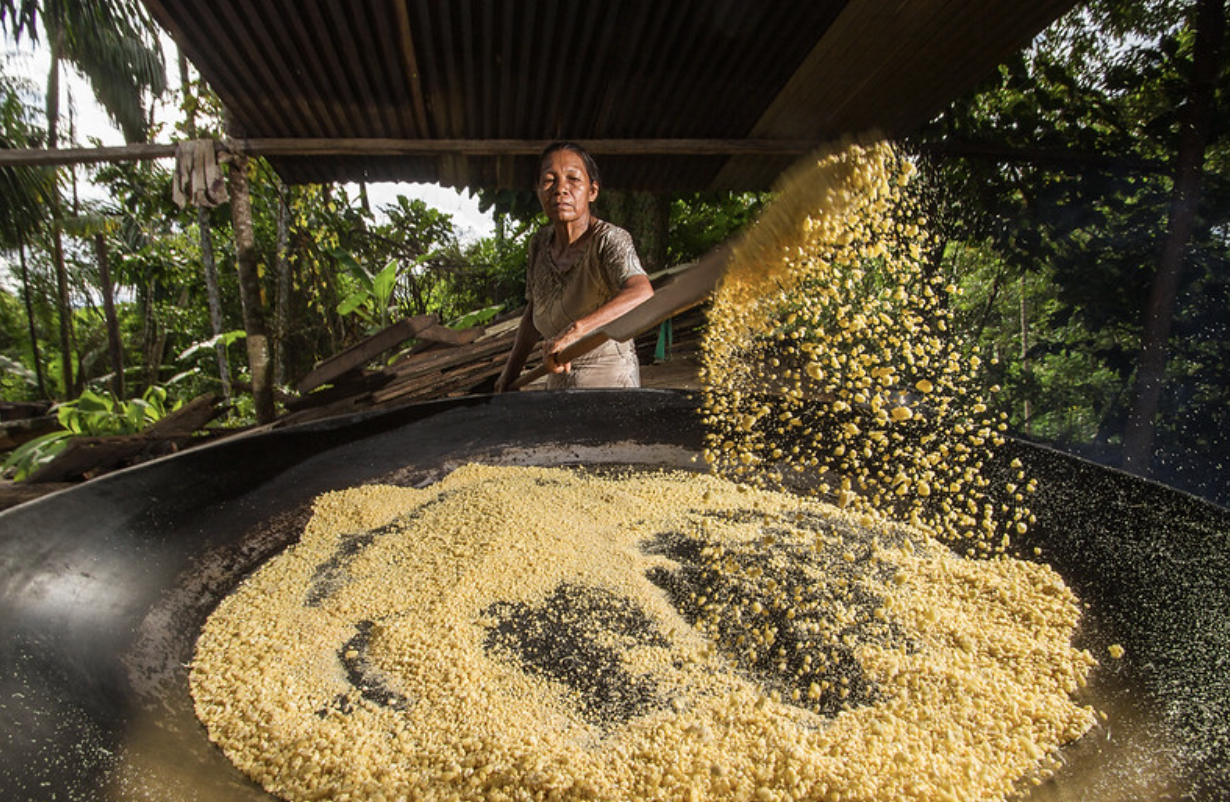
An indigenous woman toasts cassava flour in the Amazon basin, a centuries-old process that turns the raw crop into farinha de mandioca, a daily staple. Local production is crucial for a region reliant on commodity exports and increasingly shaped by external demand.
In January of this year, the European Union (EU) and the South American trading bloc Mercosur signed the EU-Mercosur Partnership Agreement, a long-awaited deal that will eliminate roughly 90% of tariffs between the two blocs and create a free trade area of more than 700 million people. The agreement concludes over 25 years of negotiations, repeatedly stalled by protectionist opposition in EU member states including France, Italy, Ireland, and Poland. Its timing is not incidental. It comes amid a turbulent period for global trade that is marked by US-imposed tariffs and renewed instability in the Middle East, where disruptions in the Strait of Hormuz have heightened concerns over energy security and the reliability of global supply chains.
For the European Union, the agreement represents a move toward strategic autonomy in a global economic landscape shaped by American trade volatility and Chinese industrial expansion. For Mercosur countries, it offers access to one of the world’s wealthiest consumer markets at a moment when external demand for the region’s resources is intensifying. Rising energy insecurity has renewed interest in South America’s oil reserves, while accelerating demand for lithium, copper, and rare earth minerals has drawn attention to deposits in countries like Argentina and Brazil. At the same time, China remains deeply embedded in the region through infrastructure financing and long-term investment in extractive industries, ensuring that European entry occurs within an already crowded field.
Yet the agreement also raises a more fundamental question about the region itself. Mercosur is one of the few instances of sustained coordination in Latin America, which has traditionally been characterized by fragmented policy agendas and limited collective action. As external demand converges from multiple directions—European trade integration, Chinese investment, and shifting US priorities—the significance of the EU–Mercosur deal lies not only in the market access it provides, but in how it interacts with this broader landscape of competing interests. The question, therefore, is not simply how the agreement will expand trade, but whether the region can convert intensifying global competition for its resources and markets into a sustained economic advantage.
The trajectory of developing economies in Latin America has long been subject to exogenous forces. Countries emerging from colonialism were left with relatively weak domestic industrial bases and economies oriented toward meeting external demand for the export of raw materials rather than developing internal capacity. The twentieth-century developmentalist approach adopted by many sought to foster diversification via Import Substitution Industrialization (ISI), using protectionism against foreign imports to allow infant domestic industries to grow. The failure of this model became apparent with the debt crisis of the 1980s, which saw sixteen Latin American countries reschedule their foreign debt; periods of high prices and strong demand had generated growth, but downturns had reversed those gains. At the same time, the region struggled to respond collectively to these external pressures. Large economies like Brazil and Argentina pursued competing strategies, limiting their ability to shape the terms of their engagement with global markets.
This competitive economic landscape changed with the creation of Mercosur in 1991, which grouped Argentina, Brazil, Paraguay, and Uruguay under one trading bloc, eliminating customs and introducing a Common External Tariff (CET) on imports external to the market. While the bloc has expanded and now boasts five active member states and seven associate countries, regional gains prove difficult to sustain amidst consistent external fluctuations. As global prices fall, US interest rates rise, and capital flows reverse, underlying vulnerabilities reemerge. What distinguishes the present moment, then, is not the existence of external demand for commodities, but the convergence of competing global interests in the region, as energy insecurity and geopolitical instability elsewhere elevate the strategic value of Latin America’s resources.
This renewed scramble for Latin America’s resources by global powers may suggest a shift in the region’s economic fortunes, but greater demand does not guarantee more favorable outcomes. Europe, China, and the United States are not competing to develop Latin American economies, but rather to secure access to resources, markets, and supply chains on terms that serve their own strategic priorities. China—now South America’s top trading partner and the second-largest for Latin America as a whole—is firmly entrenched in the region, with an estimated $286 billion in infrastructure investment across Latin America and the Caribbean. The United States, for its part, is increasing investments, particularly in the domain of rare earth and critical minerals. With the Mercosur deal, the EU is formalizing access to these commodities through trade integration. Yet in the absence of coordinated policy or sustained domestic investment, this competition can reproduce familiar patterns. Commodities are exported in raw or minimally processed form, while higher-profit stages of production—refining, manufacturing—remain concentrated elsewhere. In this sense, what appears to be a moment of opportunity risks becoming another iteration of a long-standing dynamic: demand that deepens integration into the global economy without substantially altering the region’s position within it.
With the implementation of EU-Mercosur on the horizon, the question is not simply about the expansion of trade possibilities for the two blocs, but how that expansion is structured—and where that value is ultimately captured. Under the agreement, countries in South America will preserve space for industrial policy; they will be able to place export restrictions and taxes on critical and rare earth minerals where necessary, allowing them to retain value domestically. At the same time, the agreement reshapes incentives within these supply chains by removing tariff structures that previously penalized processing at the source, providing legal certainty for long-term investment, and making it more viable to locate refining and intermediate production within South America itself. What emerges, then, is an agreement that aims to provide a framework through which Mercosur economies could move beyond raw material exports and capture a greater share of value within global supply chains.
The timing of the EU-Mercosur partnership agreement within this era of converging geopolitical and economic turbulence places Latin America at the nexus of global competition. Energy insecurity linked to instability in the Middle East, intensifying demand for critical and rare earth minerals, and overlapping ambitions of China, the US, and Europe have collectively elevated the region’s strategic importance. Yet if past cycles of commodity booms and external shocks are any guide, heightened relevance does not automatically translate into lasting advantage. What distinguishes this moment is the potential—though not the certainty—to alter that course. The agreement creates a framework through which governments can set firmer terms on investment, expand domestic processing capability, retain a greater share of value, and invest in “greenshoring” initiatives that aim to make relocation of refining to regions with abundant clean power economically viable. Whether this potential is realized will depend on whether these tools reconfigure production, rather than simply accelerate extraction for external powers.
Áine Reeves is a Junior in the Dual BA program between Trinity College Dublin and Columbia University, studying Political Science with a minor in Mathematics. Her interests lie in the intersection of post-colonial theory and development economics, with a particular focus on the political and economic affairs of the Global South.