The Irony behind the Rise of “America Skepticism” in Taiwan
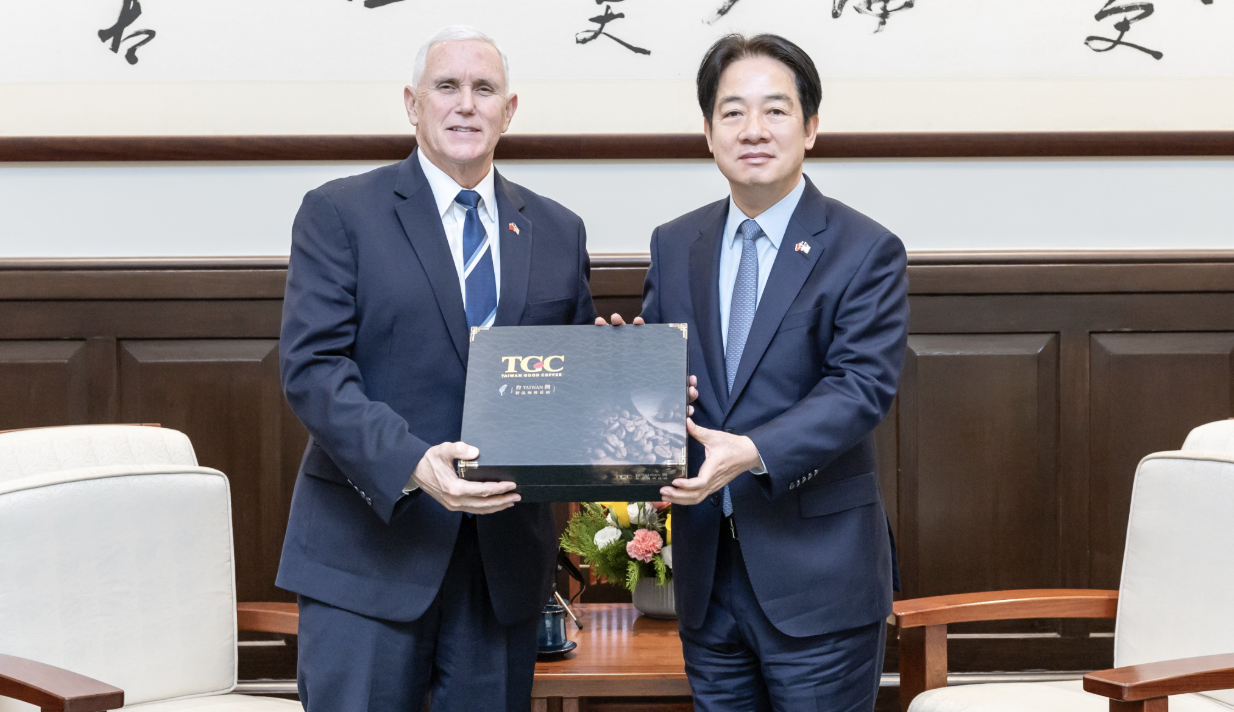
Former US Vice President Pence meeting with Taiwan President Lai 2025. Photo courtesy of the Office of the President of Taiwan.
Taiwan has been consistently ranked by the Varieties of Democracy Institute as one of the top targets of foreign disinformation. One Chinese campaign, “America Skepticism,” has grown especially pervasive in Taiwan. Resorting to overly emotional, denigratory language and feeding on fake news, “America Skepticism” encourages Taiwan to view the US as a treacherous ally that uses their country as a pawn to enhance its self-interest, ready to abandon Taiwan at any time. By spreading cynicism toward Taiwan’s allies, “America Skepticism” erodes Taiwan’s incentives to resist a potential Chinese invasion.
A 2025 poll conducted by the Brookings Institute showed alarming signs that the Taiwanese population has been falling for “America Skepticism.” When asked “What do you think the likelihood is that America will help, if Taiwan and China go to war?,” 46.7% of respondents said the US was unlikely to offer aid, almost 10% more than the 37.5% who indicated confidence in US commitments.
The popularity of “America Skepticism” in Taiwan is both puzzling and alarming. After all, ever since 2019, 70-80% of the Taiwanese population consistently expressed dislike toward the Chinese Communist Party (CCP). Why, then, is Taiwan’s overwhelmingly anti-CCP population falling for Chinese disinformation regarding the US?
“America Skepticism” is influential because the Taiwanese are averse to being manipulated as a pawn in great power politics, whether by the US or by China. But when the Taiwanese subscribe to “America Skepticism,” they fall prey to Beijing’s disinformation scheme. China, then, turns Taiwan into a pawn by feeding on its desire to not be one. Taiwan must recognize this great paradox to truly retain its autonomy.
Chinese Disinformation Fuels “America Skepticism”
The Chinese Communist Party (CCP) promotes “America Skepticism” through two routes: its own propaganda outlets and proxy actors in Taiwan.
China’s own propaganda outlets publish both Chinese-language and English-language editorials that spread state-sanctioned rhetoric. Known in Chinese as “da waixuan” (big foreign propaganda), this international information campaign often adopts the “wolf warrior” strategy, combining hyper-nationalism with hawkish criticisms of Taiwanese independence and US involvement. For instance, Global Times, a daily tabloid under the CCP’s flagship newspaper People’s Daily, published an English editorial titled “Why the US will abandon the island of Taiwan eventually” in 2021. Another state-owned media outlet, China Daily, spread the narrative that “Taiwan is expendable in Washington’s game” in 2023.
More dangerously, China has infiltrated Taiwan’s domestic media networks and selected politicians, turning them into proxies that speak for Beijing. One of Taiwan’s most influential media conglomerates, the Want Want Group, was bribed by Beijing to amplify pro-CCP messages. A 2019 report by Nikkei Asia reveals that Tsai Eng-meng, owner of the media group, received almost $500 million subsidies from China between 2007 and 2018 to advance pro-CCP narratives. In tandem with taking bribes, Financial Times exposed that the Want Want-owned cable network CTiTV directly took instructions from China’s pro-unification Taiwan Affairs Office on content creation. As such, Want Want Group’s CTiTV became the most outspoken—but by no means the only—channel propagating the “America Skepticism.”
Alarmingly, with 3.18 million subscribers on Youtube, CTiTV is one of the most widely viewed TV programs in Taiwan. CTiTV’s endorsement of “America Skepticism,” then, gives anti-American suspicion exceptional reach within Taiwanese society.
For example, CTITV invited the pro-Beijing pundit Tsai Cheng-yuan to publicly broadcast a series of graphics he shared on Facebook, which was titled “Seven Laws of US Diplomacy.” This set of graphics satirized American foreign policy, with Law Seven stating that “When the US calls you an ‘ally,’ it’s actually saying ‘I’m your boss.’”
Despite sounding like innocent satire, Tsai’s promotion of the “Seven Laws” was part of China’s disinformation campaign. To begin with, the graphics were written in simplified rather than traditional Chinese. Since Taiwan exclusively employed traditional Chinese, it is incomprehensible why a set of graphics shared by a Taiwanese political commentator for a Taiwanese audience would use simplified Chinese. This mismatch reveals that the graphics were very likely to be produced by China, which Tsai then shipped to Taiwan.
Moreover, the real intention of Tsai’s graphics was exposed when both the TV host and Tsai Cheng-yuan joked that the US made up stories about the Uyghur genocide in Xinjiang to “sling mud” at China. Their reaction underscored how demonizing the US and white-washing China’s human rights violations go together.
The most bizarre instance of anti-American propaganda in Taiwan suggests that Russia also drives the rapid popularization of “America Skepticism.” In February 2023, Tsai once again shared fake news on CTiTV that “the renowned journalist based in D.C., Garland Nixon,” revealed Biden proposed a secret plan to “destroy Taiwan.” However, the Garland Nixon in question—framed by Tsai as a respectable journalist—actually worked at Russia’s state-owned propaganda outlet Radio Sputnik. The same Radio Sputnik blatantly spread disinformation during the 2016 US presidential election, supporting Trump’s claim that Obama and Clinton created ISIS. China and Russia’s disinformation outlets joined hands to churn the narrative of “America Skepticism.”
Apart from Chinese proxy media outlets, a more moderate form of “America Skepticism” has seeped into the discourse of relatively pro-Beijing Taiwanese politicians. Instead of demonizing the US, these politicians promote the “chess piece” subnarrative of “America Skepticism.” The “chess piece” narrative claims that Taiwan is a broken prawn exploited by the US in its struggle against China, with the corollary that Taiwan should not trust the US.
Hou You-yi, the Kuomintang (KMT)’s 2024 presidential candidate, promoted the “chess piece” metaphor when he said in a rally that “we are absolutely not a powerful country’s chess piece.” The KMT’s vice presidential candidate, Jaw Shaw-kong, was equally vocal in advancing the “chess piece” narrative. Specifically, Jaw criticized the pro-American wing of the KMT, urging them to boldly say to the US “I’m not your chess piece.”
In contrast to CTiTV’s blatant disinformation, the “chess piece” metaphor may come across as reasonable. However, it eerily resembles China’s state-directed rhetoric. For example, the spokesperson of China’s Taiwan Affairs Office asserted that “for the US, Taiwan is just a pawn that serves to contain China’s development.” Echoing China’s official narrative, the Want Want-owned, pro-Beijing China Times published an editorial titled “Don’t Be A Strong Country’s Chess Piece.” These resonances suggest that domestic politicians, whether intentionally or unintentionally, amplify Chinese propaganda.
Becoming That Which You Loath: The Irony of “America Skepticism”
Nonetheless, Chinese disinformation cannot take root in Taiwan without a fertile ground. So, why is “America Skepticism” so popular, especially among Taiwan’s youth? An article from the Brookings Institute identified Trump’s fickle foreign policy as a major factor driving the rise of “America Skepticism.” The Global Taiwan Institute added that “America Skepticism” feeds off historical tensions between the US and Taiwan. For instance, many Taiwanese felt betrayed by and protested against the US decision to recognize the People’s Republic of China as the sole legal government of China and sever official diplomatic ties with the Republic of China in 1979.
While Trump’s reputational cost and the history of US-Taiwan frictions certainly play a part, the root cause of “America Skepticism” runs deeper: the Taiwanese, especially those of the younger generation, are increasingly tired of being caught in the power struggle between China and the US.
A TPOF poll reveals that “America Skepticism” is most popular among the 20-24 age group, who are less likely to be influenced by previous, historical ruptures in the US-Taiwan relations. Meanwhile, Trump’s recent tariffs likely exacerbates, but cannot fundamentally explain, the rise of “America Skepticism,” which was already becoming mainstream by 2022.
The predominance of the “broken chess piece” narrative within “America Skepticism” offers a clue to its puzzling popularity. Instead of trash-talking the US, the “broken chess piece” narrative revolves around Taiwan’s difficult attempt to preserve its autonomy while stuck between two great powers. As such, the “broken chess piece” narrative plays on Taiwan’s desire for autonomy, enabling the Taiwanese to resonate with “America skepticism.” The desire for self-determination—the ability to not act for Chinese interest nor American interest—is what drives the younger generation to be universally skeptical of all great powers.
Herein lies the paradox behind the popularity of “America Skepticism.” When the Taiwanese subscribe to this theory to resist great power manipulation, they are suddenly blind to the fact that the theory itself is driven by Chinese disinformation, and aims at turning Taiwan into the pawn they resent. Supporters of the theory do not see that supporting it undermines precisely the right to self-determination that they are seeking.
After all, China promotes anti-American suspicion because it disincentivizes Taiwan to resist potential invasion from Beijing. It makes Taiwan see resistance as a lose-lose scenario because China is bad and the US is also bad. Why resist, then? Cynicism quickly turns into nihilism.
In October 2025, Taiwan’s top polling agency Formosa found that fewer people were willing to sacrifice their all to defend Taiwan against reunification with China. 53.2% of respondents disagreed with the statement “To avoid reunification with China, everyone should give their all—including their lives—for Taiwan,” while only 40.8% agreed. The fact that 12.4%more people refuse to make sacrifices for Taiwan’s sovereignty would spell disaster should China actually invade Taiwan.
What’s more worrying than the absolute number is the trend behind it. From 2021 to 2025, the percentage of respondents who disagreed with the statement grew by 4.6%, while the percentage agreeing fell by 4.4%. Before 2025, the gap between those who agreed and disagreed was small, hovering at around 4%. But in 2025, significantly more people disagreed, and the gap widened to 12.4 %.
When this kind of nihilism burgeons and takes over, Taiwan will lose incentives to maintain its sovereignty. As such, “America Skepticism” only makes the grounds for invasion more ideal for Beijing.
Taiwan, then, is turned into China’s pawn even though—or rather, because—it does not want to be a pawn in great power politics. Taiwan must recognize this reality, the irony underlying the rising popularity of “America Skepticism,” if it wants to retain its sovereignty against Chinese encroachment. The first step Taiwan can take to resist Chinese disinformation is to see how Chinese disinformation feeds on its deepest desires and fears.
Eleanor Cao (CC ’29) is a staff writer at CPR and a student intending to major in history or political science.