
Why the World’s Biggest Polluter Is Becoming a Clean Energy Superpower
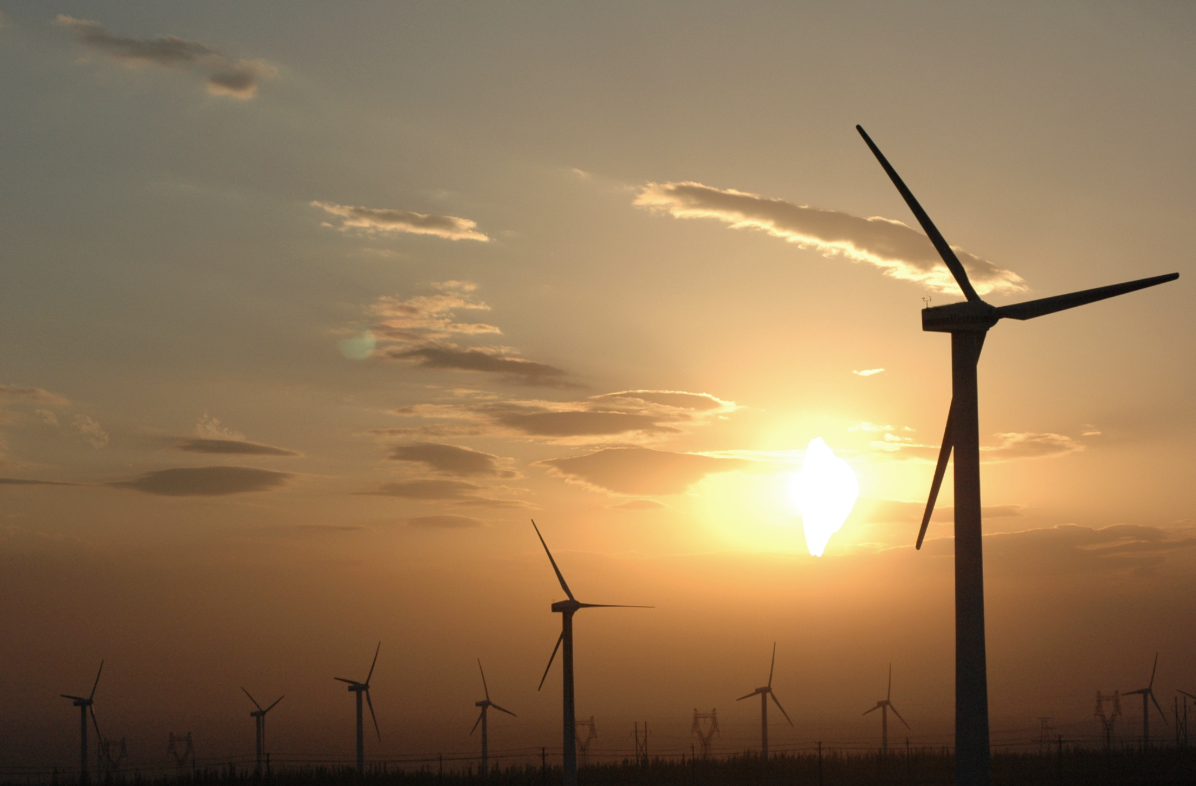
A photo of wind turbines in Xinjiang as China expands its renewable energy infrastructure. Photo Courtesy of the Wikimedia Commons

On September 24, 2025, President Xi Jinping announced that China will increase the share of renewable energy in its national energy mix to more than 30% over the next decade in a video address to the 2025 UN Climate Summit. This shift toward climate leadership stands in sharp contrast to the actions of the Trump administration, which has steadily retreated in climate action. This position has been evident since President Trump’s first term, when he withdrew from the Paris agreement. Though, Trump’s actions have ramped up since his re-election in 2024: paying companies not to build renewable energy projects, imposing a moratorium on new wind energy projects on federal lands, and having the EPA repeal the “endangerment finding” that previously concluded greenhouse gas pollution endangered human health.
This retreat has created a leadership vacuum in the global energy transition. Even though China has positioned itself as a world leader on global decarbonization, its control over multiple stages of the clean-energy supply chain suggests that it is less of a moral commitment to climate action; rather, these actions are part of a long-term strategy for geopolitical influence over the countries that will depend on clean energy infrastructure.
China’s dominance in the green energy space began before the first Trump administration took power in 2017. In 2010, China implemented government policies to become the world’s largest wind power market. By 2013, mainland China accounted for 58% of global solar cell output, making it the world’s largest producer of solar cells. In contrast, the United States accounted for only 2% of total output at that time.
China’s early expansion of renewable manufacturing capacity later grew into a broader manufacturing strategy to place itself at the center of emerging green energy technology. Beijing increasingly positioned itself as a defender of international climate cooperation, and the country’s shift in foreign policy became most apparent through the Belt and Road initiative (BRI), a colossal infrastructure project launched in 2013 to link East Asia, Europe, Africa, and Latin America through physical infrastructure.
In practice, China stands not as an equal partner, but as a primary architect of the initiative’s outcome. Since many developing countries cannot undertake large-scale construction projects without external financing, they are forced to accept China’s loans, which frequently come with strategic conditions, such as the required use of Chinese contractors, that embed recipient countries more deeply within Chinese infrastructure. This allows Beijing to become intertwined with the physical infrastructure improvements in BRI countries and gain more political influence over foreign local governments. In the long-term, China’s renewables strategy creates dependence.
In practice, these investments have major diplomatic implications, and in several cases, participation in BRI projects has coincided with shifts towards Beijing’s political views. For example, in 2015 the Chinese company Xinjiang SunOasis helped construct the Quaid-e-Azam Solar Park, a 400 MW solar facility, in Pakistan at a cost of 130 million USD. Around the same time, Pakistan began actively standing with Beijing’s positions in Xinjiang, Hong Kong, and Taiwan. In Indonesia, Chinese-backed hydropower projects began to support energy-intensive nickel processing industries and Indonesia later became the first Southeast Asian nation to formally join BRICS, a global bloc in which China holds significant influence. In Kenya, a solar power plant fully funded by China stands as the largest grid-connected solar power plant. One year later, Kenyan President William Ruto declared China and Kenya “co-architects of a new world order.” Africa’s 54 nations alone constitute the largest single voting bloc in the UN General Assembly, and China uses infrastructure investments to cultivate political alignment. The pattern is clear: as more countries embed themselves in China’s energy infrastructure, Beijing gains greater global leverage.
What makes China's position especially powerful is that its leverage extends beyond infrastructure. It also encompasses the raw materials that all green energy technology requires. While traditional energy geopolitics depends on control of oil fields and shipping routes, clean energy geopolitics relies on controlled manufacturing and minerals processing, which is currently dominated by China. They refine around 50-70% of lithium and cobalt and nearly 90% of rare-earth elements. Further, Chinese companies have also made major upstream investments in mineral-rich countries abroad, including the Democratic Republic of the Congo, Australia, Chile, and Indonesia. This allows Beijing to extend its influence across multiple stages of the clean-energy supply chain; any country that builds a renewable energy system with Chinese aid is, by default, building it on China’s terms. On one hand, China provides essential materials that enable global decarbonization. At the same time, its central role in supply chains has the potential to restrict access and shape pricing, allowing China to structure the green transition. Even states with abundant mineral resources depend on China before their minerals can go to market.
The Strait of Hormuz crisis makes this dynamic concrete. Since February 2026, Iran has effectively closed the chokepoint, disrupting roughly 25% of global seaborne oil trade. In response to the ongoing energy crisis, Chinese solar imports doubled in a month and hit a record high in March 2026. Ironically, countries scrambling to escape the geopolitical vulnerability of fossil fuels are turning en masse to Chinese solar, batteries, and electric vehicles, which Beijing controls just as firmly as Saudi Arabia ever controlled its oil fields. China’s gradual supply chain dominance means that, at the moment of maximum global demand for an alternative to fossil fuels, there is functionally only one supplier at scale.
As the United States stepped out of climate leadership, China has positioned itself at the center of the green energy transition. Its dominance in mineral refining and infrastructure finance suggests a deeper reason for the world’s leading carbon emitter’s sudden pivot to green energy. As climate change worsens, control over renewable supply chains will increasingly define geopolitical influence, and right now, China is in charge.
Emily Fan (GS ’29) is a staff writer from Toronto, Canada. She is in the dual BA program with Sciences Po and can be reached at eyf2112@columbia.edu.