Trump, Iran, and the Death of Political Promise
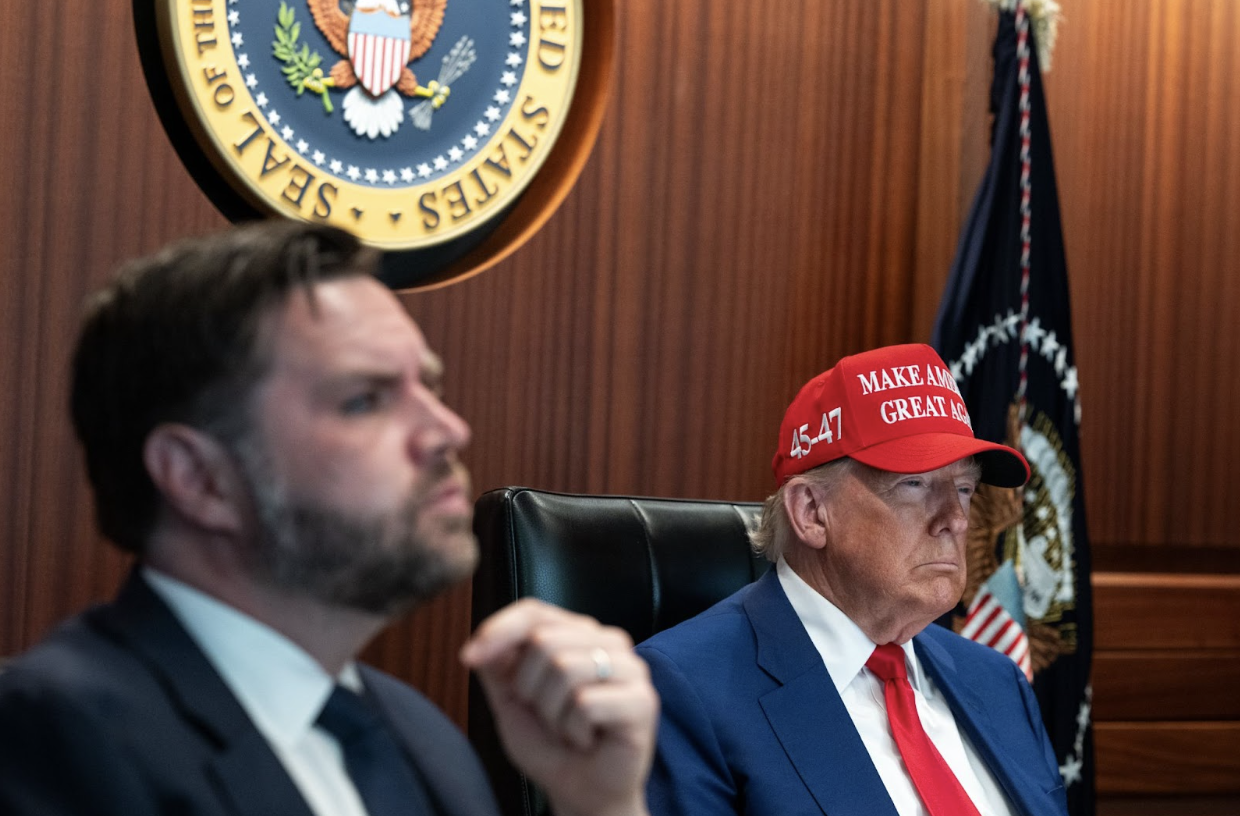
Donald Trump in the Situation Room on June 21, 2025, overseeing the strikes against Iran (photo courtesy of the White House, taken by Daniel Torok).
On Saturday, February 28, 2026, the U.S. government attacked Iran, striking the nation’s capital, Tehran, and other large cities in the region. The strikes prompted retaliation from Iran, who immediately targeted sites critical to U.S. interests in the region. Though tensions between Iran and the U.S. have heated up before, most recently when the U.S. targeted three Iranian nuclear sites last June, these new strikes have escalated the conflict even further than before leading to a full-on regional war. The widespread civilian casualties in Iran have included a girls’ elementary school in the southern town of Minab and at least 18 additional civilian deaths in Lamerd.
While the strikes are ongoing and, ensuing consequences of U.S. involvement are still uncertain, the larger calculus of Trump’s choice to directly target Iran with overwhelming force calls into question the consistency of U.S. leadership. More importantly, it challenges the campaign promises that Trump made to the American people, and brings into question the ethics of a White House more consumed with its vision of international military hegemony than ever before.
Trump’s escalation in Iran adds to a growing portfolio of foreign intervention that he distanced himself from when he began campaigning in 2024. Venezuela, Somalia, Cuba, Mexico, Greenland, and Iraq are just a few of the countries that Trump has either directly targeted or threatened since the start of his second term. Yet, despite his past record of foreign involvement, Trump’s long-standing promises to the American people, both in his campaign and during time in office, have hinged on decoupling the U.S. from foreign conflicts.
Even within his own party, his allies brought criticism almost immediately following the new wave of strikes. Congresswoman Marjorie Taylor Greene (R-GA) recently issued a scathing rebuke of Trump’s actions within Iran and the dubious claims made by the intelligence community about the country’s nuclear infrastructure. Trump’s Democratic counterparts have been equally if not more heavy handed in their anger against the administration’s military actions against Iran. Given Trump’s ideological track record, and the mounting anger against him on both sides of the aisle, the central question is what explains this sudden about-face from America’s commander in chief.
By any standard, Trump’s actions against Iran are a major risk. Engaging in single-handed regime change using shaky intelligence as a backing makes his move against Iran hard to ground in a real, credible threat. And lacking a clear plan for who should lead Iran next, Trump’s risk-taking is that much more reckless. For instance, U.S. intelligence sources are already under scrutiny for over-inflating their threat assessment of Iran’s missile arsenal. In the days leading up to the strikes, U.S. sources made exaggerated claims about the lethality of Iran’s military arsenal. The working assumption by people outside the intelligence community is that these claims are widely exaggerated, serving more as justification for a regime change operation that serves U.S. strategic interests—primarily nuclear security—and Trump’s desire to claim a transformative political legacy.
This logic would largely make sense. Consider that in 2018, Trump withdrew from the Iran nuclear deal, or Joint Comprehensive Plan of Action, (JCPOA), which he had long criticized prior to taking office. The deal was a critical agreement involving the U.S. and other major countries resolved to restrict Iran’s nuclear program and included provisions to inhibit uranium enrichment in exchange for a softening of sanctions against the country. By dismantling the diplomatic structure that constrained Iran’s nuclear program, Trump manufactured the very conditions that he is now using to justify this new military escalation. The nuclear rationale he has employed throughout his second term is entirely circular: U.S. withdrawal from JCPOA has precipitated the now-alarmist posturing of America’s intelligence and military community.
Trump’s inconsistent Iran policy, including his 2018 administrative choices, the bombing from last June, and the current military escalations, reflects a much broader unraveling of international credibility. It has produced an environment in which the White House’s stated rationale for war has shifted so frequently that no single justification can withstand scrutiny on its own terms. The Trump administration has offered multiple different reasons for the same policy of aggression, weaving a network of contradictions that even his allies in Congress are struggling to buy.
His recent State of the Union address is a perfect example of this at work. Previously, to justify his June 2025 strikes against Iran, Trump and his administration claimed that they had obliterated Iran’s nuclear capabilities; yet his State of the Union speech highlighted the ongoing development of Iran’s nuclear program. Moreover, U.S. intelligence assessments from years prior concluded that Iran had not made a decision to develop nuclear weapons; U.S. officials confirmed as much after strikes last June. So the imminent nuclear threat that Trump is peddling does not exist according to his own government’s assessments.
These contradictions suggest that the rational actor model of political behavior cannot—nor should—apply to any analysis of Trump’s behavior. A more simple explanation might be retaliation for Iran’s violations of human rights. In January, Iran arrested and killed numerous protesters—mostly students—to try and curb anti-governmental activity in the country that garnered international attention. Iran’s actions against its own citizens contributed, in large part, to the breakdown of diplomatic negotiations with the U.S., but leveraging that as justification for further conflict would be counterintuitive at best and immoral at worst. The bombing campaign against Iran has claimed the lives of schoolchildren and innocent Iranian civilians, which means that the administration’s humanitarian posture collapses. Under the weight of its own consequences, nobody—Trump especially—can claim to be avenging the massacre of Iranian university students while bombing their secondary schools.
If neither strategic logic nor humanitarian concern explains Trump’s actions, only self-interest remains as a plausible driver of his decision making.
And self-interest, in this context, is not difficult to trace. Trump’s approval ratings have cratered to an all-time low: his 61 percent disapproval rate—a fourteen point swing since he took office—has threatening implications for the Republican party as midterms roll around. His domestic agenda, from DOGE to mass deportations to the gutting of federal agencies, has generated sustained and substantial backlash with no signs of relenting. War has always been the most reliable instrument of political distraction, and Trump himself has argued as much. From 2011 to 2013, he argued repeatedly that Obama would attack Iran “to get re-elected” or “to save face” when poll numbers dropped for the White House. This cynical commentary is now doctrine, the consequences of which now extending far beyond the midterm election cycle.
Internationally, the strikes have already fractured whatever remained of American diplomatic credibility. Oman’s foreign minister urged the U.S. not to get further involved in the conflict, arguing that the war is not America’s to fight. Pakistan, which had nominated Trump for the Nobel Peace Prize just months earlier, has condemned the operation outright. Iran’s retaliatory strikes against U.S. assets throughout the region—in Qatar, Bahrain, Kuwait, and the UAE—have transformed a bilateral confrontation into a regional crisis that threatens the Strait of Hormuz and a third of the world’s seaborne oil supply. And the death of Iran’s Supreme Leader Ayatollah Ali Khamenei complicates this calculus even further.
The removal of Iran’s paramount authority creates a power vacuum for which Washington has no articulated plan to deal with. The regime may fracture, consolidate around hardliners within the country, or descend into chaos, and Trump’s encouragement for Iranians to take over offers revolutionary rhetoric without any framework to support it. In fact, the premise of U.S. involvement in toppling an old regime and instating a new one raises its own ethical questions that history has already answered in part (and resoundingly in the negative). It is one thing to topple a leader but another entirely to try and control the outcome of what comes next only to make things worse. The U.S. learned this first-hand in Iraq and Afghanistan when things went ostensibly, and rapidly, sideways. Yet, it seems like there is no indication that the U.S. has internalized these lessons in the decades since.
Domestically, the constitutional breach is just as severe. Trump launched the largest U.S. military operation since Iraq without congressional authorization, prompting bipartisan calls for an immediate War Powers Resolution vote. That members of his party are breaking ranks this quickly—and this vocally—should signal how untenable his position is. It also shows how little of this was planned with a concrete endgame in mind. What remains now is a presidency defined by wreckage, rather than the type of strategic political calculus that the highest national office—and White House—warrants. Trump did not go to war with Iran because it was necessary. He went to war because in the absence of a coherent domestic legacy, an American-induced foreign crisis was the only lever he could pull.
With the floor vanishing beneath Trump’s feet, the American public is left with one final, dismal question: how far will he drag us down? And, most importantly, when we finally stop plummeting, will there be anyone left to pull us back?
Ishaan Barrett (CC ‘26) is a senior studying urban studies and political science. His previous writing has been featured in URBAN Magazine at Columbia GSAPP, the Harvard Urban Review, the Barnard-Columbia Urban Review, the Columbia Policy Journal, and the Columbia Daily Spectator. A current Rose Research Ambassador and Gilder Lehrman Institute grantee, Barrett has previously held fellowships at the IRCPL, Harriman Institute, and the Holder Initiative, where he currently serves on the board. He can be reached at i.barrett@columbia.edu.