
When Your ‘For You’ Page Becomes the Republican Party’s Vision Board
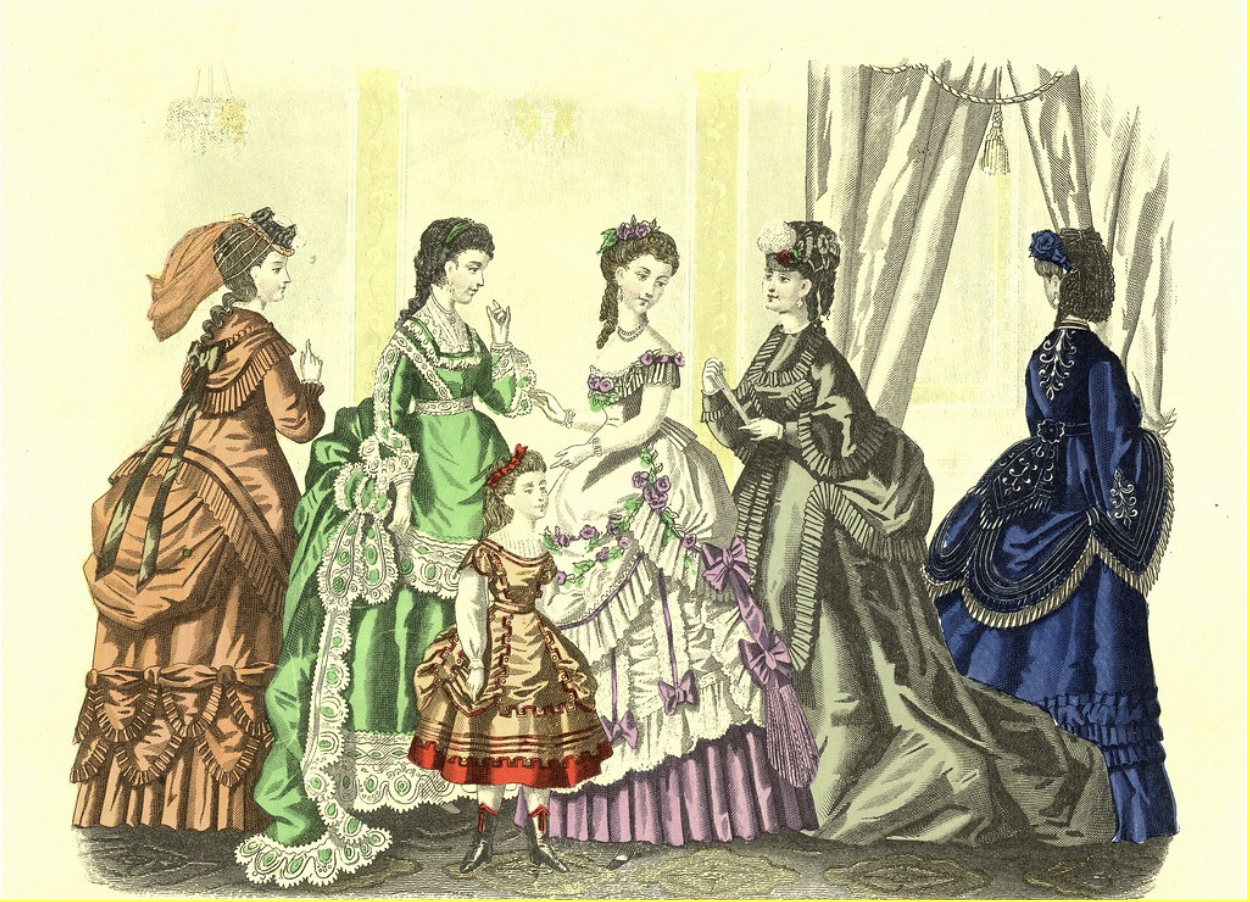
Domestic nostalgia has a lengthy paper trail. Photo Courtesy of LibraryOwl.
As NaraSmith (@narazizasmith) churns her own butter, Hannah Neeleman of Ballerina Farm (@ballerinafarm) grabs her cow “Lady” by the udder, squeezing out the last of her milk to perfectly compliment her homemade graham cracker recipe. With their aprons tied and sunbonnets perched, this revival of domesticity channels the gentle nostalgia of Little House on the Prairie and the polished femininity of Little Women. Followers of these “tradwife” influencers can expect a return to the likes of Wisteria Lane, as these stunning housewives juggle their four to five kids and execute their romanticized domestic labor. All the while, they somehow maintain a size 0, hide their perfectly concealed eyebags (from the Row), and flash a flawlessly flossed smile—a level of impossible perfection that keeps followers watching.
The domestic bliss they promote isn’t just nostalgia—it’s a restoration of an older social order that, deliberately or not, aligns with contemporary conservative visions of womanhood and the home. The tableau of the stay-at-home wife serving her breadwinner husband remains remarkably persistent, evident in figures like Lucky Blue Smith, a Ralph Lauren model and the husband of influencer Nara Smith, and Daniel Neeleman, an entrepreneur who runs the Ballerina Farm business with his wife, Hannah Neeleman. When Lucky reportedly opened a bag of Taki’s and “found them to all go stale,” Nara immediately posted a TikTok for her 12.3 million followers whipping up a homemade batch. It portrayed domestic care as second nature, as if responding to her husband’s smallest inconvenience was simply what a good wife does.
The irony, of course, is that Nara’s net worth is reportedly six times higher than her husband’s. However, the fantasy she constructs parallels a dynamic straight out of the 1950s: the ever-devoted homemaker, the satisfied husband, and the domestic sphere as a woman’s natural domain. When Nara orders rustic furniture from Facebook Marketplace, Lucky leaves to pick it up promptly, and when Lucky craves watermelon jolly ranchers, Nara rushes to the kitchen for the next three hours. The marital dynamic her tradwife aesthetic presents closely resembles the structured gender ideals of the Republican party.
On The Charlie Kirk Show, Erika Kirk, president of Turning Point USA, described the dynamic she envisions for a traditional household: “Your husband has to be the one that goes out into the world and builds and battles and comes home. [He] comes home and is like, ‘This is my nest egg, this is what I worked so hard for,’ and the wife is like, ‘Welcome home, babe, whatever you need, we’re here.’”There’s no direct link between Kirk and the tradwife scene, but her vision of a home built on male authority and female deference offers a blueprint that the movement often echoes, whether intentionally or not.
On the farm, Hannah Neeleman perpetuates Kirk’s traditional beliefs. She homeschools her whopping 8 children (Henry, Charles, George, Frances, Lois, Martha, Mabel, and Flora), runs a farm to provide her family with food, and, most importantly, she never complains. She rejects institutions, and everything runs out of her home. Her 328-acre farm functions as a dance studio, a bakery, and a grocery store (everything is naturally grown), but most alarmingly as a hospital. Hannah has given birth to six of her eight children on the compound, without the use of modern medicine. When Daniel wasn’t present for the birth of her daughter Martha, Hannah told The Times she had to resort to ibuprofen: “‘I was two weeks overdue, and she was 10lb, and Daniel wasn’t with me.”
As shown by videos, her personal preference for avoiding hospitals, epidurals, or OB-GYNs only contributes to a desire for when crisis could be handled within the four walls of the home. It mirrors the growing conservative instinct to shrink the role of public institutions—even the medical ones women depend on. The same worldview appears in Republican rhetoric about schools, where public education is framed as an attempt to “wokeify” the future generation with conversations of gender, sexuality, and critical race theory. At a 2021 GOP event, then Republican congressman Madison Cawthorn capitalized on fears that Democrats “want to take your children away and try and put them in indoctrination camps,” adding that he no longer even calls them public schools and vowing “we will not let the indoctrination of our youth happen in this country.”
With platforms exceeding 10 million followers on TikTok and Instagram, Smith and Neeleman stand head and shoulders over the rest of the tradwife influencer scene. And, as with any movement, the figures at the top shape the tone: their more polished domestic performances spark smaller creators to take the same ideals and say the quiet parts out loud.
In other words, Smith and Neeleman walked so the microinfluencers could run. Nineteen-year-old Savanna Stone makes a living verbalizing the ideals Smith and Neeleman not-so-quietly promote. Stone posted under the #tradwife hashtag, “Have you tried keeping the house clean so that it’s a sanctuary for him to come to and not more chaos?” After her content sparked backlash Stone told Fox News, “I want to stay at home, be a stay-at-home wife. I want to stay home with my kids one day. I want to rebuild a nuclear family because the left and modern feminism has truly tried to destroy that.”
Stone’s comments make explicit what Smith and Neeleman only imply: that domesticity isn’t just a personal preference, but the foundation of a moral order. Across the #tradwife tag, the language of submission, God-given gender roles, and right wing beliefs of “biblical womanhood” can be found between videos about sourdough starters and linen aprons. Even though Nara Smith and Ballerina Farm come from Mormon families—and their theology differs from the evangelical right—the aesthetic they present reads to viewers as unmistakably Christian. Whether it be the modest dresswear or the branded revival of old domestic traditions, the tradwife image coincides with the fast arrival of Christian nationalism.
With audiences large enough to sway a national election, the message viewers extract from their content inevitably feeds into the broader conservative shift that frames family, faith, and national identity as inseparable. Within the last week, Vice President JD Vance told CNN he wished his own wife, Usha Vance, was Christian, expressing, “I believe in the Christian gospel and I hope eventually my wife comes to see it the same way.” When a national leader feels comfortable publicly wishing for religious conversion—Hindu to Christianity—upon their own spouse, it creates the assumption that a “good” American family should be a Christian family, with no explanation.
The home isn’t explicitly presented as Christian in the tradwife spheres, but the cues point to the same values present in this rising cultural phenomenon: modesty, submission, obedience, and classic tradition. What looks like nostalgia for simpler times is, in practice, a push to return to a past where women churned butter because they had no choice.
Braden Mendiburu (CC '29) is a staff writer at Columbia Political Review, planning to study Political Science and Film & Media.