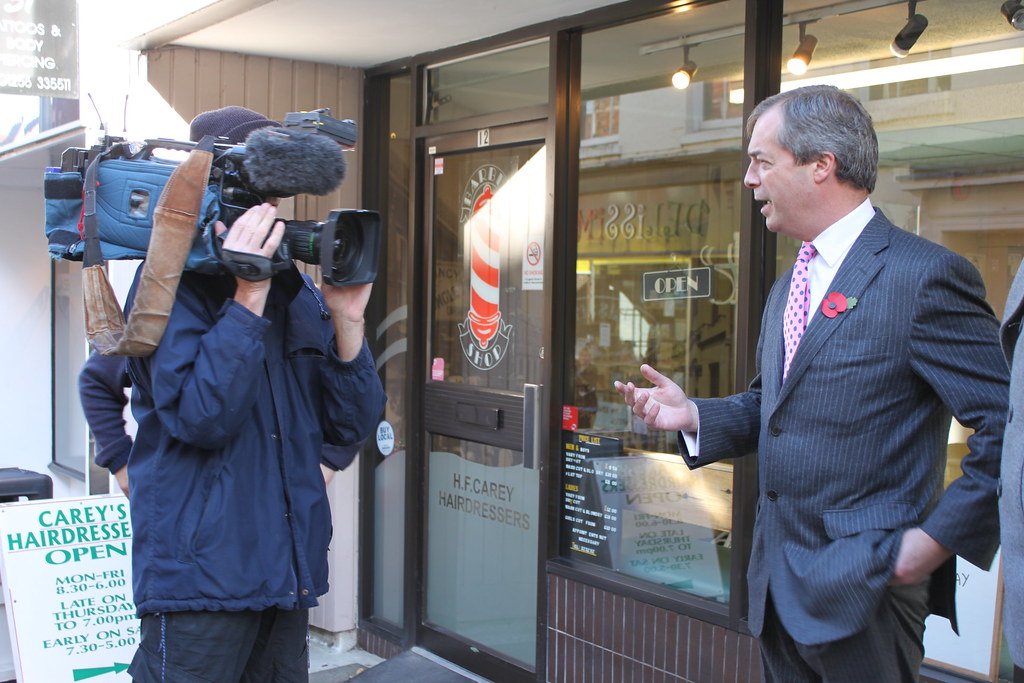
Nigel Farage speaks to the media in 2012 as a member of the European Parliament and UKIP leader. Photo Courtesy of Astral Media (Stephen West).
2026 marks a decade since Brexit, when Britain’s departure from the European Union (EU) unleashed a backlash against the liberal international order of the post-Cold War world. The chief detractors from this system are the populist right, defined by stances against immigration, liberal democracy, and globalism, which has risen from the political fringe to dominate national politics in Western democracies.
Nowhere has the trajectory of these populist movements been more apparent than the Anglosphere, which offers a collection of cases illuminating the media’s crucial role in the fortune or failure of right-wing populism. The evolutions of these movements in the United Kingdom (UK), United States (US), and Australia—all wealthy, Western, English-speaking liberal democracies with de facto two-party systems—show how fringe populist elements have grown over the previous decade.
However, each country is at a different stage of what has been termed the ‘life cycle’ of populist parties. In this model, movements transition through “insurgent,” “established,” and “decline” phases as they achieve legitimacy and are either normalized or rejected, with these stages primarily defined by how populists relate to the media. Using this analytical lens demonstrates that journalistic attitudes toward the far-right are often decisive in whether populists establish themselves in the popular political consciousness, and media institutions consequently have a responsibility to hold extremist rhetoric to account.
In the British and American contexts, lessons can be drawn from how outlets engage with populists and whether that leads to rejection or normalization. The underlying trend shows that critical media scrutiny delegitimizes populist leaders, which defines the trajectories that Australian populism could take, depending on whether it is treated with that same scrutiny.
The UK—the forerunner of modern populism, given Brexit preceded Trump’s election— represents the ‘decline’ phase of populist politics. Britain’s departure from the EU, the movement’s greatest victory, was spearheaded by the UK Independence Party (UKIP) under Nigel Farage. After Farage achieved this “political ambition” and departed from UKIP, the mantle of the British populist right followed him as he formed the Brexit Party—now Reform UK—on a eurosceptic, anti-immigration platform.
Momentarily, Reform’s national ascendancy appeared inevitable, overtaking both the center-right Conservative Party and the incumbent centre-left Labour Party in national opinion polling from May 2025. In the 2025 local elections, Reform “swept to victory” with 31% of the vote, picking up 677 seats alongside 10 council majorities.
However, this veneer of invincibility was not to last.
Reform representatives have a “torrid” performance record and scandals plague the party, from parliamentary candidates performing Nazi salutes to MPs claiming the answer to domestic violence is for the England Men’s Football Team to “keep winning.” Farage himself is embroiled in a financial misconduct investigation, having spent the past month in a self-inflicted by-election, where, running virtually unopposed, he ceded 27% of the vote to Count Binface, a satirical, bin-wearing candidate who claims to be an alien. It is an unenviable position for a Prime Ministerial hopeful, and has certainly attracted more derision than admiration.
How has such a meteoric rise petered out so abysmally? The answer lies in how Farage’s treatment by the media shifted. For most of his tenure at the political fringe, Farage enjoyed “sympathetic” coverage by large swaths of the British press, which amplified his message and positioned him as an ordinary Briton. Unpopular incumbents were attacked while Farage largely escaped scrutiny, profiting from a national platform while avoiding the critical inquiries that dogged the Conservative and Labour parties. Prior to the 2019 European Parliament election, one journalist noted Farage’s treatment by reporters as “a jolly carnival turn rather than as a party leader on the verge of winning a UK-wide election.” His Brexit party went on to win convincingly, benefiting from this lenient standard. Political showmanship assured him airtime over other minor parties, despite their greater parliamentary representation.
However, Reform has reached a point where it can no longer evade investigation. Beyond Reform’s laundry list of scandals, Farage faces the essentially impossible task of convincing the British public that he is a reasonable representative of the everyman despite ties to American trillionaire Elon Musk, extremist Islamophobe Tommy Robinson, and a host of other elite backers. These connections dominate the national conversation around Reform, underscoring a critical media turn that threatens Farage’s electoral prospects.
To see how Farage’s news coverage has cratered, consider the Times, an archetypal right-leaning British paper. Although editorially supportive of the ‘remain’ campaign, the Times platformed Farage and mentioned immigration—a key pro-Brexit issue—374 times in the four months before the referendum. By contrast, the same Times published an exposé on Farage’s political corruption in July, showing a markedly different level of journalistic incisiveness. Commenting on this change, Professor Des Freeman of the University of London notes that “Farage and Reform have lost [their] insurgency appeal.”
The future remains unwritten, but it is not unimaginable that Farage’s political success is behind him.
If Britain has passed its populist peak, the US remains at the stage of populist ‘establishment’ due to glaring differences between American and British media ethos. The Republicans under Trump control Congress and the Presidency, and the populist Make America Great Again (MAGA) faction has total control of the party. Trump-endorsed candidates command a staggering 98% win-rate across over 300 primary races, while former critics have ultimately fallen in line behind the president.
Why has American right-wing populism succeeded so massively in an arena where its British cousin faltered?
The most glaring difference is how the media interacts with populist politicians. Journalist Mehdi Hasan, who has worked in both the British and American media landscapes, argues that the fundamental difference is that American reporting maintains a “culture of deference when it comes to interviewing a person in power.” His claim holds weight: the UK and US have comparably large, entrenched conservative media markets. 90% of British newspaper circulation is controlled by right-leaning outlets DMG Media, News UK, and Reach, while Fox News reliably receives around two-thirds of American cable viewership despite declining figures for other major stations.
Yet, American politicians hold disproportionate power over the media. In mid-November, Trump—who frequently demeans reporters—dismissed a female reporter’s question about Jeffrey Epstein by saying “Quiet. Quiet, piggy.” Despite some post-factum outcry, the White House defended the comment and by December it was largely forgotten as a new “Hall of Shame” appeared on its official website. This webpage lambasts critical outlets as “misleading [and] biased.” Notably absent is Fox News, which consistently treats Trump more positively than other stations. The message is simple: access to Trump hinges on whether reporters spin him positively.
By contrast, an attempt by a Boris Johnson aide to exclude reporters from a 2020 briefing elicited a mass-walkout of outlets across the political spectrum, forcing the PM to admit the sidelined reporters. The takeaways are twofold: the stark difference between Trump’s antagonism and Johnson’s capitulation reveals how British media holds politicians to account better than the American press, and journalistic responses to press-related friction also reveal a degree of solidarity amongst the British that is absent in the American press corps. These factors combined make the path to power far more arduous for a British populist.
Ultimately, it is telling that American reporters stand when their head of state enters the room. British journalists do not.
Succeeding these two populist sagas is Australia’s ‘insurgent-phase’ far-right movement, Pauline Hanson’s One Nation. Currently, the center-left Labor Party holds a massive parliamentary majority following a landslide in the 2025 elections. However, their victory was a mixed blessing, as the center-right Liberals were defeated so soundly that One Nation now polls as the second most popular party. With the former plagued by leadership challenges and policy confusion, One Nation appears on track to challenge Labor at the next election.
One Nation has so far enjoyed a similar trajectory to that of Reform; originally a fringe far-right, anti-immigration party, it has catapulted to the forefront of the national conversation while gaining seats via defections and by-elections. However, questions have been raised of the party’s ability to contest a general election. Peter Dutton, the Liberal leader in 2025, lost the election in large part due to a “Trump-like” policy platform. This bodes ominously for Hanson, who uses the US President’s language, supports replicating his deportation policies, and ditches parliament to visit his Mar-a-Lago resort.
Unlike either Reform or MAGA, however, Australian media has been quick to treat Hanson through the critical lens applied to a political contender rather than a fringe ideologue. Her exclusion of specific media outlets from press conferences elicited broad criticism due to its Trumpian streak, mirroring the British context more closely than the American. Public critiques levied by cabinet member Amanda Rishworth and Greens Senator Sarah Hanson-Young also underscore how One Nation’s news coverage is far from a free ride.
The key departure from the pattern of British and American populism is the journalistic proactiveness on display, and the consequent inability of One Nation to gain a political footing as its policies earn widespread scrutiny. Hanson’s comments on domestic violence, Senate voting record, and calls for an Australian ‘monoculture’ captured national media attention across the political spectrum, and her connections to billionaire mining magnate Gina Rinehart have been covered extensively. This discourse developed prior to any major election, starkly contrasting how Farage’s background and backers only surfaced after the Brexit campaign.
Opinion polling now shows One Nation as unable to convincingly overtake Labor as Reform did in the UK, although it remains the presumptive opposition over the Liberals. Without a forgiving media landscape, the contradictions of a millionaire property investor who claims to be “a woman of the people” prove harder to ignore. The impacts of media coverage are quantitatively evident in Hanson’s net positivity decline from -6% to -9% after she announced a slate of controversial policies at the National Press Club. While Australians will likely not go to the polls again until 2028, the present critical media coverage and polling trends suggest One Nation will not easily coast to a parliamentary majority.
Ultimately, media is interwoven with the fate of the populist right. The British case shows that populists’ popularity declines alongside meaningful scrutiny of their moral and administrative shortcomings, while the American example reveals how media acquiescence enables the far-right to entrench itself in national politics. In the coming months and years, the trajectory of the populist right in Australia will be a bellwether for the future of these movements globally, and it will be journalists who either propel or prevent their progress.
Thomas Coorey (CC '29) is a Staff Writer from Sydney, Australia. He is a rising sophomore studying Human Rights and Political Science and can be reached at twc2134@columbia.edu.