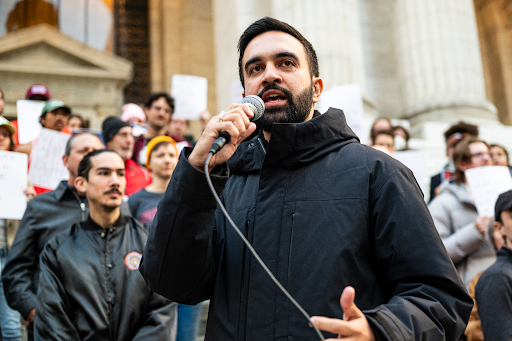
Mayor Zohran Mamdani addresses a crowd. Photo courtesy of Gaiushe.

Cait Camelia, a young activist and graphic designer, and her best friend had an idea to help then-Candidate Zohran Mamdani raise funds for his campaign: a t-shirt. But, just as they arrived, Mamdani reached his financial goal, creating an opportunity for Camelia to use the t-shirts for a greater purpose: building a community of young voters and volunteers. And so, a baby tee design that read “Hot Girls for Zohran” turned into “Hot Girls Organize”, a left-leaning grassroots organization based in New York City. Social media played a huge role in this group’s development and has led Camelia to reflect on the role of influencers and celebrities can have in activism when they are outspoken. In this interview, Camelia delves into the role of influencers in activism, urges people to foster real community with one another, and reminds everyone to take care of their mental health in this complex political climate.
Paulina Carbonell (PC): You were the leading force behind Hot Girls for Zohran, a push to elect the current New York City Mayor Zohran Mamdani, which had a huge online presence. The Instagram page “Hot Girls Organize” has almost 22k followers and was responsible for 77 canvasses and many more community events throughout the election. Even celebrities like Renee Rapp have been seen with “Hot Girls for Zohran” t-shirts. Could you talk us through how this idea came to be?
Cait Camelia (CC): When Hot Girls started, it actually was just an idea for a T-shirt. There was no real intention to make it this huge campaign. I was a graphic designer and I designed the t-shirt. It was inspired by the Hot Girls for Bernie movement that was popular in 2020. I was involved in political organizing back then, and that was the very big inspiration behind [this campaign]. I noticed a lot of my friends and a lot of younger people—specifically younger women—were really excited about [Mamdani’s]campaign, but he had not reached his campaign finance goal yet. Coming from a background in politics, I knew how difficult it was going to be for him to be able to match the funds of someone like Andrew Cuomo, Eric Adams, or anyone who’s taking corporate money. The intention was to sell the T-shirts and then donate all of the proceeds to his campaign.
I got my best friend Kaif involved, and together we ordered the first batch of Hot Girl shirts. Then, the very next day, he reached his campaign finance goal, so we were not allowed to sell them because, in New York City, we have public funds matching. Whenever a candidate reaches the [maximum] amount of money that they are allowed to make, it caps out; they're not allowed to take any more money from any donors because they are receiving public matching funds. At that point, it was illegal for us to sell the shirts. We were trying to figure out, “How do we pivot? What can we do? How can we use these shirts to elevate his campaign?” The solution was to get a lot of our influencer friends involved. We both worked in comedy and in entertainment, so we had a pretty wide network of influencers, comedians, and actors.We started sending [our T-shirts] out to some of our friends who were both politically involved and had pretty large followings. Then we launched the social campaign on Twitter and Instagram and, kind of overnight, a lot of people were DMing us asking, “How do I get the shirt? I want to get the shirt!”
However, we only had about 100 of them. Our solution was going to canvases. We were going to give them out at canvases, so that, if you wanted a shirt, you had to come to a canvas, and you had to do the work to actually help get him elected.
We did our very first canvas and it was a great success. Zohran was at the very first canvas that we did and it was really awesome to meet him so early on. We had a ton of engagement from that, and people started asking us to come to the Bronx, Harlem, Staten Island, and Queens. Kaif and I both had full time jobs at that point, so neither of us could really make the commitment to go to all of these places every single week. We put out a call on our Instagram for volunteers who were able to show up at canvases and hand T-shirts out, and we got 100 to 120 requests overnight to come volunteer with us. That was really the moment when we were like, “Okay, this is more than just giving out T-shirts. This is really an opportunity to build a grassroots organization of people who go out,volunteer, post, and do the work.” That was how Hot Girls started. It started as a T-shirt, and then organically became more of an organization.
PC: One of the most defining parts of this campaign was how you organized several unconventional events, including the Hot Girls Night with a DJ and Screen Printing Party, two comedy shows, and many others. What was the impact of having more “outside of the box” political events on young voter engagement?
CC: I have been an events and comedy producer for six or seven years now. Our first show was to give out T-shirts to a bunch of people and educate them…about ranked choice [voting]. It was a comedy show—we had Gianmarco Soresi, our friend Sureni Weerasekera, and some really great comics. It was called “Ranked Choice.” The whole thing was that so many young voters had never voted in a New York City election before, which is very different from federal elections because of ranked choice voting. We have plurality voting when you vote for the president, so it's very different. We were doing two jobs at once: trying to get people to vote and educating them on how the voting actually works.
With “Ranked Choice,” we didn’t advertise it as a political event. We advertised it as a community organizing event and comedy show. Because of that [branding], we had a ton of people who had never even heard of Zohran. They were just coming out because we had all their favorite comedians. So a lot of people at that event learned about Zohran and about the mayoral election. We were really nervous because it was on a Tuesday night and it was super rainy, but it sold out. That showed us that there was really this desire to get together, be in a community with people, and to have this connection at events that aren’t, necessarily, inherently political.
I think a lot of leftist organizations fall short by always leading with politics. They will lead with things like, “We’re going to do a book club or a training.” However, if you look at the right, they never do that. A lot of people on the right will lead with, “We’re going to do a Super Bowl watch party” or “We’re going to go have a church group.” They really lead with community, which is sort of counterintuitive because of how they operate, by not taking care of people, but they do lead with community events. We replicated that model by not even trying to reach the people who might already know about Zohran or who might already be engaged. It was really just, “We’re trying to build a community first and then bring in the politics of it.”
I think that was super effective because we ended up having people come to our events and bring their friends who had never heard of Zohran or had never voted before. Because of that, at our events, it wasn’t super ‘in your face’. You didn’t walk in and hear, “Hey, you need to vote for Zohran!” You would walk in, enjoy, and then part way through the event, we would have flyers out that say, “Hey, you should canvas for Zohran. Have you heard about Zohran?”
I think that having in-person events that really center on community and creating a positive memory for somebody, rather than focusing on, “What’s going to come out of this? Are they going to come knock on doors? Are they going to phone bank for us?” [was important]. [Getting volunteers] was never really the goal. We wanted a place where people could come and learn, and if they decided after learning that they want to organize with us, that’s amazing. That’s the goal. But, if they don’t, at least they had a good time and have a positive outlook on the people who are canvassing for Zohran, which still works in his favor.
PC: Throughout the past couple election cycles, it’s been shown that Gen Z is a very politically engaged generation. What was your experience targeting and working with first-time voters?
CC: Something that Zohran specifically did, that was super impactful, was that he treated first time voters—teenagers, eighteen year olds, and people who had never voted before—like they were competent and like they actually had valid viewpoints and feelings on issues. I think so much of the Democratic Party really speaks down to young voters, and they’re very condescending. We can see it in the way they talk about Zohran and his campaign: they’ll be like, “Oh, those Tiktok videos.” They’re very condescending and they don’t value young people’s opinions. Something that we did was really meet people where they’re at, especially younger people. A lot of the reason why we would do events like DJ parties is because we know that a lot of young people are not being brought into these spaces by people who are at their level, [such as]their peers and friends.
Targeting young people really came hand in hand with having those events and speaking to them like they were any other voter. Asking about what issues were important to them mattered. I think that, with many young people, there wasn’t a ton of convincing we had to do because so many of them have lived through governments failing them and politicians lying to them; they have this desire for radical change. Zohran was the perfect candidate for that, and he made our job a lot easier with younger people by just appealing to things that were important to them, like affordability.
PC: As our world has moved into more of a digital age, there have been big debates online around whether influencers have a duty to speak out on social issues. Some think they do, while some think they should remain quiet because they have large, manipulatable audiences. What do you think is the social responsibility of influencers in this political moment?
CC: If you are somebody with a large platform, you absolutely do have a responsibility to speak out. I think a lot of people will look at what’s happening right now and think that not talking about it is a neutral stance. But we know that in a situation where people are being kidnapped off the streets, deported, put in concentration camps, facing the death penalty for having an abortion, getting their licenses taken away [for being transgender]—seeing all of these human rights violations and saying nothing is not neutrality. What you’re doing is you are upholding the system that is allowing all of these things to happen. From my perspective, if you have a large following and you have the opportunity to mobilize people against these things, it is a moral and societal responsibility to do so.
So many influencers are like, “Oh, this is f***ed up. I don’t know what to do…I’m just an influencer. I don’t know what my role is.” So, much of it is just giving them resources and saying, “Hey, these are some actions that are happening right now that are really helpful in changing things, and you can mobilize people to do that. Here’s exactly what to post. Here’s what to link.” However, I don’t think that a lot of influencers [stay quiet ] because they don’t feel strongly about the issues or they don’t care. I think so many of them are just uninformed, and they just don’t know things that they can be doing to help. That is our responsibility as people who are informed and do know what we can be doing: to do the outreach and to give people the tools that they need to disseminate that information to their followings.
PC: What do you think are the implications when influencers do speak out on these issues?
CC: I think that influencers played a major role in Zohran’s election. Not just traditional influencers—people on Instagram and TikTok—but also minor celebrities, like people who have podcasts. I think a couple of artists brought [Zohran] out. Their concerts are huge for a couple different reasons.
I work in marketing, so a lot of the way that I look at political organizing is from a marketing perspective. So much of good marketing is creating an emotional connection to something and having this positive association. Something that Zohran did really well was he was always at these very niche events. You would see him with the guys from the Cum Town podcast, or you would see him at a Lucy Dacus show, and that’s not typical for a politician. If you are a fan of something, for example, if you see him at a PinkPantheress concert and you’re like, “Wow, I love Pink Panthress. How does Zohran know about PinkPantheress?” You automatically create this parasocial relationship, thinking, “This guy’s just like me.”
I think the implication of influencers posting is visibility. But it's also that, when you endorse somebody and you have people following you who have that association with you, [you have] that parasocial sort of relationship where you have more power over their viewpoints than you think. That's a responsibility. It’s not something that is given lightly. These people are following you for a reason, and a lot of them look up to you. I think the implications are that you are able to form their worldview in a way. When you endorse positive things and you endorse positive people, you are giving them the opportunity to then make that decision for themselves. [They will think], “This person who I respect is associating themselves with this politician. That’s somebody who I think I can trust.” It’s all about trust. Having influencers, who have people who trust them, make an endorsement builds trust in a politician, which is one of the hardest things to do these days.
PC: Based on your experience with this campaign, what do you envision as the future role of social media in political campaigning?
CC: For Hot Girls for Zohran specifically, we just rebranded a couple weeks ago as Hot Girls Organize. What we are doing now is still utilizing social media, and a lot of what we’re going to be doing is working with influencers, similar to during the Zohran campaign but a little more involved. We are actively trying to recruit new influencers, give them this information, and really set them into certain campaigns like ICE Out of New York City, the upcoming midterms, climate action, and anti-AI work. We have a lot of campaigns going.
I think that social media is something that’s a little bit difficult at the moment because so much of our social media content is censored. So much of it is very tailored, and we’re put into these echo chambers. TikTok was just bought, and everybody’s being shadow banned. To me, the future role of social media is really a tool to get people outside and off their phones, which is counterintuitive. A lot of what we did with Hot Girls’ online stuff was super important, especially for getting that information out there, but our end goal is always to get people off the screens. Whatever they see on the screens is whatever the algorithm decides that they want to show them, whereas, when you get people in person, you can have much more personal conversations.
PC: Is there any message you have for our readers, or generally for young activists, that are interested in getting involved?
CC: It’s really important to not let what’s happening outside become what’s happening inside. That’s something that so many organizers have to go through and figure out how to deal with. After the Zohran campaign, I went through about a month and a half of a really deep depressive episode because I was scrolling on my phone every day and seeing these videos of ICE and kids in Palestine. It just really put me in a dark place. I think it’s easy to get there because so much of what you see on the internet is there to harm you and to make you feel like it's hopeless. I think the most important thing is to separate yourself from that and create an environment where you are taking care of yourself first, which is something that’s not as present in leftist organizing as it should be.
If you’re not healthy and burnt out and constantly depressed, you can’t help anybody else. Take time for yourself, rest, take care of yourself, and also don’t lose hope because as soon as you lose hope, there’s nothing left to fight for. There’s always something to fight for. There are always ways to make the world better. It’s never, ever hopeless. There are always things that you can do. It’s really just about maintaining that hope and knowing that, no matter how bad things are, they can get better, and they will get better as long as people care.
Cait Camelia inspires young people to become more politically active while taking care of themselves. She also motivates young people to make real change on a human level, not just on their phones. She reminds us of an important lesson: creating a community is crucial to making things happen. What started as an idea for a t-shirt became a movement that brought people together in electing a politician who fights for systemic change. With enough effort and organization, bringing people together is always possible. Social media may be changing the way that campaigns are conducted, and having conversations about its role is extremely important, but it is crucial to remember that it has also been a tool of misinformation and a source of polarization. We should use social media as a starting point to connect with others, but we must always make sure that our political beliefs are grounded in thoughtfulness and real human interactions.
Paulina Carbonell (CC ‘29) is a staff correspondent at the Columbia Political Review majoring in Political Science and Economics.