
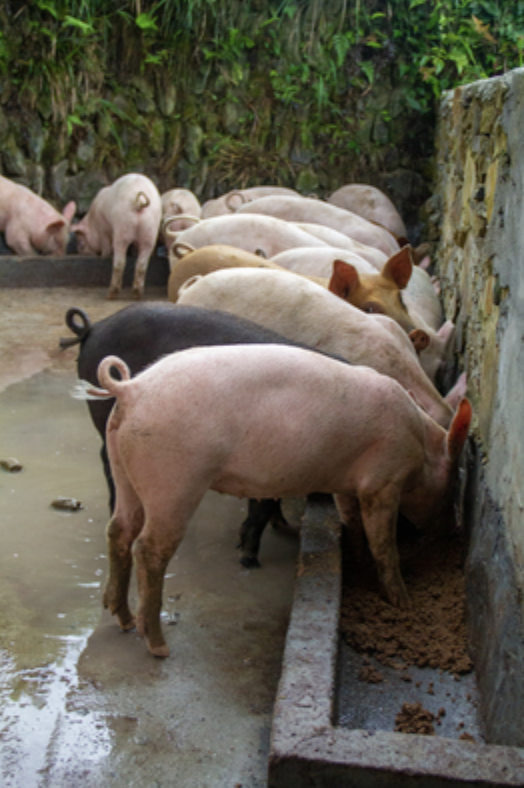
With advancements in AI, China has found new ways to use the technology, including managing pig farms. This development allows for the country to rely less on foreign imports of agricultural products, affecting the worldwide economy. Photo courtesy of Marie Anna Lee.
13,000 years ago, humans moved away from a nomadic lifestyle based on hunting and gathering and began developing agriculture, establishing for the first settled civilizations. From here, populations grew and humans achieved other advancements, including the creation of writing systems, specialized labor, and organized cities. Now, artificial intelligence (AI) is drastically changing how we view agriculture.
China has been at the forefront of this shift: farms have deployed various AI technologies to automate their operations and improve production and efficiency. As China further develops its use of AI, American farmers will need to reassess their dominance in the field, which may be diminished with the increased productivity of Chinese agriculture.
The testing of China’s new technology began, in part, in the pork industry. Chinese tech giant Alibaba has been implementing AI into the daily operations of pig farms since 2018. At one such farm in the northeast province of Jilin, an AI algorithm utilizes facial sensors, sound recognition, and robots to optimize care for pigs. The technology can manage the pigs’ food intake, rapidly count the number of pigs within a pen, monitor fluctuations in their body temperature, and even detect differences in their oinks. Through this, the cost of raising pigs has decreased by an estimated 18 million yuan–approximately 2.56 million US dollars. Improved regulation of the pigs' diets has also helped to improve their health, increasing the quality of the pork.
This system has been described as a “24-hour working veterinary,” since it monitors and cares for the pigs without the limits of human working hours. This round-the-clock availability is especially important in the aftermath of the African Swine Fever outbreak between 2018 and 2020, which killed as many as a hundred million pigs in China. As a result of this pandemic, there was a shortage of pork for roughly 18 months, and the price of Chinese pork doubled. A loss of similar scale today would be devastating to China’s pork and agricultural industries. The constant monitoring of the pigs works to prevent outbreak of diseases and protect the industry from another crisis.
Beyond the pork industry, AI is poised to drastically reinvent agriculture across the country. These developments are part of a five-year “smart farming” plan aimed at significantly increasing the technological capacity of China’s farms. Several aspects of this plan have already been implemented in other industries. For example, in Chengdu, Sichuan, China’s Institute of Urban Agriculture has developed a fully automated 20-story plant factory. Run by an AI-based control system, the factory has created artificially optimal conditions to grow plants year-round. Other advancements include robots that will eventually be able to analyze crop growth, aiding in decision-making and avoiding risks before they occur. For fishing farms, China aims to develop technology that monitors fish in a way similar to the pig farms: through automated feeding, disease detection, and water temperature control.
At the center of these developments is another issue that China is attempting to address: its aging population, which limits the farm workers available to manage livestock and harvest crops. The use of AI systems not only helps offset reliance on human labor, but also increases the efficiency of human workers. Adding to these pressures is the imbalance between China’s agricultural responsibilities and its resources. Despite being responsible for feeding one-fifth of the world’s population, China only has ten percent of the world’s arable land. This constraint has intensified in recent years, as China has lost an additional five percent of its arable land due to improper farming techniques and land neglect. Climate change will continue to reduce the arable land supply in China, further limiting its agricultural productivity.
Many of these pressures have led China to rely heavily on imports from other countries. Since joining the World Trade Organization in 2001, China has become the world’s largest importer of agricultural products. A key objective of China’s five-year plan is to decrease the country’s reliance on imports. This is especially significant in the current era of US-China tensions, where neither country can truly depend on the other. Agriculture has become the nexus of this fight, with each country placing retaliatory tariffs on the other’s goods, resulting in soaring prices of exports. American and Chinese farmers are caught in this divide, simultaneously benefiting from new technological opportunities and struggling with market instability. AI has given China an opportunity to reduce this reliance. By increasing the productivity of its domestic agricultural industries, AI farming systems may help China bring its production level closer to its current import levels, decreasing the amount of products it would need to import from other countries.
As China has begun to rely less on American imports, US farmers have increasingly recognized their dependence on exports to China. This is especially true in the soybean industry, the largest agricultural export between the two countries. In 2022, almost fifty percent of American agricultural exports to China were soybeans, valued at $16.4 billion. However, in May 2025, as a result of the ongoing trade war between China and the US, China effectively halted sales of soybeans from the US to China. China has instead turned to other countries, including Brazil, for its soybeans. This significant drop in demand caused concern among American farmers, who typically sell more than half of their crop to the country.
After negotiations, the US reached a trade agreement with China in October 2025. China promised to buy 12 million metric tons of soybeans before the end of the year and an additional 25 million tons of soybeans annually for the next three years, roughly consistent with its recent purchasing levels. This agreement brings some hope to American farmers worried about the market following the abatement of trade. Even so, the soybean industry shows how China can reduce its reliance on American farmers by turning to alternative supplies, and how dependent American farmers remain on foreign trading partners.
As China continues to integrate AI technologies into its farming practices, it will permit the country to have greater economic independence. While such an advancement would strengthen China’s agricultural security, it could also harm its trading partners, particularly American farmers. The US, however, is working to adapt AI into its own agricultural industry–from crop and soil monitoring to robots that can help with harvesting–in an effort to remain competitive.
One of the first human developments, agriculture continues to change and develop with humanity. AI is among the many technologies that have transformed this industry, and will continue to alter how we visualize human growth. As we shift from human workers to technology in favor of increasing productivity, we are forced to reassess our relationship with technology. While humanity’s relations to agriculture are guaranteed to evolve and change alongside the advancement of technology, how much we choose to adapt to these developments will determine not only farmers’ roles, but also how countries will establish control in this new field.
Ella Hummel (CC ‘28) is a staff writer at CPR studying political science and comparative literature.